Tipy
How to spot a high-quality garden set: details and comfort are decisive
Recognise a quality garden set by its frame, upholstery, comfort, and maintenance requirements. A practical comparison and pre-purchase checklist.
Author: Zuzana Krajčírová, founder of Luxco Living
Published
How to spot a high-quality garden set in practice
You can identify a high-quality garden set by its stable construction, meticulously finished joints, documented material properties and comfort that matches your way of using it. Equally important are clear maintenance instructions and suitable dimensions for the specific terrace. Appearance alone, the label 'luxury', or a brand name do not confirm these qualities.
When choosing, separate three questions: Is the furniture well made? Is it designed for the conditions in which it will stand? And will it suit you specifically? A deep sofa may be pleasant for lounging, but uncomfortable for regular dining. Even a well-made model is not automatically the right choice for every space.
With the Luxco Living range, it makes sense to proceed from intended use to the specific model, not the other way around. In the garden sets category, first choose a layout that fits your daily routine. Only then compare construction, cushions, configuration options and care requirements.
A good initial filter is the precision of the information. The description should clearly distinguish the properties of the frame, cover and filling, and state what actually belongs to the set being sold. If an important detail is missing, request it. Missing information does not by itself mean a poor-quality product, but it does prevent a reliable comparison.
Frame and joints: check the whole piece, not just the weight
Test stability on a level surface. When sitting down normally, the set should not tilt unpredictably or show significant play in the joints. If a display piece wobbles, first check the floor and correct assembly. An uneven surface can create the impression of a defect even in otherwise properly made furniture.
Neither weight nor the thickness of a visible profile is standalone proof of quality. The result depends on the material, frame geometry, support and joinery method. A light piece does not have to be unstable, and a heavy piece does not necessarily have well-engineered joints. Always assess the finished product in normal use, not a single isolated parameter.
What to look at closely
Focus on accessible edges, how individual sections align, and the areas you touch with your hands or feet. Rough burrs, sharp protrusions or loose fasteners are a reason to enquire. For modules, check the connection method and find out how the set should be correctly moved so that the joints are not unnecessarily strained.
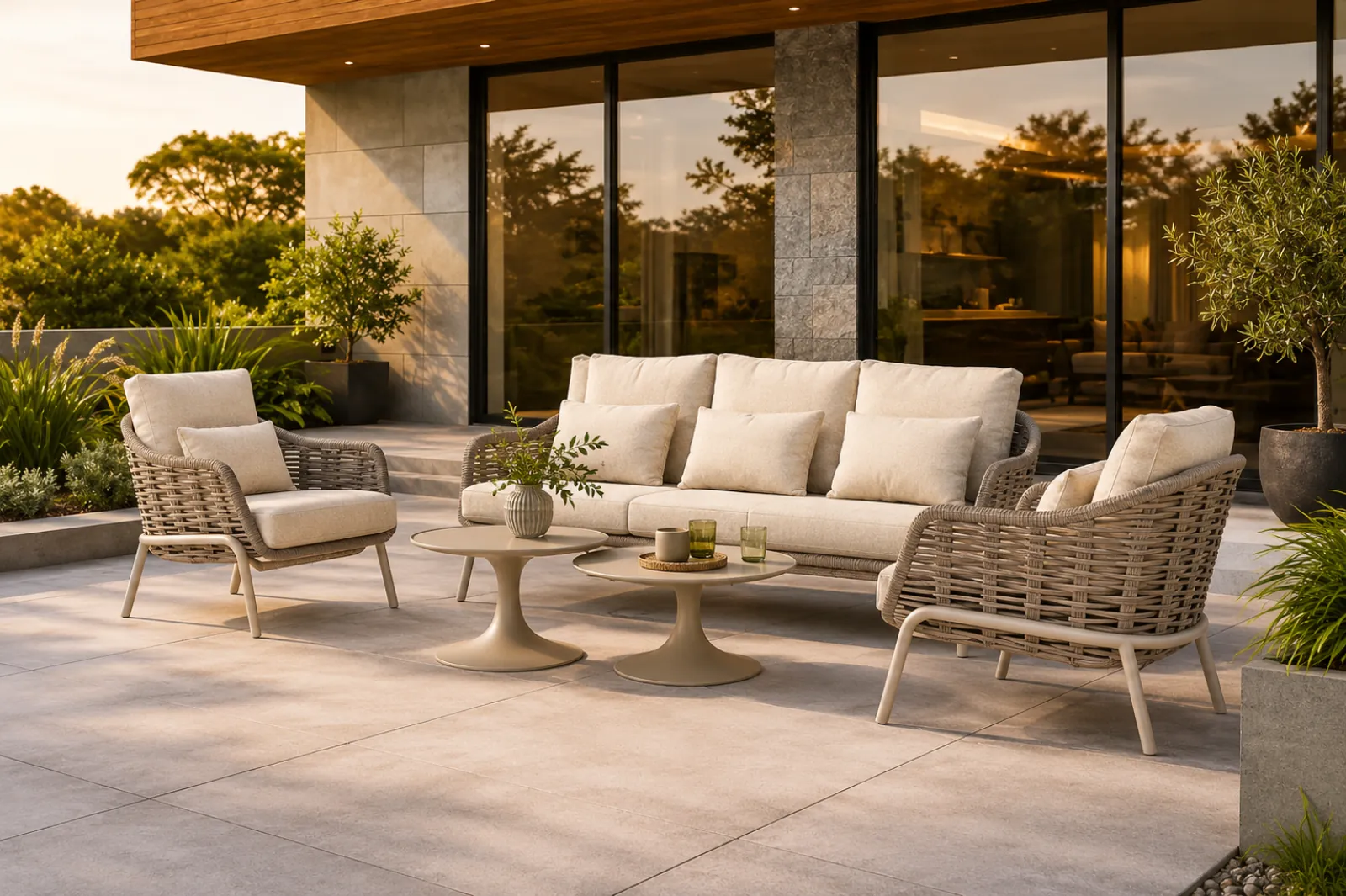
A practical example is the SUNS Bardi garden lounge set left bronze/Pebble desert bouclé. Its description specifies a stable outdoor frame, spacious cushions and ergonomic backrests. Within the collection, the modular system allows corner, open-ended and larger arrangements. Even so, verify the specific connection method and the exact contents of the ordered set separately.
Stability when seated is not wind resistance
Furniture that stands safely during use may not be secured against strong gusts. On an open or roof terrace, address placement and recommended securing separately. Do not assume that greater weight will automatically solve all the conditions of an exposed location.
Judge materials by specific data
The term 'outdoor furniture' is not a complete technical specification. The frame, finish, cover and filling perform different functions and may have different care requirements. Therefore, do not transpose information about one part onto the entire product. For example, a durable frame says nothing on its own about cushion drying times.
Similarly, distinguish between moisture resistance, water repellence and waterproofing. These are not interchangeable terms. Unless a specific property is documented, do not take it for granted, even in a premium collection. A clear approach is offered in the article how to read cover, filling and frame specifications.
Frame and surface finish
Find out the exact frame material and stated surface finish. During an in-person viewing, look at its consistency, edge finishing and any damage. Even a durable finish is not automatically resistant to every scratch or any cleaning agent. The cleaning method must correspond to the specific finish.
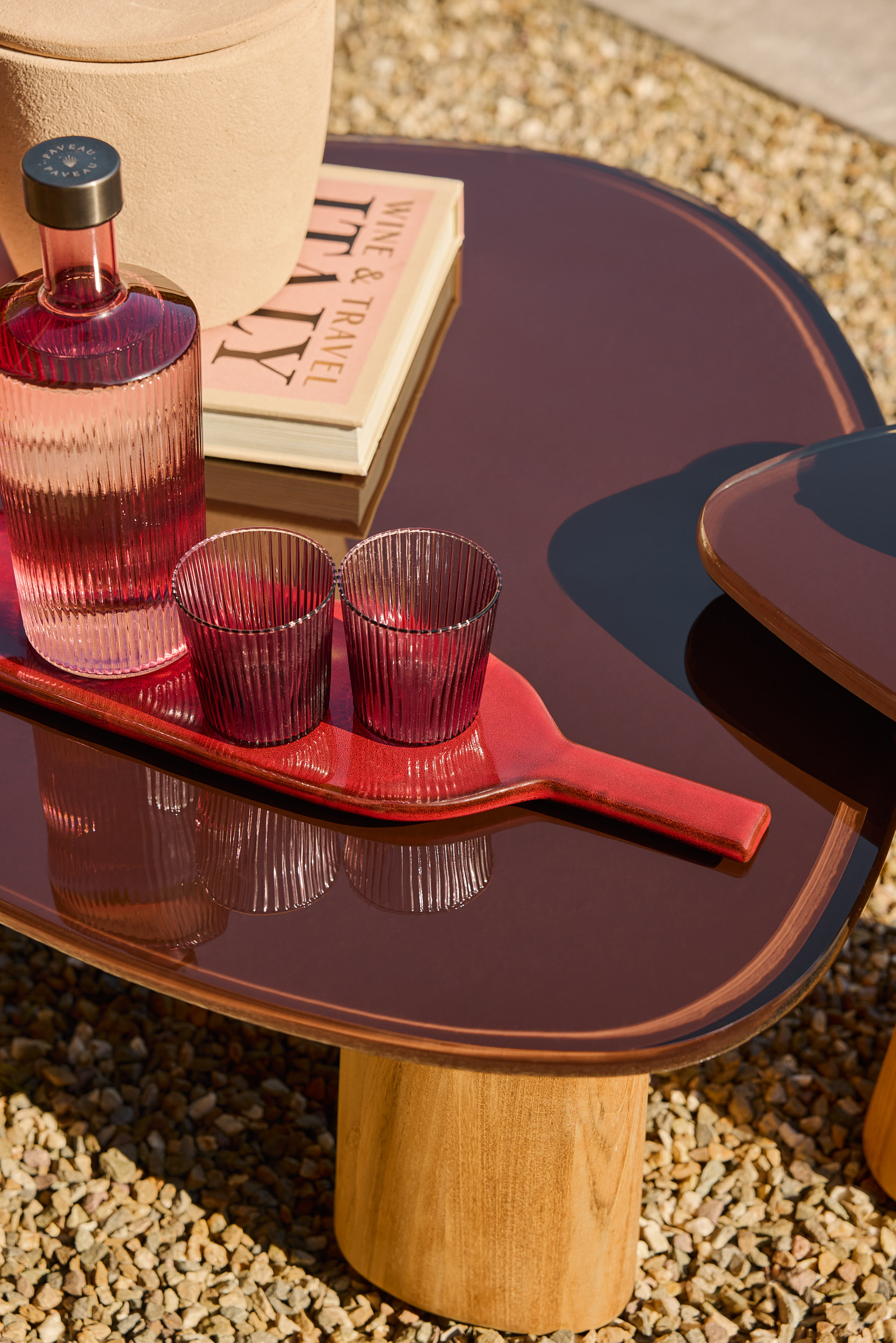
For the Farzi coffee table Ø55x41 cm bronze/Neolith, the specifications explicitly state powder-coated aluminium, light weight, and resistance to corrosion and weathering. These are concrete details for comparison. However, one cannot infer from this data the same material composition for the garden sofa you choose alongside the table.
Seat covers and filling
For upholstery, ask about recommended cleaning, whether covers are removable, and what to do after rain. A removable cover may not be machine-washable. A quick-drying filling, in turn, does not mean an immediately dry seat. The result is influenced by the overall design of the cushion, the intensity of soaking, airflow and ambient conditions.
Verify comfort according to how you will use the set
Sitting down briefly provides a first impression, not a full answer. Try out the posture in which you actually spend time: sitting upright, leaning back during conversation, and relaxing with your legs stretched out. Pay attention to back support, pressure under the thighs and how easily you can stand up.
Other regular users should also test the seating. A difference in body height can mean that the same seat suits one person while another cannot lean back comfortably without extra support. Softness is not a universal benchmark of quality; what matters is the combination of yield, support and a suitable posture.
Deep seating has its benefits and limitations
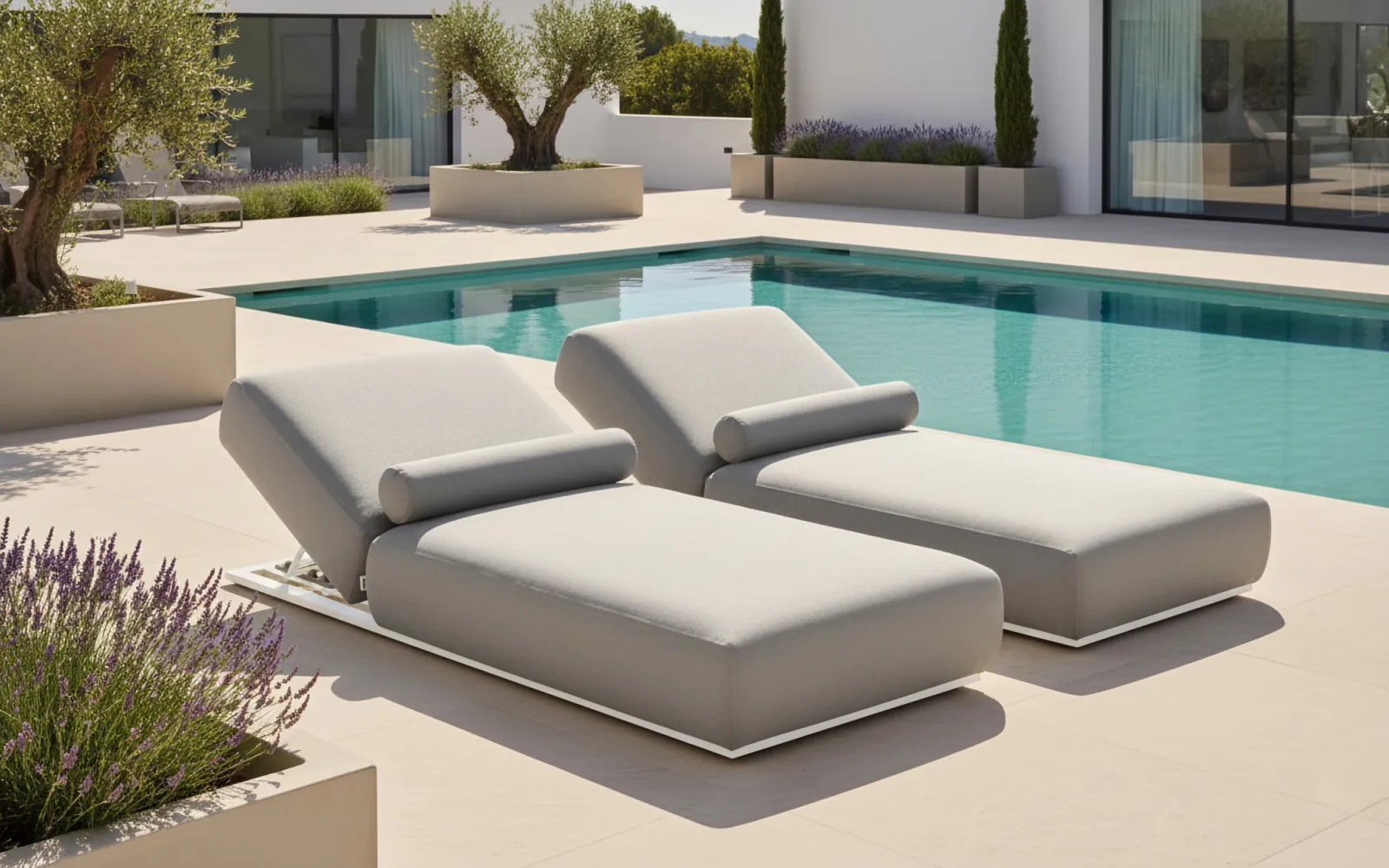
SUNS Venosa – Pebble desert Bouclé offers low seating and deep cushions; the sofa is designed for both sitting and reclining. Such a solution fits the concept of an outdoor living room. However, one cannot infer from these features that it will suit everyone when standing up or dining daily.
A practical example: a couple who unwind on the terrace with a book in the evening may appreciate deep seats more than a family using the same space mainly for lunches. Before choosing, write down your primary activity and two secondary ones. Above all, the set should handle the primary one well, rather than being average at everything.
Comfort and care must work together
For the SUNS Casto garden sofa set, ergonomically designed seating, outdoor upholstery and quick-drying cushion fillings are documented. However, the documentation does not specify the exact composition of the set being sold or definite dimensions. Both details therefore need to be confirmed before planning the terrace; a comfortable concept does not yet guarantee the right spatial solution.
Comparison of solutions: advantages, disadvantages, and questions to ask before buying
There is no single type of set that is best for every patio. A meaningful comparison stems from how it will be used and your willingness to give the furniture the necessary care. The following overview compares general layout principles, not the technical specifications of every model from a particular brand.
The advantage of a particular solution is often its limitation at the same time. Generous seating provides space to relax, but requires a corresponding footprint. Modularity allows for changes, but also introduces questions regarding how the sections join together. With modular lounge sets, you therefore evaluate not only the individual modules, but also how the entire set functions as a whole.
Use the table as a basis for conversation with your retailer. For every advantage, verify whether your chosen model genuinely offers it. Proceed in the same way with limitations: for instance, ease of handling cannot be judged from a photograph alone, as it depends on dimensions, weight, and structural design.
With furniture intended for multiple people, it is useful to test the set together at the same time. You will see whether users get in each other's way, whether they can reach the resting surface, and whether an occupied corner piece complicates access to other seats. Practical usability often provides a better verdict than the number of seats stated in the product name.
| Solution | Main advantage | Potential limitation | What to verify |
|---|---|---|---|
| Modular set | The layout can be adapted within the limits of the collection's range. | Not every combination of components may be permissible. | Compatibility, connection methods and the exact list of modules. |
| Fixed set | A predetermined configuration makes planning easier. | Less flexibility when changing the layout. | External dimensions and the logistics of moving it onto the terrace. |
| Low, deep seating | Room for relaxed lounging and shifting posture. | May not suit when standing up or dining. | Back support, reach to the table and standing up. |
| Corner layout | Can concentrate communal seating in one part of the terrace. | An unsuitable orientation can block access pathways. | The position of the corner relative to doors and main pathways. |
| Open arrangement | Allows access to be maintained from multiple sides. | May not offer the same opportunity to stretch out your legs. | The relative positions of seating spots and resting surfaces. |
Dimensions and clearances determine everyday usability
A good set does not merely fit the available floor space. It must leave room for approaching, sitting down, standing up, and the natural flow of movement between the house and the garden. Mark doors, their opening swings, fixed structures, and main pathways onto your floor plan. Do not forget access for cleaning either.
Mark your chosen footprint onto the patio using tape or another easily removable aid. Then walk the usual routes, imagining that all seats are occupied. This simple test helps reveal an overly deep set, an impractical corner, or a coffee table placed directly in a walkway.
A practical example: on an elongated patio, a corner sofa may look visually natural, but its longer section might encroach upon the route from the doorway. A more open arrangement can preserve comfort while facilitating movement. It is not about the general superiority of one shape; the actual layout and the position of the entrance are what matter.
If you also plan to install shading, incorporate its placement into the design before ordering the furniture. Space for the frame and its operation must not be relegated to whatever room is left over. Likewise, assess where the sun falls throughout the day: a high-quality sofa in an unsuitable spot will not feel pleasant simply because of its materials.
The necessary preparation is summarised in the guide what to prepare before choosing patio furniture. For your final decision, rely on confirmed dimensions of the specific variant, rather than an estimate from a photograph or data from a similar model in the same collection.
Maintenance and protection are an integral part of the selection process
Demanding minimal care is legitimate, but it must be translated into specific questions. How is everyday dirt removed? What should be done after prolonged rain? Which parts need to dry before being covered? And how should the furniture be stored out of season? The answers must come from the care instructions for the specific product.
Consider your own capabilities in advance as well. If you do not have a covered area for drying out or storing removable parts, this is crucial information when making your choice. Furniture whose maintenance you cannot keep up with in daily life may turn out to be an unsuitable choice, despite its high-quality craftsmanship.
Covering does not replace drying
When choosing protective covers, verify their suitability for the set's dimensions and shape, as well as the recommended method of use. A cover should not be an excuse to seal damp furniture away for long periods unchecked. Pay attention to air circulation, secure fastenings, and areas where water might pool.
Do not assume that a single universal procedure works for all upholstery. If cushions become soaked, adhere to the manufacturer's instructions and allow each component to dry out in the specified manner. Further context is explained in the article how to properly cover garden furniture.
Cleaning without unnecessary experiments
Avoid routinely using harsh degreasers, abrasive tools, or pressure washers. Their suitability must be confirmed by the care instructions for the specific material. Always test an approved cleaner on an inconspicuous area first. Regular, gentle care is usually far more practical than attempting to tackle long-neglected dirt with aggressive measures.
Final checklist before ordering your set
Before purchasing, have the exact variant, package contents, and overall dimensions confirmed. Verify whether the accessories shown are included in the delivery or merely illustrate a potential layout. For corner and modular solutions, a simple sketch indicating the individual pieces and their orientation is very useful.
Next, check the available material specifications, user manual, and maintenance requirements. Also enquire about how potential damage is resolved and the availability of spare parts. Do not automatically assume you can purchase a replacement cover or an additional module later; check this for the specific product and variant.
Read the warranty and complaints terms separately from the marketing description. The length of the warranty alone is not a complete measure of quality. What matters just as much is which parts it covers, what kind of usage it assumes, and what maintenance requirements it specifies. Without concrete documentation, it is impossible to promise a specific lifespan for the set.
Finally, ask yourself a simple question: can I explain why this set suits my space, my body, and my daily routine? If the answer is backed by verified data and your own first-hand experience of sitting on it, your choice will be substantially sounder than if made from a photograph. Genuine quality is recognised when superior craftsmanship works hand in hand with well-thought-out usability.
Featured products


Frequently asked questions
How do you spot a high-quality garden set during an in-person viewing?
On a flat surface, check stability and inspect accessible joints, edges and the surface. Try out normal sitting, leaning back and standing up. Then compare your personal impression with documented data on materials, intended use and maintenance.
Is heavier garden furniture always higher quality?
No. Weight is influenced by the material used, dimensions and structural design. Judge quality by stability in use, craftsmanship and suitability for a specific spot. Even a heavy set on its own does not guarantee safety in strong winds.
Does a quick-drying filling mean the sofa won't get soaked through?
No. Drying speed and water resistance are different properties. The performance of the entire seat cushion also depends on the cover, construction and environmental conditions. After rain, follow the instructions for the specific model.
Is a modular set better than a fixed lounge suite?
It is advantageous if you make use of layout changes. However, it requires verifying the compatibility of the components and how they connect. A fixed set can be just as suitable where the layout does not change and its dimensions match the space exactly.
Can a garden set stay outside all year round?
It depends on the specific model and the manufacturer's guidelines for both the frame and the upholstery. The term 'outdoor furniture' does not automatically confirm year-round use without protection. Before buying, clarify the recommended winter storage and storage for removable parts.
How long does a high-quality garden set last?
Without details on a specific product, one cannot honestly specify a number of years. Lifespan is influenced by construction, materials, environment, intensity of use and care. The possibility of maintaining or replacing worn components, if the model allows it, is also important.
What should you get confirmed before ordering?
The exact set contents, variant, dimensions, component orientation, material data and maintenance procedure. Also check delivery conditions, any assembly, and the complaints procedure. In case of ambiguities, do not rely on an illustrative photo or the properties of another model from the same brand.