Tipy
Terrace design: what to prepare before choosing furniture
Prepare dimensions, photographs and requirements for your terrace design. A practical guide from floor plan to seating selection and non-binding advice from Luxco Living.
Author: Zuzana Krajčírová, founder of Luxco Living
A good design begins with a brief, not a shopping list
Before choosing a sofa or dining set, prepare a simple floor plan, photographs and a list of activities the terrace is to serve. Doors, garden access, walkways in use and sun-exposed areas are all important. With these details, genuinely suitable sets can be compared instead of guessing from a photograph.
This procedure complements the garden furniture buyer's guide. While that guide helps decide what you are looking for, the following steps show how to prepare the space for a specific design.
Measure the terrace and the obstacles around it
Record the lengths of individual sides on the sketch. Mark doors and their opening direction, steps, pillars, railings and fixed planters. Divide an irregular terrace into simpler sections and note the points where its width changes. Attach photographs looking outward from the house and vice versa.
Do not confuse the furniture footprint with the space needed for use. You need to pull out a chair, an adjustable lounger can take up additional space when reclined, and a walkway must remain around the set. Try marking the outline of the chosen furniture on the floor; then walk your usual route with the doors open.
Choose one primary activity and secondary needs
Note down how many people will use the terrace on a regular basis and whether dining, casual seating or reclining to relax predominates. Distinguish everyday needs from a few large gatherings a year. On a smaller area, one well-designed seating arrangement may be more practical than three zones getting in each other's way.
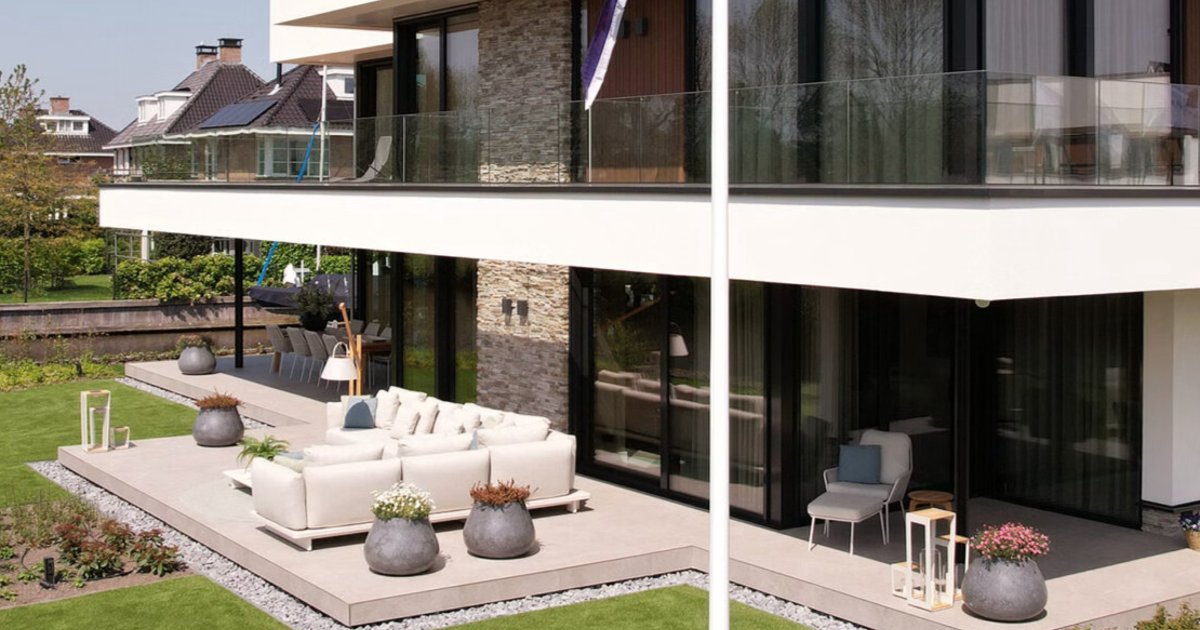
For a larger area, start with a dining and relaxation section. Place a side table where someone can actually reach it, and do not lead the pathway into the garden across a lounging area. An example of matching furniture with the house is provided by the terrace with SUNS Aspen; this serves as inspiration, not a layout suitable for every home.
Observe the sun at the times you will be outdoors
Record where the sun is in the morning, at lunchtime and in the evening. Include details about any existing canopy and the direction from which rain comes. When planning shade, take into account not only the area of the roof or parasol, but also the position of the base and the path of the sun.
If you are choosing standalone shading, continue with the comparison of cantilever and centre-pole parasols. Anchoring and use in windy conditions are governed by the specific product; the layout plan itself does not replace them.
Materials and budget belong in the same brief
State whether you want natural wood, a metal frame or generously upholstered seating. Even more important is where the cushions will be kept off-season and how much regular care you want to give the furniture. Prepare an indicative budget for both the furniture and necessary accessories so that the design is not built solely around the price of the sofa itself.
When comparing, look separately at the frame, cover fabric and filling. You will find practical considerations in the article on how to read garden furniture specifications. Then link the brand choice with specific dimensions, not just its name.
What to send for a free terrace design
Prepare a sketch with dimensions, a few photographs, the number of users, the main way of use, an idea of materials and an indicative budget. In the Luxco Living contact form, describe your space and request a free terrace design. Photographs and further materials can subsequently be arranged via contact or WhatsApp.
Advice on furniture layout is not automatically building documentation, a structural assessment or a utility connection plan. If you require assembly, its scope and terms must be arranged individually. Before ordering, also check the delivery route, doorways, staircases and the unloading point.
Frequently asked questions before a consultation
Do I need a professional drawing? For an initial discussion, even a clear sketch with dimensions and photographs is useful. A technical design may be required for specific structural work, not for every furniture selection.
Does a small terrace make sense for a bespoke design? Yes, even on a small area it helps clarify the main activity, furniture outlines and walkways. The outcome does not necessarily mean more furniture.
Is assembly included in the free design? Assembly is arranged separately. Ask about the specific scope of the service before confirming your order.