Realizace
Showroom project: greenery, vases and styling that creates an experience
Luxco Living showroom project: striking floral arrangements, interior greenery and designer vases. How to connect showcased products with a meeting space.
Author: Zuzana Krajčírová, founder of Luxco Living
A showroom as an environment, not just a row of products
In a showroom, visitors do not merely encounter the product. They also perceive the light, the space between individual exhibits, and a place where they can talk undisturbed. Greenery and decorations make sense when they complement this whole and let the main product stand out. A striking vase can serve as a focal point, while a more subdued group of plants creates a backdrop for conversation.
This Luxco Living project connects showroom presentation with floral arrangements, greenery and lounge seating. The photographs capture automotive exhibits alongside a pair of distinctive armchairs. We do not disclose the client's name, address, or the specific models of decorations used: the source material does not identify them. The article demonstrates work with composition and proportions, not sales or footfall metrics.
A colourful arrangement alongside automotive exhibits
In the first image, a large rounded planter with a glossy dark finish stands on an angular pedestal. Above it unfolds an airy arrangement featuring red, blue, orange and pink flowers. In the background is a green automobile, a pale floor, black vertical elements and linear lighting. The flowers enter the technical environment as a contrast without needing to cover the entire background with decorations.
The height of the composition is noteworthy: the vessel and pedestal raise the arrangement above the level of part of the showcased car. The eye can thus move between the floral details and the exhibit. For your own showroom, verify such an arrangement directly on-site. Decorations must not obscure information plaques, key sightlines to the product, or visitor flow. Dimensions cannot be deduced solely from the photo's perspective.
A relaxation zone is part of brand presentation
The second image shows two high-back armchairs in a rust-orange hue, a striking floral arrangement between them, and low coffee tables with metallic-effect tops in front. The colourful flowers echo the upholstery while introducing cooler blue and violet accents. This creates a composition that differs from the exhibition area in both scale and mood.
A similar zone can serve for consultations, waiting or a brief rest. Therefore, do not assess the design solely from a distance. Test the view from a seated position, access to the table and space for personal belongings. The arrangement should neither obstruct conversation nor force visitors to move the planter. For your own project, usability is far more important than an exact replica of the photograph.
Greenery softens a technical environment
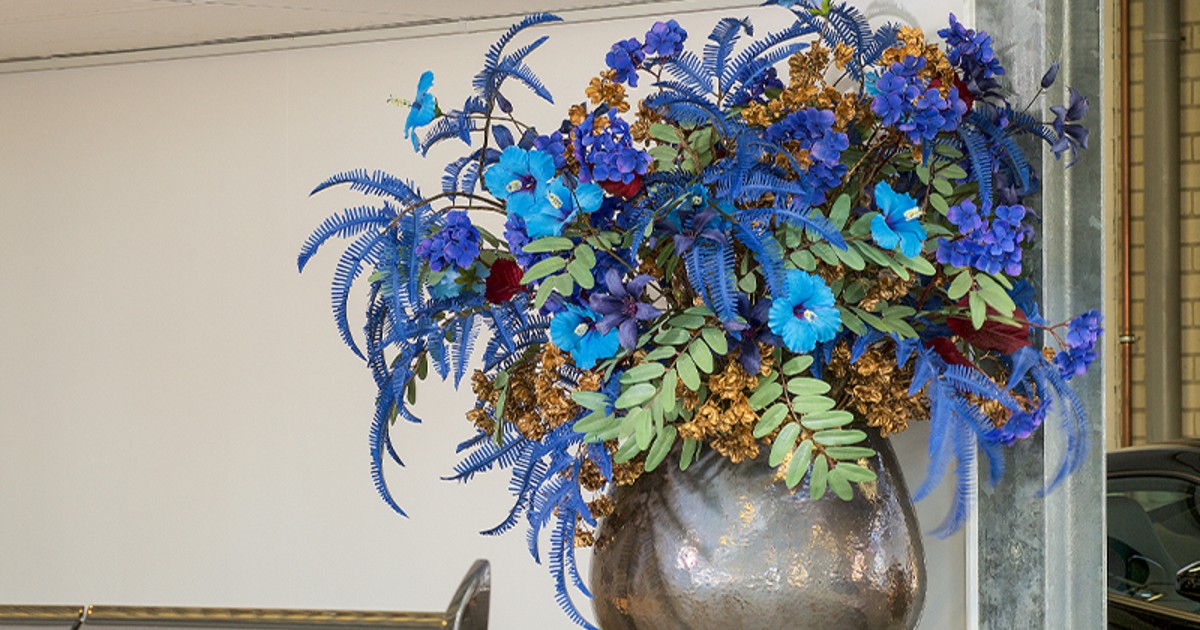
The third photograph shows branching greenery in a sizeable vessel with a glossy, textured surface. In the background, a car, staircase, glazing and ceiling lighting remain visible. The leaves break up the interior's regular lines and create an additional layer between the foreground and the display area. It is precisely this use of depth that prevents the decoration from appearing as a solitary piece placed in a corner.
The photograph itself does not reveal the plant species, whether it is live or artificial, or the material of the vessel. For a similar design, you can choose from our selection of artificial plants, but we do not match any specific catalogue product to the photographed greenery here. Suitability for a given space is judged by actual height, crown width and operating conditions.
Vases and planters must suit the scale of the space
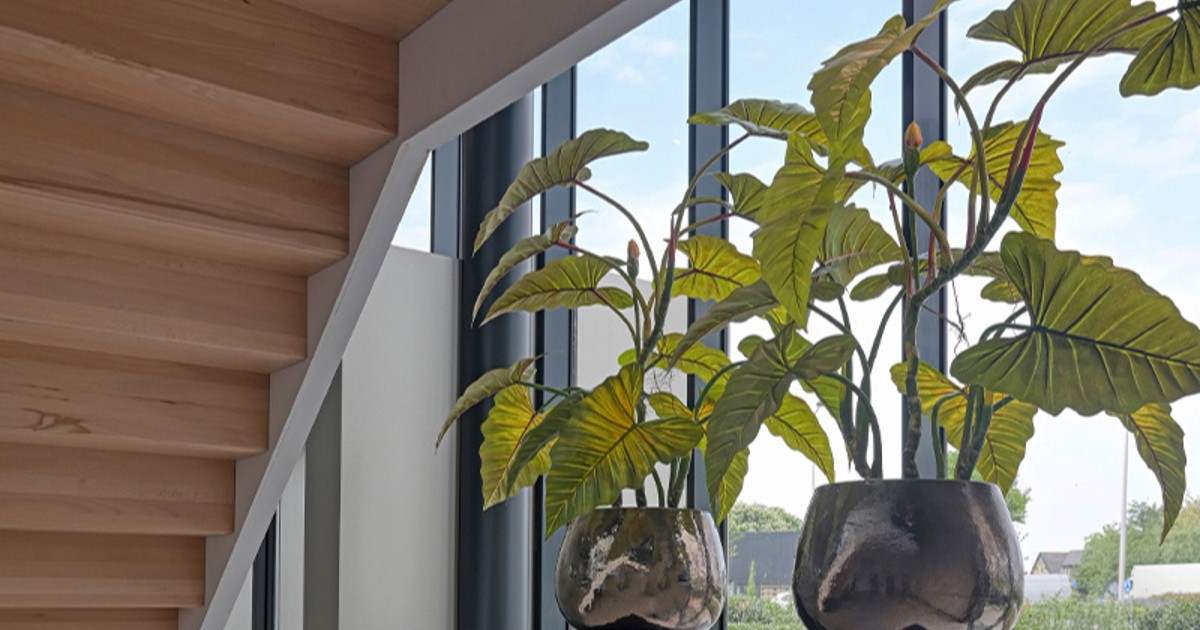
In a large hall, a diminutive vessel gets easily lost. A more prominent statement piece can link greenery to architecture if its scale and finish harmonise with the surroundings. In this project, the planters carry their own visual weight: in one image thanks to the rounded shape and pedestal, in another thanks to the tall green composition. They are not merely containers, but an integral part of the overall layout.
When choosing from the planters and vases category, distinguish between the exterior dimensions and the actual internal capacity. Check the potting method, overall weight and stability of the finished arrangement. A glossy appearance in a photo does not confirm metal, ceramic or any specific surface finish; verify these characteristics for the chosen product.
Brand character dictates both colours and the quantity of decor
A car showroom, a furniture display and a property development centre do not need to share the same style. However, they are united by the need to keep the core offering clear. Start with what visitors should see upon entering and what they should see during consultations. Then determine one primary colour relationship and the locations where more prominent accents can feature.
In the documented shots, the flowers act as a colourful contrast to the cars while tying in with the orange seating. This principle can be adapted to another interior, though without mechanically replicating the exact same number of vessels. The outcome depends on the layout, lighting and operational requirements. A similar relationship between greenery and a lounge area is showcased in the artificial tree project in a modern interior.
Address operations and maintenance during the design phase
In an interior open to the public, clear walkways, access to exhibits and the ability to carry out routine cleaning must be maintained. Do not place decorations in front of fire escape routes or building service equipment. Verify the stability of tall arrangements and any material requirements with the person responsible for the specific premises; the photograph alone does not prove the safety of the installation.
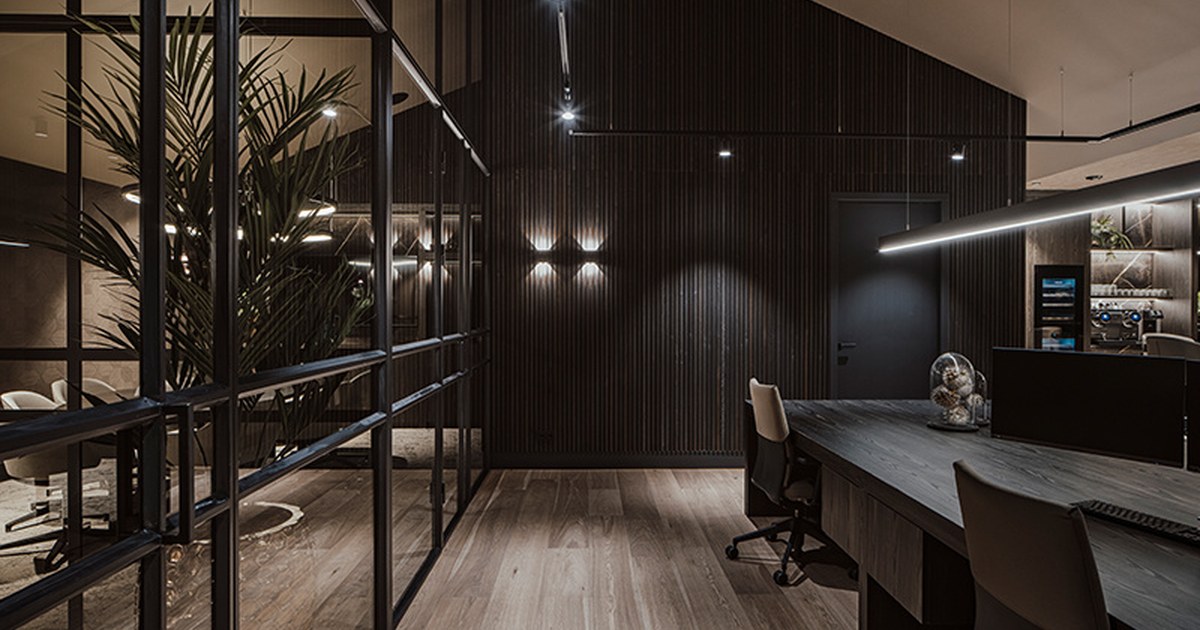
Artificial greenery does not require watering, but it still needs cleaning according to the care instructions. For plants near glazing, verify the UV specifications of the exact model rather than inferring them from a similar product. For living plants, plan lighting conditions and care separately. Operational considerations are also explored in the office greenery project.
Frequently asked questions about showroom greenery and styling
How do you select greenery for a showroom? Start with the floor plan, sightlines to exhibits, and meeting spaces. For a specific plant, verify its dimensions and operating conditions; for a planter, check its internal volume and planting stability.
Do all decorations have to match in colour? They do not. A shared link to materials or upholstery is helpful, whilst a single striking feature can create contrast. Adapt the number of accents to the size of the space.
Are the plants in the photos specific models from the online shop? Their exact identity is not documented. The photographs serve as documentation of the composition; the links to the range provide options for selecting pieces for your next project.
Does showroom styling guarantee higher sales? Such an outcome cannot be promised without metrics. This article outlines visual solutions, presentation clarity and the use of space, not verified business results.
Information required for your own showroom project
To prepare for a consultation, provide photographs from several angles, a floor plan, dimensions of available spaces, and a description of day-to-day operations. Specify which products must remain prominent, where meetings take place, and who will handle maintenance. Having an idea of colours, timelines and budget will also help. The scope of design and any potential installation is arranged individually.
Get in touch with Luxco Living via contact and explore the range of artificial plants and planters and vases. This article presents a completed project and is not an invitation to the Luxco Living showroom in Prague: the Karlín showroom is temporarily closed. Please arrange a consultation for your space in advance remotely.