Tipy
Outdoor sun loungers: how to choose comfort for both the terrace and poolside
How to choose an outdoor sun lounger based on comfort, space, and care? Practical comparisons, planning shade, and choosing a protective cover for patio and poolside.
Author: Zuzana Krajčírová, founder of Luxco Living
Published
How to choose an outdoor sun lounger: start with how you relax
Choose an outdoor sun lounger according to how you want to relax on it, how much space you have, and what care you can give it. First check the comfort when lying down and standing up, then the dimensions in the position used, the outdoor use conditions, and protection options. Assess the appearance only alongside placement, shade, and the practical day-to-day use of the terrace.
For reading, comfortable back and head support will be important. When relaxing lying down, support for the entire body is key, whereas with home wellness you will also appreciate easy access and a smooth connection to the path into the house. There is no universally best solution: the same sun lounger may suit one person while seeming too low or too hard to another.
Before you start browsing garden sun loungers, write down three priorities. These might be comfortable reading, the ability to change location, and simple covering. Such a list will help distinguish a genuinely useful feature from a detail that merely looks good in a photograph.
Be clear on who will use the sun lounger
When choosing together, test the comfort for all regular users. Differences in body height and the way one stands up can change the outcome. Also consider the frequency of use: a sun lounger for daily afternoon relaxation requires different practical decisions than equipment you only use over a few weekends.
Dimensions and placement: factor in movement around the sun lounger
The footprint of the product alone is not enough. On the terrace, you need room for approaching, sitting down, standing up, and maintenance. If you choose a reclining design, check its dimensions in each position. During normal use, no part must obstruct opening doors or the main walkway.
Mark out the outline of the intended placement on the floor in a way that will not damage the surface. Then walk the usual routes between the house, the relaxation area, and other spots on the terrace. Also test the scenario where one sun lounger is in use and a second person walks past it.
When planning a pair of sun loungers, do not simply judge their combined width. Every user should be able to stand up comfortably without climbing over the adjacent spot. Keep fitting the cover in mind as well: a layout tight against the wall may look space-efficient, but it can complicate day-to-day handling.
A practical example: a narrow apartment terrace
On a narrow terrace, first maintain a clear walkway from the door. Only then delineate the relaxation area. If two sun loungers fill almost the entire space, it may be wiser to choose one and leave comfortable access around it. A greater number of seats does not automatically mean a better utilised terrace.
To prepare a layout plan and photographs, use the guide what to prepare before choosing terrace furniture. Good supporting materials will make comparisons easier and reduce decisions based purely on impressions.
Comfort and controls: what to check before ordering
Comfort cannot be reliably guessed from cushion thickness or a "luxury" label. When testing, observe lumbar support, shoulder position, leg support, and pressure behind the knees. Stay on the sun lounger for a while: an initial pleasant impression may not match how you will feel during longer reading.
Try standing up without awkward twisting or searching for support. If the product allows adjustment, check the procedure according to the instructions and make sure the controls suit you. Reclining, wheels, folding, and removable covers cannot be taken for granted; they must be documented for the specific model.
The following comparison shows the priorities of different ways of use. It is not a description of the features of all sun loungers on offer, but a tool to help you ask the right questions.
| Way of use | What to prioritise | Benefit of the right choice | Potential limitation |
|---|---|---|---|
| Reading and semi-reclined relaxation | Back and head support, or documented reclining | Comfort during longer reading sessions | A position suitable for reading may not suit lying down |
| Relaxing lying down | Length of usable surface and full-body support | Ability to relax the entire body | Necessary to account for the full area occupied |
| Alternating sun and shade | Proven handling method and clear route | Ability to adapt location to the time of day | Moving it can be strenuous |
| Relaxing after home wellness | Easy standing up, privacy, and care rules | Seamless connection to the relaxation zone | Higher demands on moisture control and drying |
| Smaller terrace | Actual dimensions and access around the product | Preserving clear walkways | It may be necessary to reduce the number of sun loungers |
Always weigh benefits alongside limitations
The option to adjust the position can broaden the sun lounger's versatility, but it adds demands on space and mechanism checks. Distinctly soft cushioning may feel pleasant, but for some it will make standing up harder. A low silhouette, on the other hand, can blend well into the terrace without necessarily suiting every user. It is personal testing, not appearance alone, that decides.
Materials and durability: read the parameters of individual components
With an outdoor sun lounger, assess the frame, finish, any cover, and filling separately. The durability of one part does not automatically say anything about the others. Likewise, an "outdoor use" label on its own does not confirm that the entire product can be left outdoors unprotected across all seasons.
Ask how the individual parts are cleaned, what should be left to dry after rain, and what requires storage. For fabric components, check the documented care instructions rather than just the commercial name of the fabric. Water repellency, waterproofness, and drying speed denote different properties and cannot be used interchangeably.
Similarly, do not transfer characteristics between different products of the same brand. When choosing from the SUNS or FLOW range, the documentation of the specific model is decisive. Photographs or belonging to the same collection are no substitute for information about construction, suitable placement, and recommended care.
If information is missing, have it confirmed before ordering. Particularly important are the conditions of use on an uncovered patio, any pool-side restrictions, the drying method, and recommendations for the winter period. Whether individual parts can be treated separately is also of practical significance.
More detailed guidance is provided in the article cover, filling, and frame: how to read garden furniture parameters. The aim is not to pick the material with the most impressive description, but a design that matches your environment and your willingness to care for it.
Plan shade and privacy alongside the loungers
A well-chosen sun lounger will not be comfortable if harsh sunlight falls on it while you are resting and its position cannot be adjusted. Therefore, observe the spot in the morning, afternoon, and evening. Shade shifts throughout the day, and shading suitable for a seated person might not cover a fully reclined body.
When comparing garden parasols, consider not only the shaded area, but also base placement, operation, and instructions for use in windy conditions. For a more permanently arranged relaxation area, pergolas can be considered; however, even overhead cover does not automatically guarantee protection from low, angled sunlight.
Low, angled sun may require a dedicated solution
The Coolfit outdoor roller blind 150 cm – anthracite is designed for shading balconies, patios, pergolas, windows, and garden structures. According to the stated specifications, it provides up to 95% UV protection, offers intensive shade, and helps reduce temperature. At the same time, its open structure allows air to circulate.
At a specific location, it is necessary to verify the suitability of installation and the extent of the area actually shaded. The advantage of side shading can be glare reduction; the disadvantage may be a partially obstructed view. Decide according to the angle of the sun and whether you primarily want privacy or an open view of your surroundings.
In practice, first test the position of your head on the lounger at your usual rest time. It is from right there that you should judge glare and privacy, not just while standing at the door.
Choose a protective cover based on dimensions and usage patterns
A cover is not a one-size-fits-all sleeve that can be selected simply by the label "for sun lounger". Measure the product in the position intended for covering and verify compatibility. A cover that is too tight can make handling difficult, whilst an overly loose fit requires attention to securing and water run-off.
In the protective covers category, assess protective properties alongside practical everyday use. What matters is whether you can conveniently put on, secure, and pack away the cover after removal. Even breathability does not mean furniture can be sealed away wet and left unchecked over the long term.
Three candidates and their documented properties
The Protective cover for garden loungers 7988 provides year-round protection against rain, UV radiation, dust, and dirt. The AeroCover membrane reduces condensation, and the reinforced fabric prevents tears from spreading. It includes a storage bag for carrying and storing the folded cover.
The Protective cover for garden loungers 7989 protects against rain, moisture, UV radiation, dust, and dirt. It features a drawstring with two stoppers for securing in the wind. This detail is worth including in your comparison, but it does not replace checking for the correct dimensions.
The Protective cover for garden loungers 7964 is a lightweight cover with a breathable membrane that reduces condensation. Ripstop fibres restrict the spread of tears; the cover can be quickly put on, removed, and folded down into a small space. Without comparing dimensions, none of these covers can be recommended for a specific lounger.
Mid-season maintenance and preparation for longer downtime
The best care regime is one you can follow regularly. Regularly remove loose dirt and deal with any stains according to the manufacturer's instructions. Choose your cleaning product according to the specific surface; a "universal" label does not on its own confirm suitability for all parts of the lounger.
After rain, check not only the visible surface, but also areas where moisture can linger. Dry fabric components in the manner specified by the manufacturer. Do not cover them simply because the surface feels dry to the touch if you are unsure about the condition of the underlying layers.
Before a longer break in use, clean the lounger, allow it to dry thoroughly, and inspect joints and any moving parts. Next steps are determined by the instructions for the specific product. A cover's year-round protective function does not automatically confirm year-round outdoor storage for the furniture itself.
Practical example: weekend use
If you use your patio mainly at weekends, factor your Sunday departure into your selection. A sun lounger whose protection you can handle quickly and properly may be more practical than a solution that makes clearing away a chore every time. Upon your return, check the condition under the cover, especially after rainy spells.
Details are summarised in the guide how to properly cover garden furniture. The foundation is cleanliness, dryness, proper fastening, and regular checks; a protective cover is no substitute for routine care.
How to integrate loungers with your patio and home wellness area
Sun loungers should have a clear role within the space. Orient the quiet zone according to views and privacy, but maintain an easy connection to the house. Assess colours and shapes against your existing furnishings: sometimes repeating a shade works, other times a similar silhouette does. You do not need to unify every single detail.
By the pool, first check the access route and the conditions of use for the selected lounger in that environment. In a home wellness setting, observe whether the person resting will be disturbed by others passing by. A well-considered position often contributes more to comfort than adding extra accessories.
Practical example: a pair of loungers in a relaxation zone
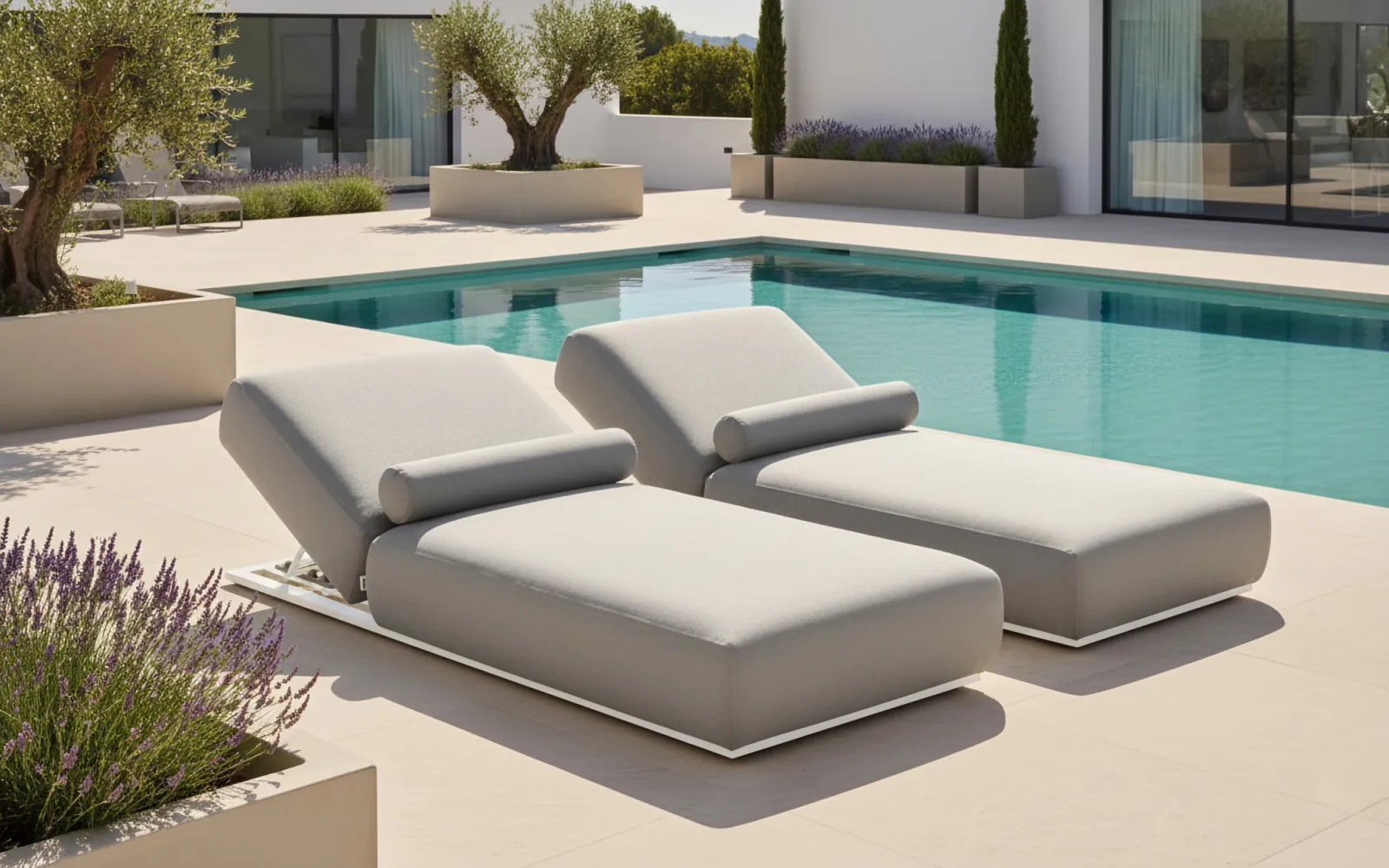
Two loungers do not have to sit exactly side by side. A slight offset from one another can help preserve a walkway or take advantage of shade at different times of day. However, verify each spot independently: easier access to one must not mean struggling to get up from the other.
Final checklist before ordering
Before deciding, confirm dimensions, comfort, conditions for outdoor use, cleaning rules, and the method of protection. Also check the route by which the furniture will reach the patio, as well as the space for any potential storage.
Then base your choice at Luxco Living on these specific requirements. The right outdoor lounger is not just a striking exterior feature: above all, it suits your body, your space, and your daily habits. It is precisely this alignment that determines whether you will genuinely enjoy using it.
Featured products


Frequently asked questions
How to choose an outdoor sun lounger for a small terrace?
First mark out its footprint in the position in which it will be used and keep the walkway from the door clear. Allow space for standing up as well as for covering it. If two sun loungers restrict the space too much, it is usually more practical to have one that is easily accessible.
Is a reclining sun lounger always better?
No. Reclining can help when alternating between reading and relaxing lying down, but the specific user's comfort is what decides. Check the available positions, adjustment mechanism, and space requirements. For relaxing in a single favourite position, adjustability may not be essential.
Can outdoor sun loungers stay outside all year round?
Only if the instructions for the specific product and its individual components allow it. Neither the designation "outdoor furniture" nor an all-weather protective cover are an automatic confirmation of suitability for outdoor winter storage.
How do you determine the correct protective cover size?
Measure the sun lounger in the position in which you will cover it, and compare the figures with the dimensions and recommendations for the cover. Take into account height, protruding parts, and the fastening method. A similar product name does not guarantee compatibility.
Does a breathable cover prevent all condensation?
No. A breathable membrane can reduce condensation, but not unconditionally eliminate it. Cover furniture when clean and dry, follow the fitting instructions, and regularly check the condition underneath the cover.
What to check for a poolside sun lounger?
Above all, documented suitability for the given environment, cleaning and drying rules, and convenient access. Also check the conditions regarding potential contact with pool water. The durability of the frame cannot automatically be assumed for the upholstery and filling.
Are a photograph and material description enough when choosing a sun lounger?
It is not enough to assess all the important properties. A photograph will help give an idea of the appearance, but comfort ought to be tried out. You also need dimensions, maintenance instructions, outdoor use conditions, and information on any adjustment mechanisms.