Tipy
Gas fire pits for patios: how to coordinate a fire table, seating, and accessories
How to integrate a gas fire pit into your patio, choose a gas bottle cover and glass wind guard, and what to keep in mind regarding positioning, use, and care.
Author: Zuzana Krajčírová, founder of Luxco Living
Published
How to choose a gas fire pit for the patio and its accessories
Choose a gas fire pit for your patio based on the role of the fire in your seating area, the available space, and safe operating conditions. A fire table can serve as a striking focal point for a relaxation zone; when integrating a flame into a different layout, the overall design is decisive. Select accessories only afterwards: a gas bottle cover unifies the appearance of the surroundings, whilst a glass enclosure helps reduce the effect of wind on the flame. For both, it is essential to verify suitability for your specific set-up.
First, answer a simple question: do you primarily want to dine, relax, or sit around the fire in the evening on your patio? Each activity requires a differently arranged space. The fire does not have to be the geometric centre of the patio, but it should have a clear relationship to the seating and should not obstruct everyday thoroughfares.
When browsing the selection of outdoor fireplaces and fire pits, therefore, assess the whole picture, not merely the appearance of the flame. Space for operation, fuel supply routing, access to the bottle, and alignment with other furnishings are all essential. This guide focuses on patio layout and documented accessory properties; it does not replace the installation manual for a specific appliance.
A practical sequence is as follows: determine the purpose of the space, map out the seating and walkways, verify the operational conditions of the fire pit, and finally fine-tune the accessories. This approach prevents situations where a visually appealing accessory does not fit the set-up technically or spatially.
Real flame: pros and cons for outdoor seating
A gas fire pit operates with a genuine flame, not a simulated light effect. The movement of the fire creates a striking focal point around which an evening gathering can be arranged without the need for numerous other decorations. A fire table can thus be not only a standalone feature, but also the starting point for the entire design.
When a gas fire pit is operated correctly, it does not produce the typical smoke and flying sparks associated with burning wood. However, this does not mean it operates without combustion gases, nor that an outdoor appliance can be used in an enclosed space. A real flame always demands a suitable environment, adherence to the instructions, and responsible operation.
Advantages: atmosphere and a clearly structured space
The primary advantage is a naturally captivating focal point for the seating area. Other furnishings can remain visually understated, as attention is drawn to the fire. Operational convenience, which is often the reason for choosing a gas solution, must always be assessed according to the specific appliance and its manual.
Accessories can address two distinct needs: visually concealing the technical background or enclosing the flame. If you distinguish between their functions right from the planning stage, you will avoid unnecessary purchases and the expectation that a single cover will handle every task.
Disadvantages: spatial requirements and operational limitations
The disadvantage is the necessity of accounting for fuel, operational access, and safe clearance distances. The space required for the set-up is therefore not identical to the footprint of the table itself. If the clearance from the seating is too small, the arrangement can be uncomfortable even if all elements physically fit onto the patio.
Another limitation is weather and shade conditions. A glass wind guard is no guarantee of safe use in any wind, and a pergola does not automatically mean a suitable location for a flame. Nor should you assume that every fire pit will provide the same thermal comfort; this cannot be determined without verified specifications.
Patio layout: seating, thoroughfares, and space for operation
When planning your layout, distinguish between the lounge and dining areas. Around a fire table, the primary objective is usually gathering together and enjoying the view of the flame. In a dining arrangement, you need to maintain comfortable service and adequate space for dining. The fire should not force guests to reach over the flame or navigate obstacles every time they stand up.
Therefore, link the selection of garden furniture with the fire pit plan from the very outset. It is not enough to compare colours: verify the sightline height from a seated position, the position of walkways, and the accessibility of control elements. The design should function when fully occupied, not merely in a photograph of an empty patio.
Practical example: a smaller patio
On a smaller patio, first mark out the outlines of the intended furnishings on the floor. Then walk the route from the door to the seating and test standing up from each seat. Also include space for the gas bottle cover and access for changing the bottle in your plan. If everything only works when the seating is pushed back, the layout requires adjustment.
A simple floor plan indicating doors, canopy edges, and fixed obstacles will help. What documentation to prepare is summarised in the article Patio design: what to prepare before choosing furniture. Only add the dimensions and clearances of the specific appliance to it based on verified data.
Practical example: separate dining and evening seating
On a larger patio, the dining area can remain separate, whilst the fire pit creates a second space for evening relaxation. The advantage is a clear division of activities. The disadvantage can be an excess of furnishings if both areas lack sufficient space and a natural connection.
Address the positioning of the bottle and its cover in conjunction with the fuel line. The hose must not create a trip hazard along walkways; its routing must comply with the appliance's manual. Aesthetically concealing the technical equipment must never take precedence over accessibility and safe connection.
Gas bottle cover or glass guard? A comparison of functions
The word 'cover' can refer to very different products. A gas bottle cover primarily adjusts the appearance of the technical equipment. A glass screen for a fire pit forms an enclosure around the flame. Neither of these terms on its own denotes a protective cover for enclosing the entire set-up when not in use.
The following comparison lists only the documented functions of selected accessories. The table does not determine mutual compatibility. This cannot be deduced merely from a similar name, colour, or because the products appear alike in photographs.
| Accessory | Documented function or property | When to consider it | What to verify before choosing |
|---|---|---|---|
| Gas bottle cover Lagune teak | An accessory for the Lagune fire pit that discreetly conceals the bottle; the natural look of teak unifies the space. | When visually linking the technical equipment with the surroundings of the Lagune fire pit. | Suitability for the bottle used and the specific layout. |
| Gas bottle cover Square oyster beige | A standalone cover with a modern shape and a very light neutral shade. | When you want to visually conceal the bottle while maintaining a light colour scheme for your seating. | Spatial requirements and operational access. |
| Gas bottle cover RIB antracit | A ribbed design and solid, stable construction for long-term daily outdoor use. | When you want the cover to add distinct texture in addition to concealing the bottle. | Compatibility with the bottle and placement conditions. |
| Glass screen for built-in fire pit square | Clear glass reduces the impact of wind gusts and creates a physical barrier between the fire and its surroundings. | When you need a flame enclosure while preserving the view. | Exact dimensional and installation compatibility with the fire pit. |
| Glass screen for built-in fire pit round large | Reduces the effect of wind, helps maintain an even flame, and contributes to fuel efficiency. | When you are looking for this functionality for a matching fire pit. | Compatibility; the designation 'large' is no substitute for actual dimensions. |
How to coordinate a gas bottle cover with your seating style
Select the gas bottle cover as part of the composition, not as an afterthought of technical equipment. It can echo the colours of surrounding furnishings or create a gentle contrast. More important than an exact match of all finishes, however, is that its position makes sense in relation to the fire pit and everyday operation.
The Gas bottle cover Lagune teak is designed as an accessory to the Lagune fire pit and discreetly hides the gas bottle. The natural look of teak helps unify the outdoor lounge space around the fire pit or fire table. However, its intended use for the Lagune fire pit is no basis for claiming universal compatibility.
The Gas bottle cover Square oyster beige combines a modern silhouette with a very light neutral shade. It is available separately and helps create a more cohesive setting for an outdoor fireplace. In your design, it can be considered where you do not wish to interrupt light-toned seating with a bold colour accent.
The Gas bottle cover RIB antracit adds a more distinct texture thanks to its fluted design, whilst keeping the bottle visually concealed. It is an independently sold accessory featuring a solid, stable construction for long-term daily outdoor use. However, load-bearing capacity or the suitability to use it as a seat cannot be inferred from this property.
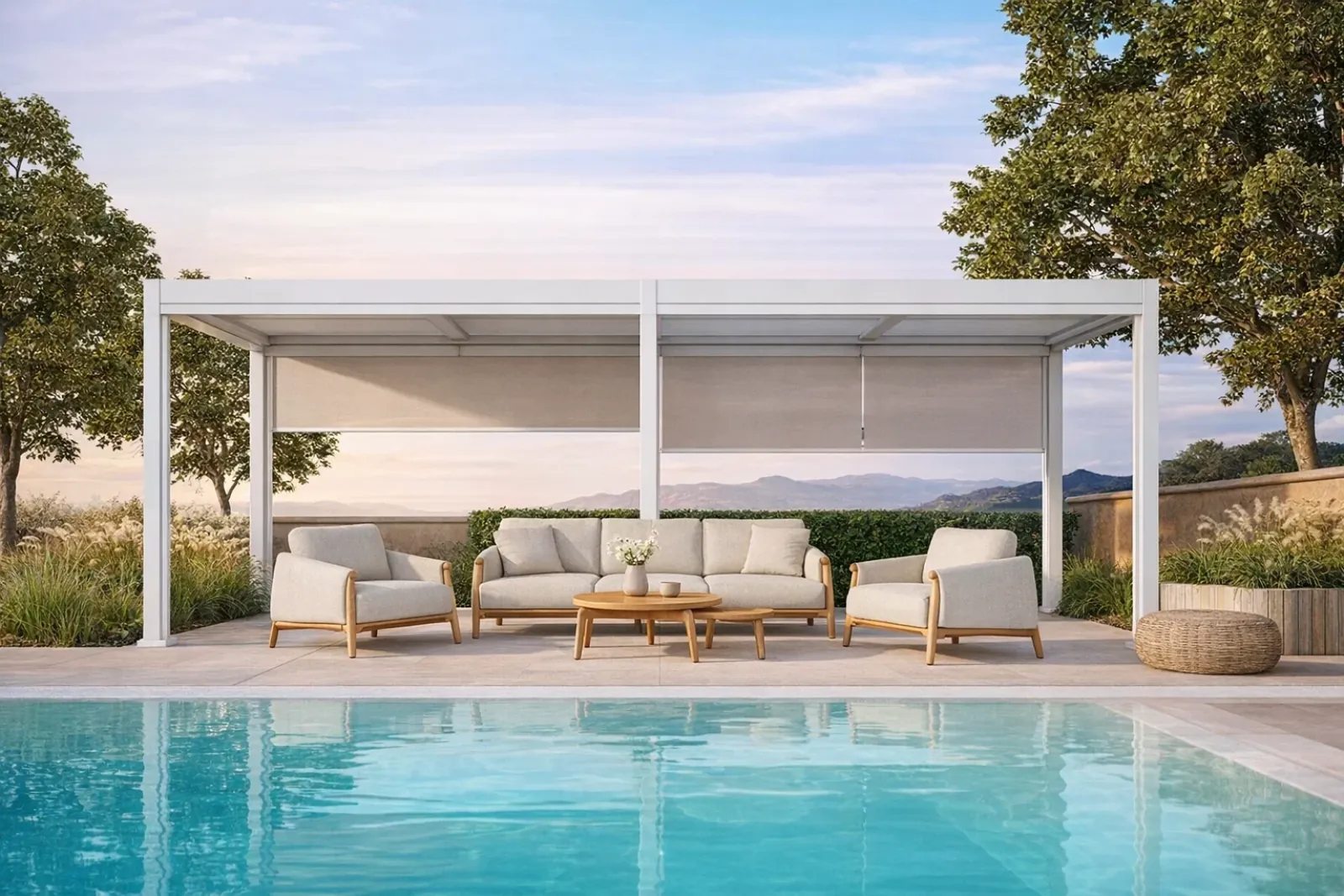
Inspiration for the relationship between light seating, teak, and fire can be found in the SUNS Bora patio project. Use the photographs of the project to assess the composition, not as a replacement for technical documentation. Visually identical set-ups may have different requirements for connections and clearances.
Glass flame enclosures: what they offer and what they do not replace
A glass wind guard maintains the view of the fire while helping to reduce the effect of the wind. Its benefit lies in combining an open look with a functional barrier. However, the selection must begin with compatibility with the fire pit, not with the question of which shape you prefer aesthetically.
The Skleněný kryt na vestavěné ohniště čtvercové uses clear glass that keeps the flame clearly visible and complements the look of the table. It reduces the impact of wind gusts on the flame and creates a physical barrier between the fire and its surroundings.
The Skleněný kryt na vestavěné ohniště kulatý velký likewise preserves the view of the fire. Mitigating the effect of the wind helps maintain a calm, steady flame and contributes to fuel economy. A specific rate of savings is not stated, so it is not appropriate to promise percentages or a specific runtime.
Shape and name are not enough to confirm compatibility
Before ordering, have the exact dimensions, intended purpose, and method of fitting the guard confirmed. A square shape does not automatically mean suitability for every square fire pit. Likewise, the designations small or large serve to differentiate variants, not as a technical specification.
A barrier is not protection against every risk
Glass is no substitute for a safe clearance, child supervision, or rules for operating in windy conditions. Treat the area around the flame as a potentially hot spot. Do not consider the guard as a storage surface, and do not take its presence as a reason to move textiles or seating closer than permitted by the manual.
Fire pits by a pergola or parasol: what to verify in advance
Shading and open flames must be assessed together. The mere existence of a roof, open sides, or an adjustable canopy does not confirm that the space is suitable for a gas fire pit. The requirements of the specific appliance, ventilation, surrounding materials, and prescribed safety clearances are the decisive factors.
When planning a pergola, therefore, also map out the position of the fire and how the space changes throughout the day. Side closures or altering the position of the shading can change airflow conditions. If the suitability of the location is not clearly confirmed by the documentation, request a professional assessment before installation.
A practical example: an open relaxation zone
Imagine a terrace where the dining area is shaded and the evening seating area lies outside its footprint. Such a division can simplify the design, but on its own it does not guarantee safety. It is still necessary to check the overhang of the shading, proximity to the facade, and all other conditions specified in the fire pit's manual.
With a parasol, also consider its position when tilted or rotated. What is outside the fire zone during morning use may later end up directly above it. Therefore, assess a safe arrangement across all commonly used positions, not just in a single default configuration.
Maintenance, covering, and inspection before each use
Divide maintenance into aesthetic accessories, glass components, and the gas appliance itself. Each group may require a different procedure. The name of a surface finish is not a reliable guide to the material: for example, the label travertine does not warrant inferring that it is natural stone without further details.
Clean covers according to the instructions for the specific product. If the material and recommended procedure are not confirmed, do not experiment with abrasive tools or harsh chemicals. Allow glass parts to cool before cleaning and prevent sudden temperature changes. In the event of damage, address further use according to the manual and with the supplier.
Before ignition, check that the surroundings are clear, access to the shut-off valve is unobstructed, and the arrangement of seating or shading has not changed since the last use. Carry out gas connection checks in the manner prescribed by the manufacturer; never test for leaks with a naked flame. If you smell gas, do not use the appliance and follow the safety instructions.
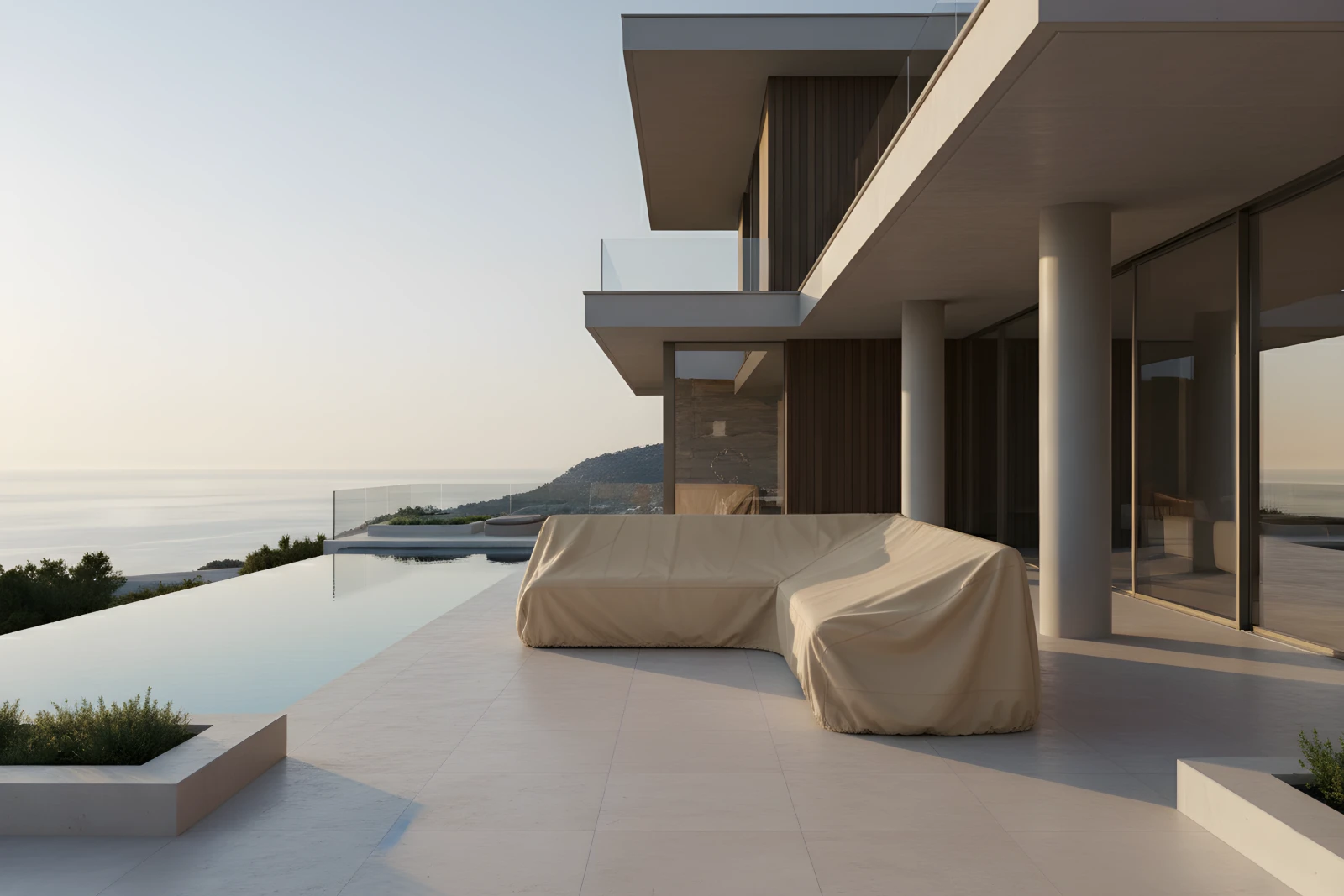
Protective covers for furniture represent a different category from gas bottle covers or glass fire guards. To cover the appliance, use only a solution intended for the given purpose, and only after it has cooled down completely. General principles for surrounding equipment can be found in the article How to properly cover garden furniture.
Before purchasing, therefore, confirm three things: the accessory matches the specific set, its positioning allows for safe operation, and you are familiar with the recommended maintenance. Only then fine-tune the shade and texture. The result will be a terrace where technical equipment does not disrupt the aesthetic, yet remains accessible and properly arranged.
Featured products


Frequently asked questions
Does a gas fire pit produce a real flame?
Yes, it is a real fire, not a decorative imitation. It therefore requires compliance with the manual, adequate ventilation, safe clearances, and supervision during operation.
Does a gas fire pit smoke and produce sparks?
When operated correctly, it produces neither the typical smoke nor flying sparks associated with a wood fire. However, the combustion of gas produces flue gases, so an outdoor appliance cannot automatically be used in an enclosed space.
What is the difference between a gas bottle cover and a glass fire pit guard?
A gas bottle cover visually conceals technical equipment. A glass wind guard encloses the flame and, depending on the specific model, reduces the effect of the wind and creates a physical barrier. They are not interchangeable accessories.
Is every gas bottle cover suitable for every fire pit table?
No, universal compatibility cannot be assumed. Verify suitability for the bottle being used, the required space, operating access, and the requirements of the set. Matching colours do not confirm compatibility.
Can a glass wind guard reduce fuel consumption?
For the product Skleněný kryt na vestavěné ohniště kulatý velký, it is stated that reducing the effect of the wind contributes to fuel economy. The specific rate of savings is not documented and cannot be generalised to all guards.
Can a gas fire pit be placed under a pergola?
Only if such positioning is permitted by the conditions of the specific appliance and the requirements for both ventilation and safety clearances are met. The open sides of a pergola are not in themselves confirmation of safety.
Can a gas bottle cover be used as a table or a seat?
Such use cannot be inferred from appearance or a description of solid construction. Without explicit confirmation of its purpose and load capacity, only use the cover in the manner specified by the manufacturer.