Tipy
Corner garden sofa: how to choose the right one for your patio
How to choose a corner garden sofa based on space, chaise longues, materials, and maintenance. A practical comparison of selected FLOW and SUNS models.
Author: Zuzana Krajčírová, founder of Luxco Living
Published
How to choose a corner garden sofa: start with your space and seating style
Choose a corner garden sofa based on the usable patio space, the number of regular users, and whether you primarily want to sit upright or also stretch out and recline. Next, verify the corner or chaise orientation, the dimensions of the specific configuration, the materials, and the outdoor use requirements. The best choice is not the largest sofa that physically fits onto the patio, but one that leaves comfortable walkways and suits your daily routine.
A corner layout gathers seating into a single unit and helps define an outdoor relaxation zone. It suits both lively evenings together and quiet afternoons, but on its own it does not guarantee space savings. A deep configuration can crowd a smaller patio just as easily as several standalone pieces of furniture. What matters is the footprint, not merely the "corner" label.
Before browsing options, note down three priorities: how many people will use the sofa on a daily basis, what relaxation posture you prefer, and how much maintenance you are willing to invest. Only then should you compare individual garden sofa sets. This will make it much easier to distinguish genuinely important features from details that simply look impressive in a photograph.
When making your decision, also distinguish an ordinary day from an occasional gathering. If you mostly use the patio as a couple, a large set designed for crowds may not be the best solution. Conversely, regular family get-togethers deserve an appropriate seating area, not just a striking chaise lounge for one.
Measure the patio, including walkways, doorways, and the actual view
Measure the area you can genuinely dedicate to furniture, not just the overall patio dimensions. Mark doors, pillars, level changes, and typical walkways on a sketch. Also account for any overhang of backrests and cushions if included in the set's overall dimensions. The sofa must not act as an obstacle between the house and the rest of the garden.
Mark out the footprint of the chosen design on the ground using masking tape suitable for the surface. Then walk the route from the door around the future seating area. Test ordinary situations: two people passing each other, someone getting up from the corner, and another walking behind the backrest. Such a simple test often reveals issues better than a drawing alone.
Smaller patio: keep the main path clear
On a narrower patio, it usually makes sense to position the longer side along the edge where it will not disrupt movement. However, the shorter return must not block the entrance. This is not a universal rule to place it against a wall: door clearance, access to individual seats, and the room required for maintenance are the decisive factors.
Open patio: a corner can zone the space
In a larger space, a corner set can separate relaxation from other activities. Check where you will be looking from the seats and whether the backrest creates an unwelcome barrier in front of the view from the house. Before making your choice, the guide on patio design essentials will help you prepare dimensions, photos, and your specific requirements.
Two sides, a chaise lounge, or a modular solution?
Two full-sized seating sides and a sofa with an extended chaise lounge may look similar in photographs, but they offer distinct experiences in everyday use. A classic corner fosters shared seating. A chaise lounge offers room to stretch out your legs, but cannot automatically be counted as the same number of individual seats with back support.
Modularity is an entirely separate feature. A corner sofa is not necessarily reconfigurable, and being split into multiple sections does not automatically mean they can be arranged in any arbitrary layout. When exploring modular sofa sets, always verify the possibilities of the specific collection, the available modules, and how they connect.
For a right- or left-hand chaise lounge, do not rely merely on your own assumption of which perspective orientation is assessed from. The product diagram and retailer confirmation are decisive. If the extended part impedes the walkway, neither coordinated colours nor comfortable cushioning will fix that mistake.
| Layout | Key benefit | Potential drawback | What to verify |
|---|---|---|---|
| Two seating sides | Shared seating arranged towards a single space | The corner seat may be less comfortable when fully occupied | Usable seats and access to them |
| Sofa with chaise lounge | Relaxing with legs stretched out | The extended section occupies walkway space | Orientation and total depth |
| Modular corner set | Ability to tailor the arrangement to the space | Reconfiguration depends on the specific units | Permitted configurations and module connections |
| Fixed corner set | Clearly defined final layout | Less adaptability if patio needs change | Alignment of the footprint with long-term plans |
Pros and cons of a corner arrangement
The benefits include a cohesive relaxation zone, a natural angle for conversation, and the ability to make good use of patio edges. The drawbacks tend to be a larger contiguous footprint and less flexibility to alter the layout unless the set is modular. Moreover, the corner seat may not suit everyone equally: when seated together, neighbouring users' legs may meet.
A practical example: for a couple who primarily read and unwind in the evening, a chaise lounge may be the priority. For a family that regularly sits together to chat, easily accessible seating along both sides may be far more important. Neither variant is universally superior; each caters to a different pattern of use.
Judge comfort by body position, not the number of cushions
A comfortable garden sofa does not mean the same thing to everyone. Some prefer to sit upright with their feet firmly on the ground, while others look for deeper seating for laid-back lounging. A photograph clearly displays the shape, but it is difficult to gauge actual back support, seat firmness, or how easy it is to stand up.
If you have the opportunity to test the sofa, sit on it the way you would at home. Do not just sit on the front edge. Lean back, shift positions, and stand up several times. On a chaise lounge, test stretching out your legs; in a corner, sit down alongside another person. It is often that shared space that determines the overall comfort of the set.
A chaise lounge as part of everyday relaxation
The FLOW Plush Heather Chalk with right-hand lounger offers a true chaise longue as a dedicated spot for relaxation. In appearance, it is reminiscent of an upholstered indoor sofa, while the frame and cushioning are built for outdoor environments. Rounded lines soften the layout and the light finish complements both timber and light paving.
Social seating with clean lines
The FLOW Easey Graumel Chalk makes the most of a corner arrangement for relaxing together and using patio space effectively. Minimalist lines and a light shade suit modern architecture as well as natural materials. When deciding between these approaches, ask yourself a simple question: do you primarily want space for entertaining, or a dedicated spot to stretch out?
Verify materials and outdoor durability for the specific variant
For an upholstered garden sofa, evaluate the frame, fabric, and filling separately. Each component affects a different aspect of use and care. The name of the fabric alone reveals nothing about the overall construction, just as details about the frame do not indicate how cushions will behave after rain. A generic 'outdoor' label is no substitute for specific guidance.
A prime example is the FLOW Emerald Platform Sooty. It features a powder-coated aluminium frame, seat and back cushions with Sunbrella® covers, and Quick Dry Foam filling. The set is designed for year-round outdoor use without the need for seasonal storage. This is essential information for a patio where you do not want to be regularly moving furniture.
However, an all-weather design does not mean the sofa is instantly dry in all circumstances or that it requires no cleaning. Quick-drying filling is not the same as the entire sofa being impermeable. Actual drying times are also influenced by the weather, airflow, and how the furniture is covered. When planning day-to-day use, separate material durability from comfort immediately after rain.
Do not automatically transfer technical specifications between colour variants or collections from the same brand. If information on filling, removable covers, or winter use is missing for your chosen finish, have it confirmed. For a more detailed guide, see the article on how to read fabric, filling, and frame specifications. Your decision should be based on verified characteristics, not on visual similarities in product photos.
How to coordinate a corner sofa with architecture and future changes
Choose colours in relation to large surfaces: the façade, flooring, and structures surrounding the seating area. A light sofa can appear visually lighter, whereas dark elements create a more defined silhouette. However, colour alone reveals nothing about durability, quality, or maintenance requirements. Assess these properties independently.
When viewed from indoors, a sofa is often a prominent feature of the overall vista. Therefore, do not judge fabric samples in isolation; consider backrest heights, arm lengths, and the total volume of upholstered surfaces in the space. It is best to assess a colour swatch outdoors under varied lighting conditions, not merely on a screen.
SUNS Stockholm for flexible layouts
The SUNS STOCKHOLM I. anthracite/light anthracite utilises the modular SUNS You Create concept, allowing you to tailor the layout to your patio and garden. The matt anthracite frame contrasts with natural timber, while plush cushions create comfortable seating. Before selecting a specific configuration, verify the combinations available for your intended floor plan.
FLOW Lux for light modular seating
The FLOW Lux Heather Chalk features a delicate shade that visually softens a sizeable corner set. The collection is modular, allowing you to combine modules to suit the size of your space. The materials are designed for year-round outdoor use without complex winter storage, and the comfort rivals indoor seating.
A practical example: if you are still finalising your patio layout, adaptability may be more important than a striking detail. Conversely, if the space is structurally complete and its use will not change, you can place greater emphasis on the exact proportions of a single, chosen configuration.
Plan positioning under shade alongside the sofa
A sofa may be comfortable, yet you might find yourself avoiding it at certain times of day due to direct sunlight. Observe your patio during the hours you most intend to relax there. Morning light and late-afternoon sun create very different conditions; a shading footprint alone does not reveal where the actual shadow will fall.
When planning pergolas and parasols, consider not only the centre of the seating area, but also both ends and the chaise longue. A pergola post or parasol base must not obstruct access. You should also account for clearance needed to operate the shade safely, in accordance with the specific solution's instructions. Seating and shade should work together as a single, well-thought-out whole.
Under a pergola, do not automatically assume complete protection from driving rain. Much depends on its design, positioning, and current weather conditions. The choice of outdoor materials therefore remains essential even on a sheltered patio. At the same time, a shelter is no reason to push a sofa flush against structures, leaving no room for cleaning and inspection.
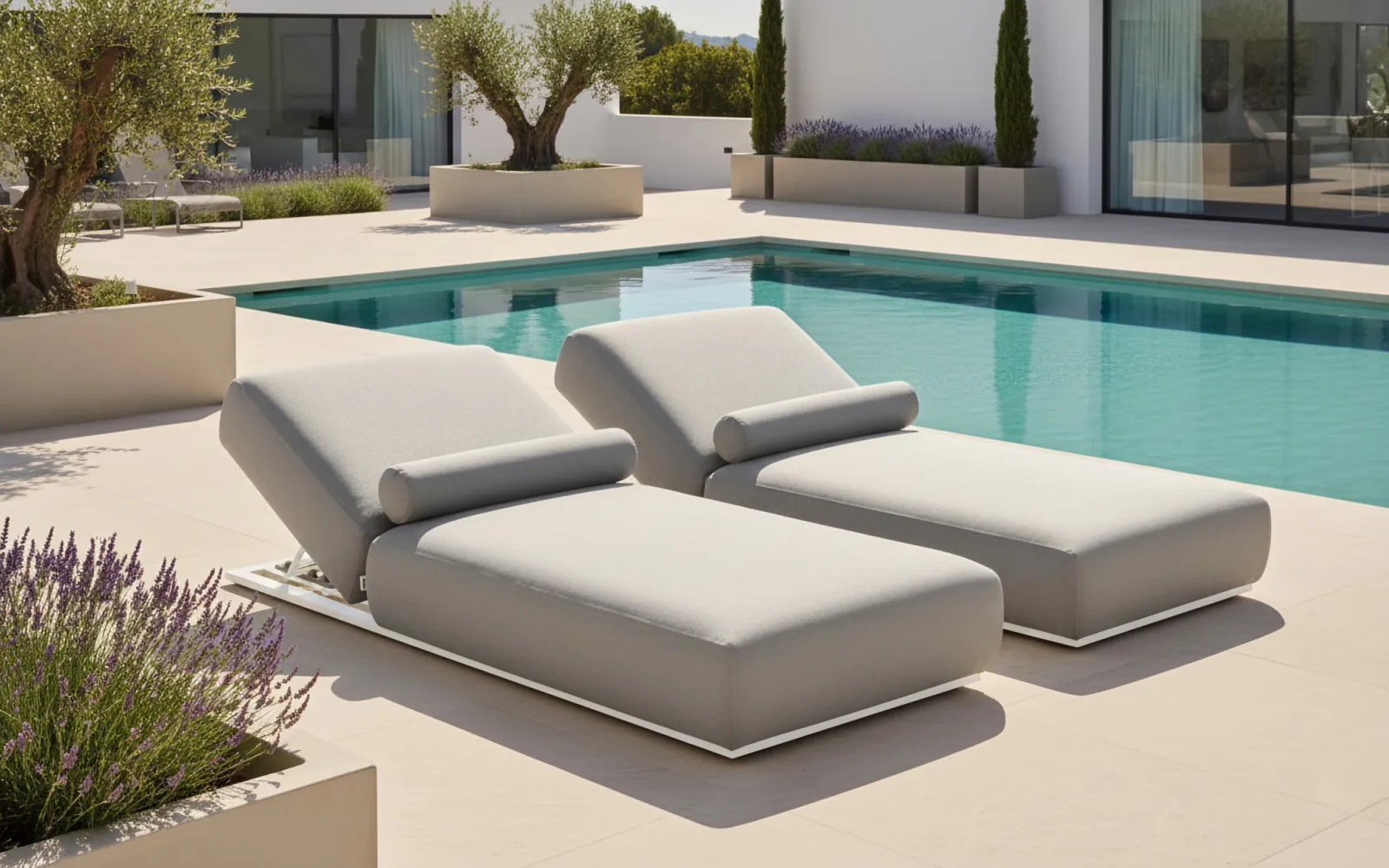
On a patio adjacent to a swimming pool or home wellness area, maintain a clear walkway around the relaxation zone. Users should not have to skirt the edge of the patio around the chaise longue or squeeze between seated guests. Picture a typical evening: someone is relaxing, another is heading indoors, and someone else wants to sit down. A good layout facilitates all these activities without constant shifting and standing up.
Care, covering, and final checks before ordering
Address maintenance requirements when making your selection, not after the first stain appears. Check the recommended cleaning methods for covers and the frame, drying conditions, and guidelines for prolonged storage. A removable cover does not automatically mean it is machine-washable. Cleaning procedures and potential reproofing treatments cannot be recommended universally across all garden sofas.
Remove everyday dirt promptly and gently according to the instructions. If permitted by the guidelines, test unverified cleaning products on an inconspicuous area first. Allow furniture to dry thoroughly after rain or cleaning. Sealing in moisture under a cover for long periods is no substitute for proper care.
Choose a cover tailored to the set's actual shape
When selecting protective covers, match both the shape and dimensions to the sofa's complete footprint, including any chaise longue. Check the fastening methods and ventilation features. A cover should not form pockets where water can pool long term. Even well-chosen protection does not replace routine furniture inspections.
If you are not using the set for an extended period, inspect its condition throughout that time. A practical approach is outlined in the article on how to properly cover garden furniture. The specific instructions for your model and cover must always take precedence.
What to verify before ordering
Prepare your final floor plan, corner orientation, exact variant code, and the list of included components. Never assume from a photo that all pictured elements are included. Also inspect access routes to the patio and check whether individual sections can be brought in without difficulty.
Once these points align and you understand the care requirements, you can choose based on personal comfort and aesthetics. A well-chosen corner garden sofa should above all enhance relaxation, rather than impose daily compromises on movement or outdoor living.
Featured products


Frequently asked questions
Is a corner garden sofa suitable for a small patio?
Yes, provided its footprint leaves doors and the main walkway clear. Before choosing, mark out the entire outline on the floor and test moving around it. The corner shape alone does not guarantee space savings; the depth and length of both sides are equally important.
How do I know whether I need a left- or right-hand chaise lounge?
First, determine which side the extended chaise can stand on without obstructing the walkway. Then verify the orientation against the product diagram and with the retailer. Do not rely on your own interpretation of left- or right-hand terms, as the description method specific to that particular set is what counts.
Is every corner garden sofa modular?
No. The corner shape describes the layout, whereas modularity refers to the ability to combine individual components. Even with a modular collection, you must check the permitted configurations and how the pieces connect. You cannot automatically assume that every module works independently.
Can an upholstered garden sofa stay outside all winter?
It depends on the specific model. The FLOW Emerald Platform Sooty is designed for year-round outdoor use without seasonal storage. However, this feature cannot be assumed for other sofas. Always follow the instructions for cleaning, protection, and long-term storage.
Does quick-drying foam mean the sofa will not get wet after rain?
No. Quick-drying foam and impermeability are different properties. After rain, the surface or the interior of the cushioning may be damp and require time to dry out. It also depends on the weather, ventilation, and the construction of the specific model.
How many people can comfortably fit on a corner sofa?
Determine the number of users based on documented specifications and genuinely usable seats. The length of the sides alone is not enough: a corner can mean shared legroom, and a chaise lounge may not provide the same back support as a standard seat. If possible, test sitting together in person.
Does a garden sofa under a pergola need a protective cover?
Follow the instructions for the specific sofa and consider its degree of exposure to the elements. A pergola may not keep out driving rain or debris. A suitable cover can provide supplementary protection, but furniture should be clean and dry before being covered for extended periods, with adequate ventilation allowed.