Tipy
Bioclimatic pergola: what it is and how it works
How does a bioclimatic pergola with rotating louvres work? Discover the options for shading, ventilation, and rain protection, as well as principles for selection and maintenance.
Author: Zuzana Krajčírová, founder of Luxco Living
Published
What is a bioclimatic pergola
A bioclimatic pergola is a patio roof with adjustable roof louvres that can be rotated to regulate sun, shade, and natural airflow. When fully closed, the louvres can create a roof that protects against rain; the specific level of protection and drainage method depend on the model. Unlike a fixed roof, you can continuously adapt the conditions beneath the pergola to the weather and how you are currently using the patio.
The designation 'bioclimatic' does not mean air-conditioned. The pergola does not actively cool the air, but helps manage sunlight and natural ventilation. On a hot day, you can reduce direct sunlight whilst leaving space between the louvres for airflow. On a cooler morning, by contrast, you can open the roof to let more light into the seating area.
The aim is not to turn the patio into an enclosed indoor room. It is about a more flexibly usable outdoor space for dining, relaxing, or socialising. In the range of patio pergolas, you should therefore look not only at the appearance of the structure, but above all at the roof function, control method, placement options, and operating limitations of each specific variant.
How louvres, ventilation, and rainwater drainage work
The foundation of a bioclimatic pergola is adjusting the position of the louvres. A single setting might not suit the entire day: the sun changes in altitude and direction, and you need different conditions at lunchtime compared to an evening gathering. The resulting shade is also affected by the pergola's orientation, surrounding buildings, and whether the sun is falling from above or from the side.
Open and tilted louvres
A more open position lets in more daylight and allows airflow through the roof. When partially tilted, the louvres can block direct sunlight without completely enclosing the space. It is precisely this combination of shading and ventilation that marks the main difference compared to a solid, fixed roof.
In practice, this means finding a position based on where you are sitting, rather than simply how the roof looks. If the sun is dazzling someone at the edge of the dining table, closing the louvres further may not resolve the issue: the rays might be coming in through the open side of the pergola.
Closed roof and drainage
On models designed for rain protection, the closed louvres interlock and precipitation is channelled away via gutters or integrated channels. It is therefore not enough to look only at the roof. The point where the water exits the structure and how the drainage connects to the patio surface are equally important.
For example, the Alvaro aluminium pergola in anthracite finish features a waterproof roof when the louvres are fully closed, and drains rainwater via an integrated gutter system into the posts. Its manual mechanism requires no electricity, so it remains operable even during a power cut. These details apply to this specific variant and cannot be automatically applied to other pergolas.
What the roof cannot solve
A waterproof roof does not mean a waterproof space. Wind-driven rain can penetrate from the open sides, and the louvres alone cannot provide the thermal comfort of an enclosed room. Likewise, any claim of year-round use should always be read alongside the rules regarding wind, snow, frost, and other adverse conditions.
Advantages and disadvantages of a bioclimatic pergola
The greatest advantage is the ability to adjust conditions over the very same part of the patio. In the morning, you can let in the light, add shade during a sunny lunch, and close the roof when it rains, provided it is designed for this function. What is more, you do not have to move your furniture every time the weather changes.
Another advantage is the natural definition of an outdoor dining or lounge area. The structure gives the space a clear frame and helps connect the patio to the house. However, the benefit depends on proper placement: an awkwardly positioned post or a poorly designed passageway can, on the contrary, detract from everyday comfort.
A drawback compared to simpler shading is the higher demand on site preparation, anchoring, and installation coordination. Moving louvres and drainage channels also require inspection and maintenance. If electric control is added, power supply and the procedure in the event of a power failure must be addressed according to the specific system.
Another limitation is low-angled sun and wind from the sides. The roof protects primarily from above; the extent of side protection depends on accessories and their operational limits. Therefore, choose a pergola as part of the entire patio, not as a standalone feature that automatically resolves all weather situations.
| Roof position | Main benefit | Things to consider | Typical situation |
|---|---|---|---|
| Open louvres | More light and natural airflow | Less protection against direct sun and rain | Morning seating or a less sunny day |
| Partially tilted louvres | Combination of shade and ventilation | Shade depends on the sun's direction and orientation of the structure | Lunch or relaxing on a warm day |
| Fully closed louvres | Rain protection on suitable models | Functional drainage required; sides remain open | A shower within permitted operating conditions |
| Roof supplemented with side shading | Reduction of low sun and increased privacy | Accessory compatibility and durability are verified separately | Afternoon seating on an exposed side of the patio |
Manual or electric louvre control?
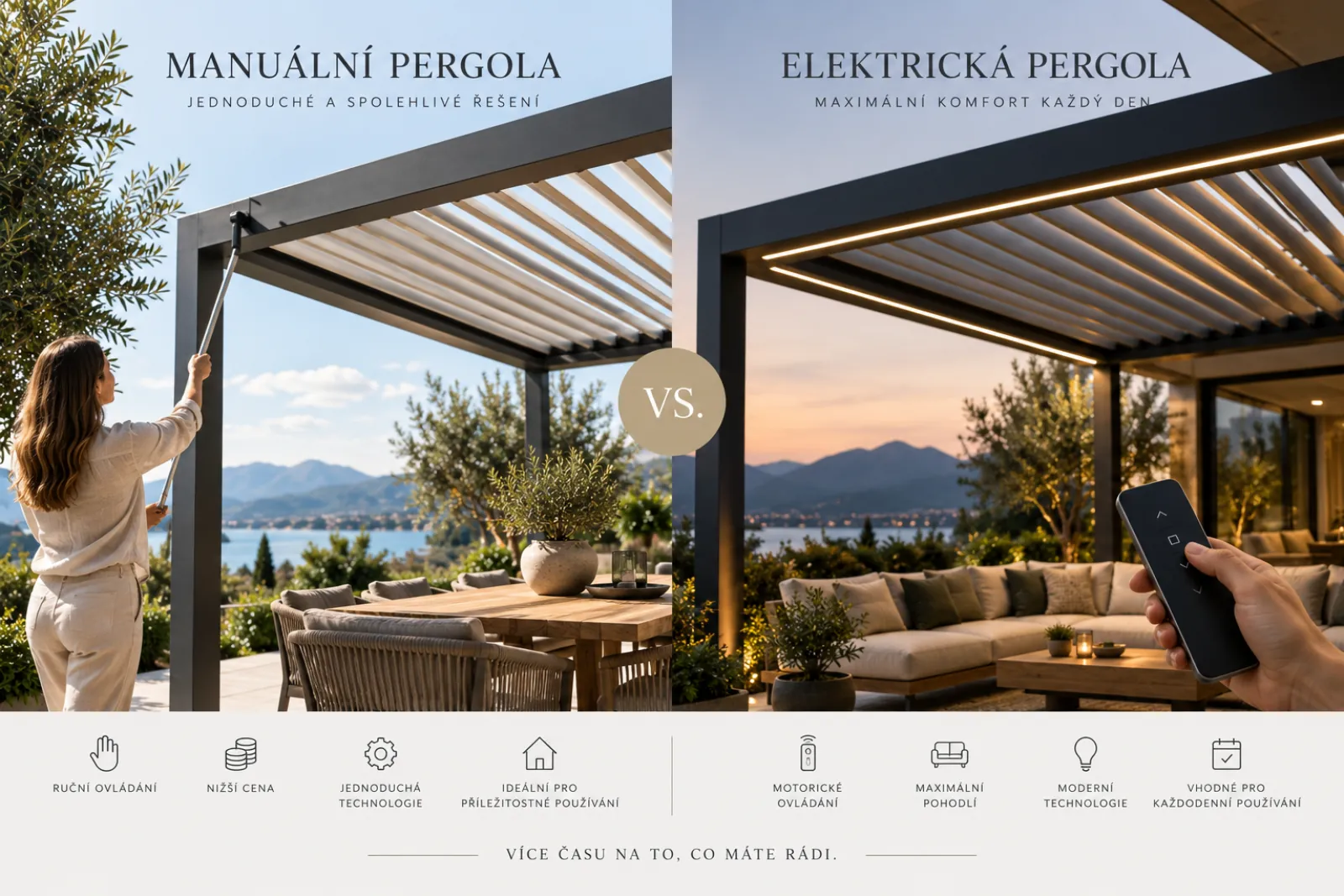
Choose the control method based on frequency of use and the accessibility of the control point. With a manual version, it is important that you can comfortably reach the mechanism even when furniture is set up. Electric control may be more convenient if adjusted frequently, but requires checking the power supply, operation, and capabilities of the specific model.
The name 'bioclimatic' does not in itself indicate whether the pergola includes a motor, remote control, or automatic weather response. Likewise, the presence of lighting is not proof of an electric louvre drive. Have each feature confirmed individually, including what is included in the package and what constitutes optional equipment.
When choosing a manual pergola, picture a typical day: who will adjust the roof, how often, and from where. If multiple members of the household use the patio, operation should be straightforward for everyone. It is also important to know how to proceed safely during sudden changes in weather.
A more detailed decision-making process is discussed in the article Electric or manual pergola?. The basic rule is simple: choose features you will actually use. The sheer number of accessories is no guarantee of comfort if they do not match the orientation of the patio and the way you spend time outdoors.
How to choose size, location, and side shading
Base the pergola's footprint on how the patio is used, not just its total area. Mark furniture, doors, walkways, and post locations on a sketch. For a dining set, allow room for pulling out chairs; for a lounge area, ensure comfortable access to all seats. What matters is the usable space between structural elements.
Connection to the house and movement across the patio
First, determine the main route between the house and the outdoor seating. A post should not hinder opening doors or natural thoroughfares. Also consider the view from the interior and the change in daylight entering the adjacent room: a pergola affects not only the area beneath the roof, but also the overall perception of the facade and patio.
Verify whether a design can be freestanding or attached to the building for the specific model. Before ordering, address ground suitability, anchoring methods, drainage, and installation access. Any building regulations or planning requirements depend on the situation and local rules; they cannot be determined by the pergola's trade name alone.
Low sun and open sides
Observe the sun on your patio at the times you actually use it. The issue during a late dinner may be quite different from at midday. If the rays come in from the side, explore side blinds for pergolas, their compatibility, and permitted conditions of use.
With the Alvaro aluminium pergola in matt white, optional side blinds can be added on all sides according to the product documentation. They provide additional protection against sun, wind, light rain, and chill. This does not mean, however, that the pergola becomes an insulated room or a structure without limitations in adverse weather.
Information needed for a sensible design
Prepare the patio dimensions, photos of the connection to the house, compass orientation, and a description of the intended use. Add details about the base/ground surface and power availability. Further context is explored in our guide to choosing a bioclimatic pergola. With this information to hand, specific solutions can be compared far more accurately than from photos alone.
Practical examples: dining area, smaller patio, and evening seating
The following examples illustrate a way of thinking about the space, rather than one-size-fits-all designs. The same pergola can function differently on two patios depending on orientation, connection to the house, and furniture arrangement. Therefore, start with the main activity for which you wish to use the canopy.
Outdoor dining area for everyday use
If you mainly dine under the pergola, position the dining area so that it can be comfortably walked around even when the chairs are occupied. Check the shade at both lunchtime and dinner time. The pathway from the house should not lead through a spot where someone is currently sitting, and the drainage outlet should not obstruct the main walking route.
When planning garden furniture under the pergola, assess the entire space as a whole. The roof, posts, and furniture should not be chosen separately: otherwise, a set with suitable dimensions might restrict the operation of the louvres or access to side shading once installed.
A smaller terrace with one primary function
On a smaller terrace, it is usually more practical to prioritise either dining or relaxing rather than trying to fit both zones in at the same time. According to the specifications, the POSITANO LED model with a 3.6 × 3.6 m footprint is also suitable for smaller terraces. It combines daytime shading with evening lighting, and the louvres allow you to regulate the inflow of sunlight and air.
However, specific suitability will only be determined by a sketch. Check the clearance around the doors, the position of the posts, and the connection to the uncovered area. Year-round use of this model is subject to observing operational limitations; it cannot be interpreted as unlimited use in all weather conditions.
A terrace used mainly in the evening
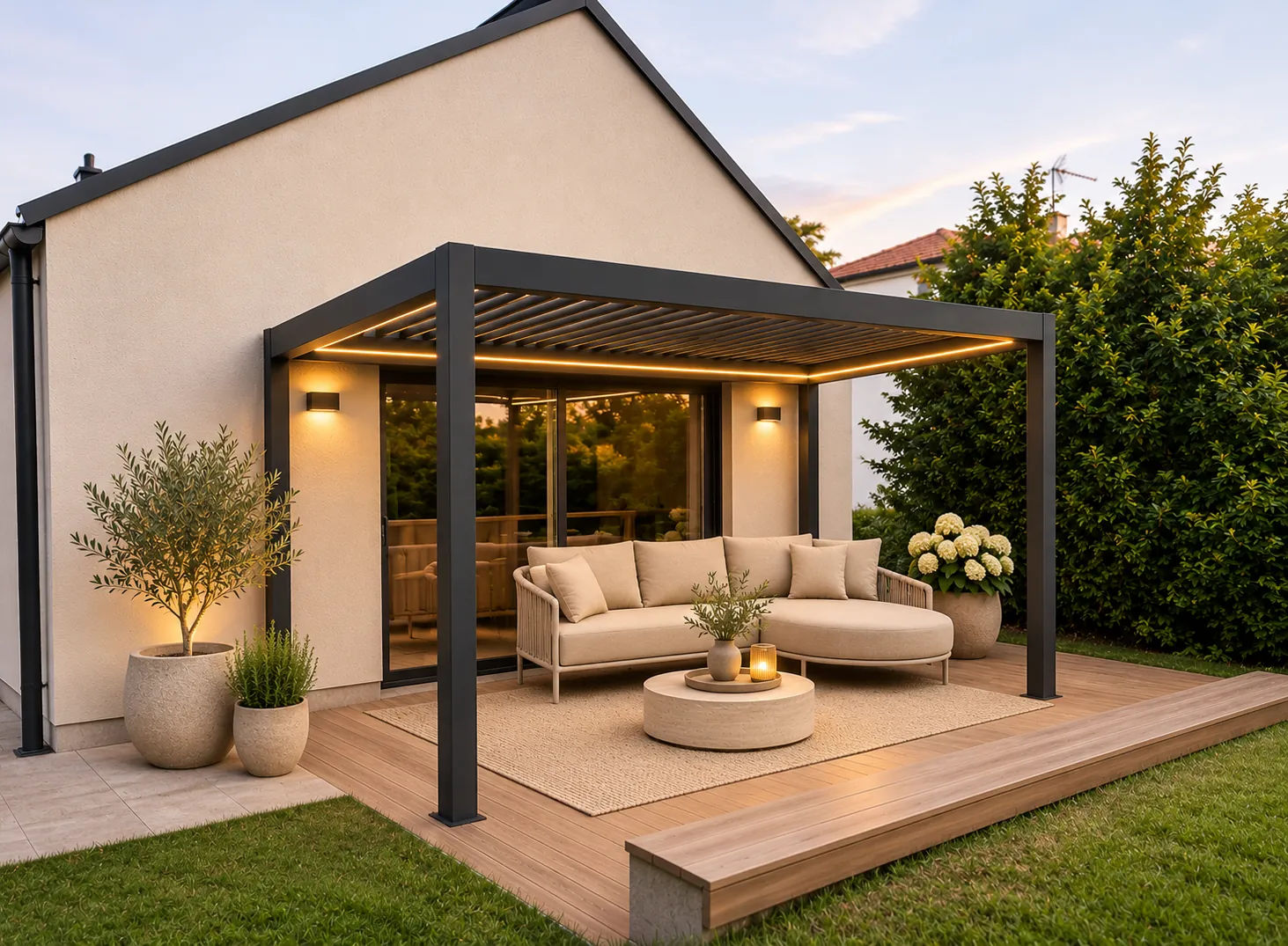
For evening use, it makes sense to address the lighting together with the roof. The POSITANO LED aluminium pergola in matt anthracite offers both white and coloured lighting. The louvres regulate shading and natural ventilation, form a watertight roof when fully closed, and drain rainwater through channels inside the legs.
During planning, clarify whether you need light primarily for dining or for relaxing. Inspiration for combining a pergola with an evening atmosphere is provided by the terrace study with the SUNS POSITANO pergola. Always check the lighting specifications for your chosen option.
Pergola maintenance and protection of equipment under the roof
A bioclimatic pergola is not maintenance-free. Regularly check the cleanliness of the louvres and ensure drainage channels are clear, as blockages can impede proper water run-off. The cleaning procedure, suitable cleaning agents, and accessibility of individual parts are governed by the manual for the specific model. Do not tamper with the mechanism or structure in any way not permitted by the manufacturer.
When moving the louvres, watch for unusual resistance or changes in operation. If the mechanism does not behave normally, do not attempt to force it. Particular caution is required in freezing conditions or if there is an obstruction in the moving parts. The correct roof position during snowfall or strong winds is not universal and must be based on the operating instructions.
Equipment under the pergola also remains outdoor equipment. A closed roof limits direct rain, but it does not eliminate air humidity, dust, or precipitation coming in from the sides. Therefore, tailor furniture care to its materials and the manufacturer's instructions, rather than relying solely on the fact that it is under cover.
During longer periods of non-use, suitably chosen protective covers can help. Clean the furniture and let it dry before covering it; follow the ventilation and fastening rules for the specific cover. The pergola and the cover serve different purposes, and one form of protection does not automatically replace the other.
What to confirm before ordering a pergola
Before making your final choice, have the exact version, external dimensions and usable space, post layout, control method, and installation requirements confirmed. For the roof, ask about the stated rain protection and drainage routing. For accessories, verify compatibility, the scope of delivery, and any need for electrical preparation.
Request the operating guidelines for adverse weather separately. What matters is not only the stated structural resistance, but also the required position of the louvres and blinds in a given situation. The concept of year-round use does not replace these instructions, nor does it mean that comfort under the pergola in winter will be the same as indoors.
A well-chosen bioclimatic pergola matches when and how you want to be outdoors. Therefore, the most convincing solution is not automatically the largest structure or the most extensive set of features, but the harmony between the roof, orientation, walkways, and terrace furnishings. It makes sense to review the specific possibilities of the space with Luxco Living right at the design stage, before ordering and preparing the fixings.
Featured products


Frequently asked questions
What is the difference between a bioclimatic pergola and a fixed roof?
A bioclimatic pergola has adjustable louvres that allow you to change the light intake, shading, and airflow. A fixed roof does not allow this adjustment. Rain protection with a louvred roof depends on the specific model and proper closure.
Is every bioclimatic pergola watertight?
Watertightness cannot be assumed solely from the label 'bioclimatic'. Verify the stated properties of the selected option, the conditions for closing the louvres, and the drainage. Even a watertight roof will not prevent wind-driven rain from entering through open sides.
Does a bioclimatic pergola lower the temperature?
Shading and natural ventilation can improve perceived comfort, but a pergola is not air conditioning. The result depends on the weather, orientation, louvre position, and surrounding surfaces. A specific drop in temperature cannot be promised without measurements.
Does a bioclimatic pergola need electricity?
It depends on the controls and equipment. A manual mechanism can operate without electricity; a documented example is the aforementioned anthracite Alvaro variant. Electric functions require a suitable power supply, the provision of which must be verified prior to installation.
Can the pergola also be used in winter?
Some models are designed for year-round use, but always within operational limits. In snow, frost, and strong winds, follow the manual for the specific pergola. Year-round use does not mean a heated or indefinitely resistant space.
Do louvres help against low afternoon sun?
Only partially, as low sun can penetrate through an open side. In such situations, consider compatible side blinds. Check their availability, effectiveness, and wind limitations for the specific model.
What information should you prepare when choosing a pergola?
Prepare the terrace dimensions and photographs, compass orientation, furniture layout, and information about the base surface and electricity. Also indicate whether you mainly want to dine, relax, or use the terrace in the evening.