Tipy
Parasol or pergola? Comparing patio shading options
Compare parasols and pergolas by shade, rain protection, space, and maintenance. A practical guide to shading your dining and relaxation terrace.
Author: Zuzana Krajčírová, founder of Luxco Living
Published
Parasol or pergola: how you use your patio is key
Choose a parasol if you primarily need localised shade and want to retain flexibility in your patio layout. A pergola makes more sense for a permanently defined outdoor dining or lounge area where you require sun control and, with a suitable model, rain protection. Neither option is inherently superior: the deciding factors are your daily habits, installation conditions, and the specifications of the chosen product.
First, picture an ordinary day, not just hosting a special gathering. Do you sit outside briefly after lunch, or from morning till evening? Do you want to shade a single relaxation spot or a communal dining table? Do you need to stay outside when the weather turns? The answers will reveal far more than the size of the patio alone or a photograph of a finished setup.
The relationship between the shading and the house is equally important. A pergola becomes a prominent feature viewed from indoors and permanently defines the layout of your outdoor space. A parasol typically represents a less permanent intervention, but it requires a well-considered base placement and operating clearance. Therefore, even a smaller option is not without spatial demands.
When browsing our range of garden parasols and patio pergolas, focus primarily on comparing truly usable shade. The roof's footprint or the canopy dimensions of an open parasol do not tell you on their own whether your favourite spot will remain sheltered in the late afternoon.
Clear comparison: advantages and limitations of both solutions
A parasol primarily addresses shading for a specific spot. A pergola also creates a permanent structural boundary for an outdoor room. This distinction influences planning, day-to-day operation, and the ability to rearrange furniture later. The following comparison outlines general principles; always check specific features, fixing methods, and operational limits on the selected model.
The advantage of a parasol is the ability to adapt shading to a more flexible layout. Disadvantages can include an obstructive base or the need to respond more frequently to changing weather. The advantage of a pergola is consistent shelter and, with louvered models, light regulation. Its limitation is a fixed position and greater demands on site preparation.
When making a decision, do not simply tally up the advantages. If you only need to shade a single relaxation spot during the summer, a larger structure may not offer commensurate value. Conversely, if you regularly dine outdoors and require seamless continuity with the house, a stable spatial solution will be more important than the ability to move the shading around.
| Criterion | Parasol | Pergola |
|---|---|---|
| Main purpose | Localised shading for a selected seating area. | Permanent definition of a shaded outdoor zone. |
| Layout changes | Possible depending on design, base, and fixing method. | The structure's position remains fixed; furniture adapts to the space. |
| Shade adjustment | Depends on the adjustment options of the specific model. | With adjustable louvers, by altering their angle. |
| Rain protection | Cannot be assumed without verified specifications. | Available on models with a suitable closable roof. |
| Low evening sun | Effectiveness depends on positioning and adjustment options. | An overhead roof alone may not suffice. |
| Spatial requirements | Base, support pole/arm, and clearance for opening and closing. | Posts, anchoring, operation, and maintenance access. |
| Wind | Requires adhering to the user manual and closure guidelines. | Requires adhering to structural limits and prescribed louver positions. |
| Visual impact | A freestanding element complementing the seating. | A striking architectural framework for an entire section of the patio. |
When a parasol is more practical than a pergola
A parasol is a suitable starting point where outdoor space is used intermittently or where the layout of the seating area has not yet been definitively resolved. It also helps divide a patio into sunny and shaded zones without creating a permanent structure over both. However, mobility cannot be taken for granted: it depends on the weight of the base and the method of installation.
Its benefits become apparent, for instance, when you alternate throughout the day between reading in the shade and lounging in the sun. You do not have to alter the character of the entire patio for the sake of one spot. When choosing, however, look beyond just the shaded area to include ease of operation and the ability to close it safely.
A small patio requires clear walkways
In a confined area, where the support pole and base will fit is often crucial. Plot them onto the floor plan just as carefully as the furniture. Ensure they do not obstruct entry from the house, getting up from seats, or moving around the furniture. Shading that looks fine in a photo can become an awkward obstacle in everyday use.
Also check the operational clearance. The parasol must be able to open and close without clashing with surrounding furniture. For more detailed layout principles, consult our guide on how to choose a garden parasol.
Account for weather and storage
A disadvantage of a parasol can be the need for active operation when conditions change. On an open or roof terrace, do not consider a heavy base as a substitute for following the manual. Decide in advance who will close the shade and where you will store the dry protective cover during use. Practical details often determine whether you will actually use the parasol.
When a pergola offers a more useful setting
A pergola is more suitable if you want to use the outdoor seating area as a permanent extension of your living space. It allows you to design a clearly defined dining or lounge area and align it with the route from the house. It is not just about more shade: the structure dictates where people will sit, where they will walk, and how the terrace will look when viewed from the interior.
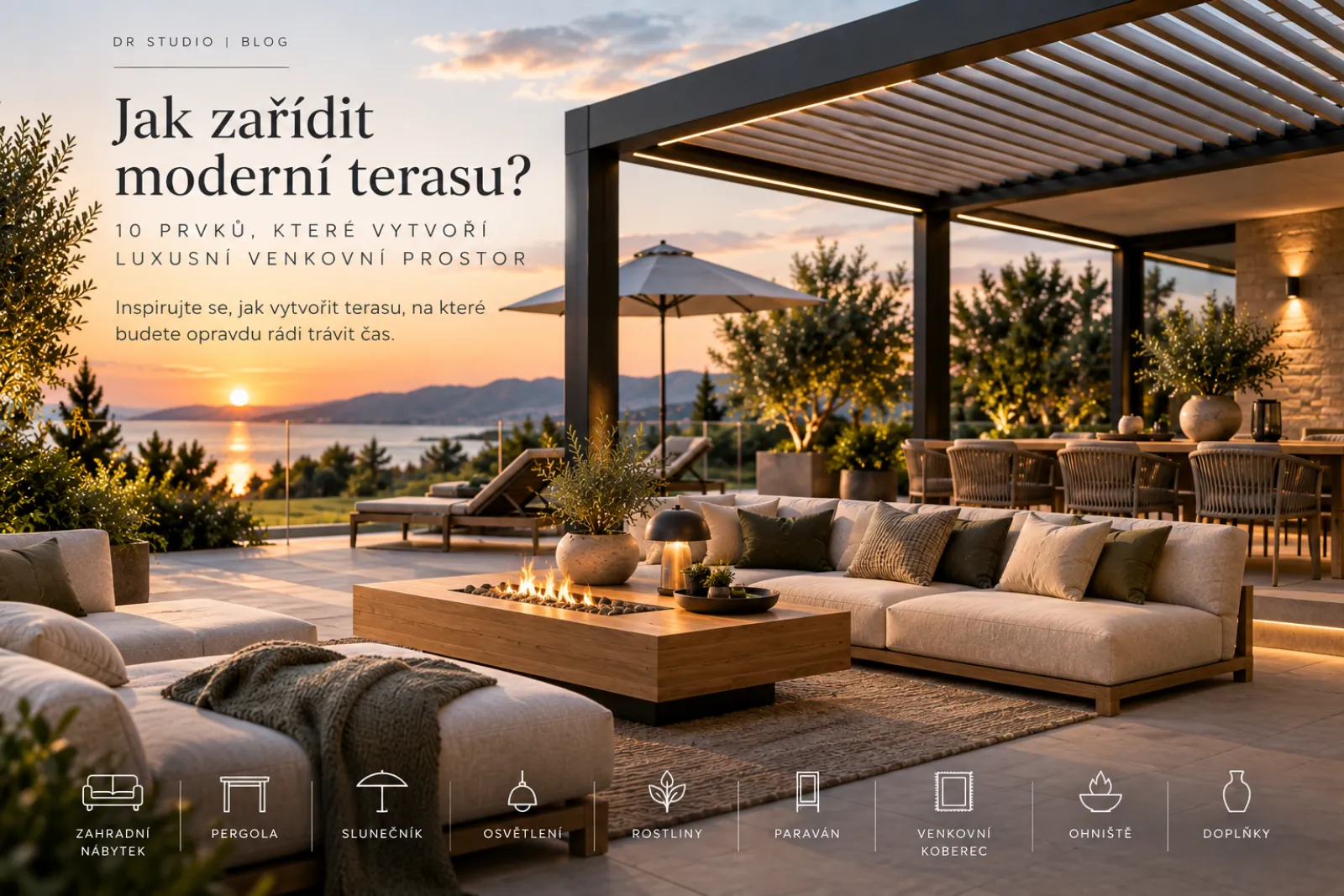
An example of a specific solution is the ROTA aluminium pergola in matt white. The position of the louvres allows you to adjust the amount of sun and shade; when fully closed, the roof creates waterproof protection against rain. The area beneath the structure can provide a setting for a garden dining or lounge set.
The advantage of such a solution is the ability to respond to changing light without rearranging the seating. The limitation remains the fixed position of the structure. Therefore, it pays to consider not only your current furniture set, but also whether you will need more space or a differently routed walkway later on.
Louvres influence light, not all conditions
The ability to tilt the louvres is useful, but it does not automatically mean complete shade from all directions. Morning and evening sun can penetrate through open sides. Likewise, roof protection is not identical to an enclosed room. When planning, separate the requirements for overhead shade, low-angle sun, and precipitation protection.
A fixed structure requires preparation
Before choosing, verify the suitability of the sub-base, the anchoring method, drainage, and the relationship to doors or the façade. On a terrace with waterproofing, it is essential to consult a professional about any structural interventions. At the same time, check any regulatory obligations based on the location and scale of the installation. Year-round usability of a pergola does not mean unlimited resistance to snow, wind, or any weather conditions.
How to design real shade over a seating area
The most common mistake is choosing shading purely based on the open terrace area. What matters more is where people will be positioned throughout the day. Shade shifts, and with low sun it can fall outside the area you want to protect. Before ordering, observe the terrace at the times when you actually spend time there, ideally across various sunny days.
Start with a simple floor plan. Sketch the doors, terrace edges, walkways, and the planned seating. Then mark the spots that require shade during lunch and afternoon relaxation. Only then position the pergola posts or the parasol base. This gives you control over whether the design suits everyday practical use.
For the dining area, do not just shade the centre of the table: consider the seated guests and the space behind them. For a lounge spot, track the position of the head and upper body when reclining. When designing a shared seating area, make sure that one favourite spot will not be permanently exposed to the afternoon sun.
For inspiration on preparing your materials, see the article on what to prepare before designing a terrace. Photos from multiple angles and a list of scenarios you want to enjoy outdoors will help. A precise description of usage is more valuable for the design than a vague brief of "as much shade as possible".
Do not forget the view from inside the house either. An overhead structure can alter the perception of the space in front of glazed doors. Therefore, assess the shading both from the outside and the inside, and consider its position when open as well as closed. A well-designed terrace should be pleasing even when you are merely looking at it.
Three practical scenarios for a dining and relaxation terrace
The following examples are neither universal sets nor confirmations of product compatibility. They illustrate a way of thinking that you can apply to your own design. Dimensions, walkways, and installation conditions always need to be verified for the specific site.
A single dedicated relaxation spot
If you primarily want a tranquil spot to unwind, you can start with a standalone daybed and localised shading. The FLOW Yavi Beige is a minimalist garden daybed designed for a dedicated relaxation zone in the garden, on a roof terrace, or by the pool; it is also well-suited to hotel and wellness environments.
For such a design, assess the shade according to the actual reclining position, not the centre of the furniture piece. A parasol can be suitable if you require primarily summer shade. However, whether a specific pairing works in terms of dimensions and operation must be verified independently.
A terrace used throughout the day and evening
For regular evening gatherings, it pays to address shading together with lighting. The POSITANO LED pergola in matt anthracite has a 3.6 × 3.6 metre footprint and combines daytime shade with evening illumination. The louvres regulate sunlight and airflow; year-round use requires observing operational limits.
When designing beneath such a structure, first determine the primary activity. If the terrace is intended mainly for dining, do not compromise comfort with too many secondary functions. Clear walkways and easy access from the house can be more valuable than trying to squeeze every piece of furniture under a single roof.
A main sheltered seating area and a secondary sunny section
On a more articulated terrace, a combination of a pergola and a parasol may be the best approach. The pergola defines the main seating area, whilst a standalone shade serves the peripheral relaxation zone. This way, you do not need to cover the entire space, preserving the choice between sun and shade.
If you are considering extending the structure during the planning stage, the Pergola Luxe Gazebo offers a modular solution with the option to connect additional bays. Adjusting the louvres allows you to create full shade or let in light. Even so, plan for future extensions right from the initial design, particularly regarding clearances, the sub-base, and walkways.
Maintenance and protective covers belong in the decision-making process from the start
Comfort is created not only by shade, but also by straightforward care. Before choosing, imagine the routine handling after use: closing the parasol, fitting the cover, inspecting the pergola, and reaching areas that require cleaning. If any task is difficult, it will easily be postponed in day-to-day life.
For a parasol, follow the manual for cleaning, drying, and storage. A cover is no substitute for proper closure or secure anchoring in adverse weather. Allow the fabric to dry before covering, and periodically check that moisture is not trapped underneath. Select the correct size based on the actual shape of the folded parasol and the manufacturer's guidelines.
The Premium protective cover for garden parasol 290x60 cm uses a breathable technical fabric and ventilation that helps reduce condensation. This is a useful feature, not a reason to cover wet equipment without further checks. Other options can be found in the protective covers category.
For a pergola, follow the manual for the specific structure. Monitor the cleanliness of moving parts and, where drainage is part of the system, ensure it remains clear. Avoid unverified cleaning methods and do not leave maintenance until the mechanism begins to meet resistance. Before winter, check the prescribed roof configuration.
At the same time, having a roof does not mean you can neglect the furniture underneath it. Driving rain, dust, and humidity can also affect sheltered areas. Therefore, link the design of your garden furniture with its conditions of use and the ability to cover or store it conveniently.
How to make the final decision without unnecessary compromises
Choose a parasol if you primarily need localised summer shade, do not wish to fix the future layout of the terrace, and accept the need for weather-dependent operation. Consider a pergola if the outdoor area is an everyday extension of your home, has a fixed location, and you require a continuous shelter with features documented for the specific model.
Before ordering, confirm five things: which spot must be in shade, at what time of day, where people will walk, how the shade will be safely secured, and who will handle its operation. If any answer is missing, it is better to refine the design first rather than choosing purely on appearance.
For a pergola, our guide on choosing a terrace pergola can assist with further decisions. However, always compare specific configurations. Adjustable louvres, rain protection, lighting, or the drive mechanism are not automatic features of every model.
The outcome does not have to be a single winner. A pergola can work for the main social seating area, whilst a smaller, separate zone benefits from a parasol. The best shading is one that suits your daily rhythm and allows you to enjoy the terrace comfortably, safely, and without the need to move furniture around every day.
Featured products


Frequently asked questions
Is a parasol or a pergola better for a small patio?
Size alone is not the deciding factor. A parasol can be suitable for localised shading, but its base must not obstruct walkways. A pergola can make sense even for a smaller permanent seating area, provided the installation conditions are right. What matters most is the usable space once the structure and furniture are arranged.
Does every louvered pergola protect against rain?
No. Rain protection must be checked in the specifications of the specific model. For instance, the aforementioned ROTA pergola features a waterproof roof when fully closed. Even so, open sides cannot be considered protection against wind-driven rain from the side.
Can a pergola be used year-round?
For models designed for year-round use, yes, but always within operational limits. This specification does not mean unlimited resistance to wind and snow, nor the thermal comfort of an enclosed room. Always follow the manual, including the prescribed louver position in adverse conditions.
Will overhead shading also handle the evening sun?
Not always. Low-lying sun can penetrate beneath the pergola roof as well as under a parasol. Before choosing, observe the angle of the sun at the times you use the patio. Assess the actual position of the shade over the seating area, not just the footprint of the overhead cover.
Can you combine a pergola and a parasol?
Yes. A pergola can cover the main dining or lounge area, while a parasol serves a separate spot beside it. This combination is useful if you do not want to cover the entire patio permanently. Both solutions must have sufficient space for safe installation and operation.
Does a parasol need a breathable protective cover?
Breathability and ventilation can help reduce condensation under the cover. However, they are no substitute for drying and regular inspections. Choose a protective cover based on the dimensions of the folded parasol, protection requirements, and the manufacturer's recommendations; it is not a universally interchangeable accessory.
What should you prepare before a patio shading consultation?
Prepare a floor plan, photographs, locations of doors and walkways, information about the substrate, and the intended seating layout. Add details regarding when the patio is used, the sun's direction, and rain protection requirements. For a pergola, anchoring and drainage are also vital considerations.