Tipy
How to choose a garden parasol: size, shade, base and care
Choose a garden parasol based on your seating arrangement, the movement of the sun and the base. Practical comparison, VOYAGER and NOVARA models, UV protection and canopy care.
Author: Zuzana Krajčírová, founder of Luxco Living
Published
How to choose a garden parasol that truly shades your seating area
Choose a garden parasol based on the entire usable area, the direction of the sun and the space for the base, rather than merely the size of the tabletop. Then compare the canopy shape, the position of the pole, tilting and rotating options, the fabric's UV protection and maintenance requirements. The best model is not automatically the largest one, but the one that safely provides shade where you actually sit or relax.
With a dining set, the chairs and the people around the table also need shade. For a garden sofa, the crucial elements are the seat cushions, backrests and individual seats, not just the coffee table. With a sun lounger, pay particular attention to the position of the upper body and the ability to adjust the shade as the angle of the sun changes throughout the day.
Before you start browsing garden parasols, write down three priorities: who the shade needs to protect, what hours you will be outside, and whether your furniture layout will change. You will appreciate one type of adjustment for regular lunches and another for relaxing from the afternoon into the evening.
The order of decision-making is important. First address function and placement, then the frame and base, and only then the colour scheme. An elegant parasol that obstructs walkways or is difficult to open over the back of a sofa will prove an unnecessary compromise in everyday use.
Determine the size and shape based on the entire shaded zone
Measure the footprint of the set in everyday use. For a dining table, factor in pulled-out chairs; for a sofa, its outer edges; and for loungers, their intended orientation. Add doors, main walkways and spaces that must remain accessible to a simple sketch. A practical procedure is detailed in the article what to prepare before choosing terrace furniture.
The dimensions of the canopy are not the same as the size of the shade on the ground. Shade shifts during the day and, when the sun is low, can fall significantly to the side. Therefore, you cannot reliably determine how many people a parasol will shade from a single dimension. Always verify the approximate size against your specific furniture set and time of use.
Round, square, or rectangular shape
Round shading naturally complements compact seating around a table. A square footprint is easy to incorporate into regular layouts. A rectangle can be more advantageous over an elongated table or on a long terrace. However, this is not a hard-and-fast rule: the crucial factor is where the actual shade falls, not the geometry of the furniture itself.
When comparing options, also check the clearance required for opening and closing. Neither the canopy nor the moving parts should collide with the façade, railings, or surrounding furnishings. In a compact space, a well-positioned smaller shade can be far more practical than a larger model with restricted movement.
One large area, or two separate zones
If you switch between dining and lounging on your terrace, consider separate shading for each area. The advantage is independent adjustment; the downside is additional bases and more elements cluttering the space. Conversely, a single large parasol visually unifies a shared seating area, but it might not simultaneously suit people at the table and those on a distant sofa.
Cantilever and centre-pole designs: advantages, disadvantages, and space requirements
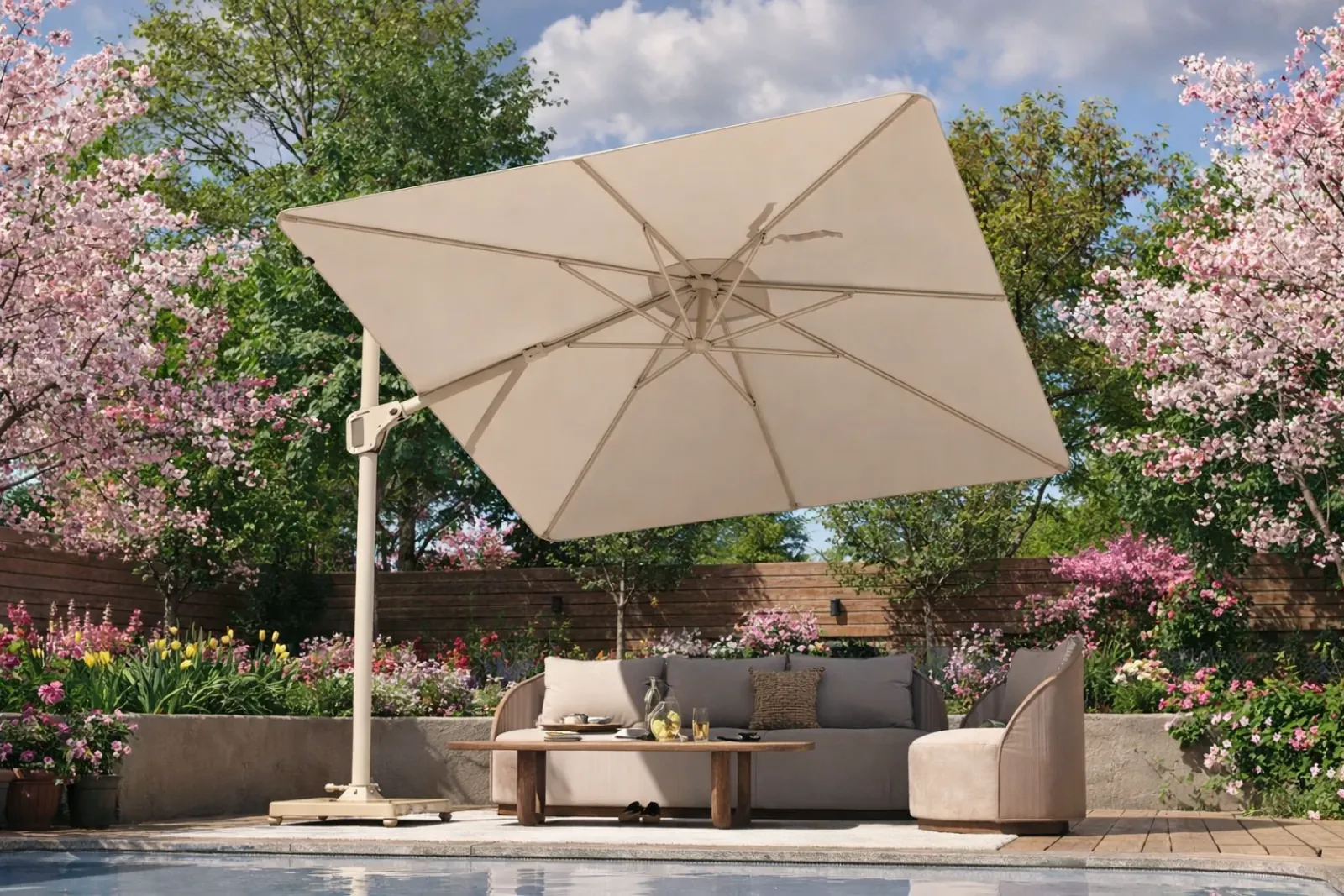
The position of the support pole affects how you arrange furniture beneath the parasol. A centre-pole design can make sense with a table prepared for such use. A cantilever design leaves the main shaded area free of a central pole, but its supporting mast and base still require dedicated space outside the seating area.
The difference is therefore not merely aesthetic. Picture the path from the door to the table, pulling out a chair, or getting up from the sofa. The base must not form an obstacle right where people walk most often. For more detailed layout considerations, see the guide to cantilever and centre-pole parasols.
| Criterion | Centre-pole design | Cantilever design |
|---|---|---|
| Main advantage | Natural positioning at a table designed for a centre pole | Clear main area beneath the canopy |
| Main disadvantage | The pole restricts furniture arrangement | The support mast and base require space beside the seating area |
| Typical situation | A permanently arranged dining area | A sofa or seating area without a suitable spot for a centre pole |
| What to check | Table compatibility, walkway clearance, and base | Shade reach, frame movement, and base |
| Shade adjustment | Depends on the specific mechanism | Depends on the specific mechanism |
When to choose which option
A centre-pole design is suitable where its position fits naturally into the set's arrangement. The disadvantage is the restriction when moving furniture around the pole. A cantilever solution offers greater freedom under the canopy, but you will only benefit from this if you have suitable space for the support mast and the required ballast.
When comparing specific models, make sure you understand the opening, locking, and adjustment mechanisms. Also check the mechanism maintenance requirements and the availability of spare parts. Convenient operation is no minor detail: if adjusting it is cumbersome, you will reposition the shade far less often than you need to throughout the day.
Tilting and sun movement: what to check with VOYAGER and NOVARA models
Rotation and tilting allow you to respond to shifts in the sun's direction. However, they are not interchangeable: changing the direction of the shade does not necessarily mean you have the same option to alter the tilt angle. Therefore, compare the explicitly stated functions of each model. Do not automatically apply the features of one variant to the entire collection.
Before purchasing, observe your terrace at the times you typically use it. Note where the sun comes from at lunchtime and where it sits later in the afternoon. This will help you determine whether you primarily need to rotate the canopy, adjust its tilt, or arrange the zones differently.
VOYAGER: adjustment without moving the entire parasol
The VOYAGER T¹ 250 x 250 cm Sand/Ivory garden parasol allows you to adjust the shade according to the sun's position without moving the parasol. Its colourfast fabric provides UV protection of up to UPF 50+. When choosing, you can therefore assess both how the shade is adjusted and the verified fabric specification.
The VOYAGER T¹ 300 x 200 cm Sand/Ivory model features a rotating aluminium base, which allows you to change the direction of shade without moving the entire parasol. It is designed for gardens, terraces, or outdoor seating areas. However, do not assume it has the UV rating of the previous variant without verification.
NOVARA: smooth adjustment for larger seating areas
The NOVARA 4×3 Camel Sand/černá garden parasol with LED offers nearly 360° rotation and smooth adjustment centimetre by centimetre. It is ideal for larger terraces, gardens, and outdoor seating areas, as well as SUNS garden sets. It is supplied without a base; a 170kg base with castors is recommended for easier manoeuvring.
Frame, fabric and UV protection: read the specific specifications
The frame material is important, but on its own it does not determine the quality of the entire parasol. Also look at the design of the joints, ribs, operating elements, and surface finishes. An aluminium part might be the base, mast, or canopy frame; you cannot infer the material of all other components from information about a single part.
Similarly, distinguish between canopy properties. Colourfastness describes the ability to maintain appearance, UV protection relates to the penetration of ultraviolet radiation through the fabric, and water resistance is another separate feature. One does not automatically confirm the others. Therefore, do not treat a parasol as rain protection simply because it is meant for outdoor use.
What the UPF rating means
UPF is an indicator of the protection provided by fabric against UV radiation. For the VOYAGER variant, for which up to UPF 50+ is documented, the rating applies specifically to the fabric. It does not imply complete protection for a person under the parasol: radiation can enter from the sides and reflect off surrounding surfaces.
The mere feeling of pleasant shade is therefore no indicator of UV protection. Alongside suitable shade, standard skin protection and adapting your time outdoors to current conditions are essential. When comparing parasols, favour verified specifications over generic labels such as high-quality or premium.
Consider colour in relation to the entire terrace
Coordinate the colour scheme with your upholstery, furniture frames, and façade. A neutral shade can visually unite the dining and lounge areas, whereas a contrasting tone highlights a distinct zone. However, do not judge specific protective qualities by colour or photograph alone. The specification of the chosen variant remains decisive.
Base and wind: address safety before ordering
Choose the base at the same time as the parasol. There is no universally correct weight: it depends on the frame design, canopy dimensions, mounting method, and conditions of use. A recommendation for one model is not a guideline for another. Therefore, always compare the range of garden parasol bases with the requirements of the specific model.
Also check the scope of delivery. Neither the variant name nor product photography necessarily confirms that a base is included. Some NOVARA variants even feature a 170 kg designation in the title, yet the description states delivery without a base. Clarify any discrepancies before placing an order.
Plan the positioning on a suitable surface and clear of main walkways. On a roof terrace or balcony, load-bearing capacity and local weather conditions must also be considered. Do not take moving a heavy base across uneven ground, thresholds, or steps for granted, even if it has wheels.
A larger canopy catches more wind. Neither a robust appearance nor a heavy base provides proof of a specific wind limit. Follow the user manual and, as the wind picks up, close and secure the parasol in the prescribed manner in good time. Never leave an open parasol unattended in changeable weather; a protective cover is no substitute for secure anchoring.
Practical examples: dining terrace, sofa, and sun loungers
A sound layout begins with the specific setting, not a generic recommendation based on the number of people. The following examples demonstrate what to check when planning. They are not a guarantee that a particular size will automatically shade every similar seating area.
Oblong dining table
The family uses the terrace primarily for lunch and has chairs along both long sides of the table. The floor plan must therefore also account for pushed-back chairs and clearance for walking around. Rectangular shade is worth considering, but priority should be given to ensuring shade reaches all occupied seats. A base positioned on the shorter side must not block access to the table.
Corner garden sofa
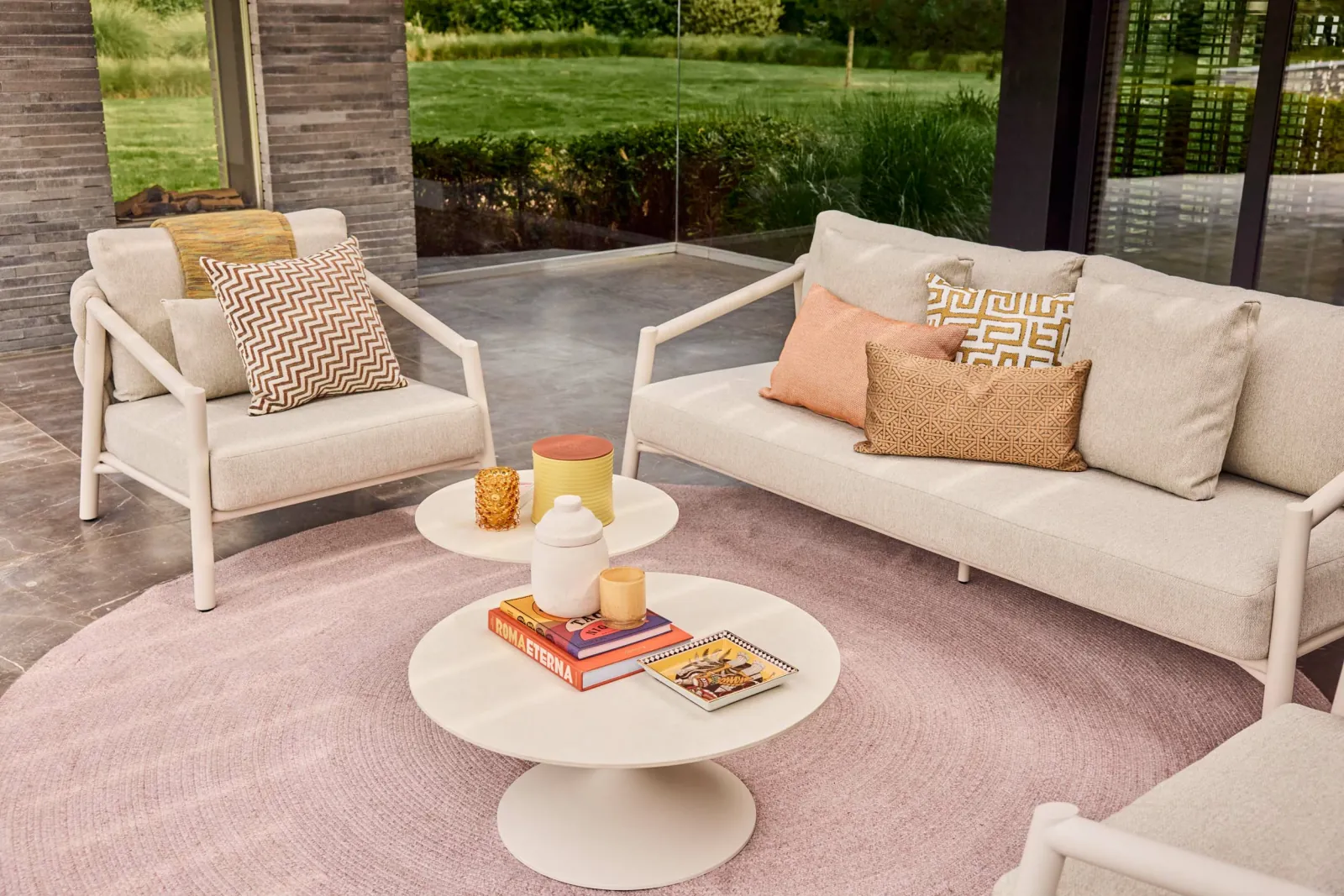
On a relaxation terrace, the most frequently used spot is often at one end of the sofa. A parasol positioned merely relative to the centre of the coffee table might miss this very spot. Therefore, take into account the outer seats, the backrest height, and the movement of the canopy. The advantage of adjustable shading is the ability to respond to the afternoon sun without rearranging the entire layout.
A pair of sun loungers and continuity with a pergola
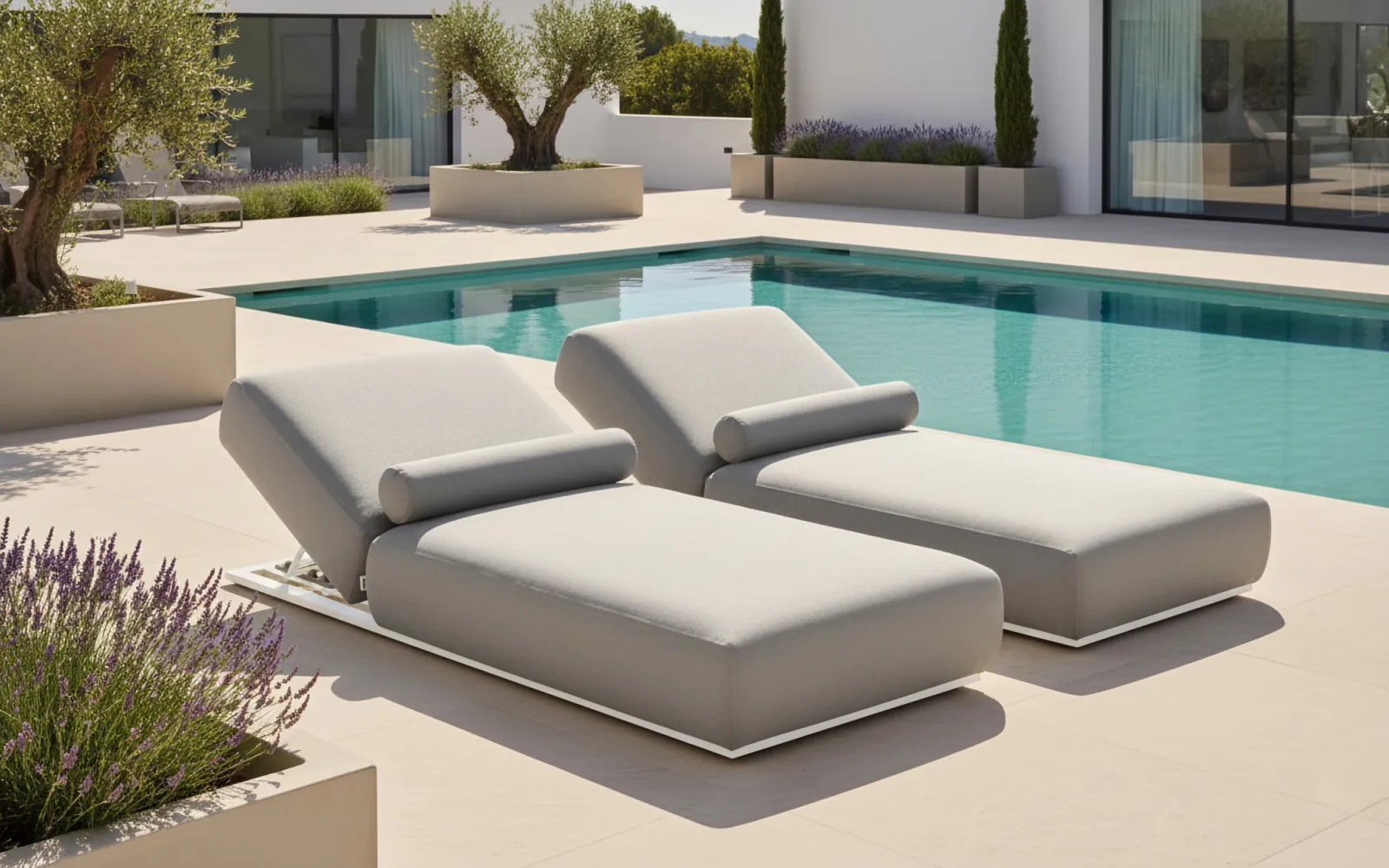
With sun loungers, first determine whether you want shade across the entire lounging area or primarily over the upper body. Maintain safe side access and space for adjusting positions. A single parasol does not necessarily need to serve both the loungers and a separate dining set at the same time.
If you are looking for a more permanent solution for a defined outdoor zone, also compare the parasol with pergolas. The advantage of a parasol is the ability to close the canopy and adjust it depending on the design. The disadvantage is the handling required during changing weather. Evaluate a pergola based on its specific construction and site preparation, not as an automatic replacement for every parasol.
Maintenance, protective cover, and final selection checklist
Regularly remove dust, pollen, and loose dirt using the method recommended for the specific canopy fabric. Tailor the cleaning agent, water temperature, and any additional care treatments to the user manual. Aggressive cleaning can damage the material; therefore, a one-size-fits-all approach is not suitable for all outdoor fabrics.
Allow the parasol to dry thoroughly before covering it for an extended period. Trapped moisture beneath a cover is undesirable, even if the cover is breathable. Regularly inspect the condition of the fabric, joints, and operating mechanisms. If a mechanism encounters unusual resistance, do not force it; consult the recommended procedure instead.
Choose a cover based on the folded parasol
In the protective covers category, do not just compare the product name, but above all check compatibility with the folded frame. Verify the required length, circumference, and ease of fitting. A matching name or a similar photograph is not sufficient on its own.
The Prémiový ochranný obal na zahradní slunečník 290x60 cm uses breathable technical fabric and ventilation to help minimise condensation. It is made entirely by hand. However, these features are no guarantee of suitability for just any parasol; dimensional compatibility must be verified independently.
Out of season, follow the storage instructions for the specific model. General principles of drying and airflow are complemented by the article on how to prevent mould under protective furniture covers.
What to confirm before buying
Before placing an order, six things must be clear: the shaded area at the required time of day, the clearance space for frame movement, the operating mechanism, the specified base, the package contents, and the maintenance procedure. Once these points check out, select your colour option. This ensures you create shade that not only complements the terrace, but genuinely makes its everyday use effortless.
Featured products


Frequently asked questions
What size garden parasol do I need for six to eight people?
The number of people alone is not enough. Measure the table as well as the space needed for occupied and pushed-back chairs, and check the sun's position during dining hours. Depending on the layout, a rectangular canopy, a larger canopy, or separate shading for multiple zones may be suitable.
Is a cantilever parasol always better than a centre-pole one?
No. A cantilever frame frees up the primary space beneath the canopy, but requires a suitable location for the mast and base. A centre-pole design may blend better into a dining set featuring a table adapted for a parasol pole.
How heavy should a parasol base be?
Follow the recommendation for the specific model. There is no universal weight. For instance, for the NOVARA 4×3 Camel Sand/černá s LED parasol, a 170kg wheeled base is recommended; this specification cannot be transferred to other models.
Is the base automatically included with the parasol?
No. Verify the package contents in the description of the specific model variant. Even the 170 kg designation in the name of some NOVARA variants does not indicate an included base according to the provided descriptions. Any ambiguity is best resolved prior to ordering.
Does a parasol with UPF 50+ provide complete sun protection?
No. This rating refers to the protection provided by the fabric, not the entire area beneath it. UV rays can penetrate from the sides and reflect off surrounding surfaces. Therefore, complement the parasol shade with standard skin protection.
Can a garden parasol remain open in the wind?
Follow the user manual for the specific model and, as the wind picks up, close and secure it in good time. Without documented data, a safe wind speed cannot be determined. Neither a sturdy construction nor a heavy base guarantees safety in all conditions.
Can a parasol be covered with a protective cover while still damp?
Allow it to dry thoroughly before covering it for an extended period. The breathability and ventilation of the cover help minimise condensation, but are no substitute for proper drying. Choose a cover based on the dimensions of the folded parasol and regularly inspect the condition underneath.