Tipy
Outdoor rugs for the patio: how to choose size, placement and care
How to choose an outdoor rug based on your seating, shading and patio flooring? A practical comparison of placements, advice on sizing, cleaning and storage.
Author: Zuzana Krajčírová, founder of Luxco Living
Published
How to choose an outdoor rug for the patio
Choose an outdoor rug based on the furniture layout, outdoor specification and patio conditions. It should connect the seating area, leave clear walkways and allow maintenance of the flooring underneath. Before purchasing, check the dimensions, material, recommended cleaning and drying method; the label “outdoor” alone does not guarantee slip resistance or suitability for being left outside all year round.
A rug can visually unify a sofa, armchairs and coffee table into a single cohesive whole. On a more spacious patio, it helps zone the lounge area from dining without creating a physical barrier. On a smaller area, conversely, it requires more careful positioning: it should not obstruct doors or create awkward edges along the main route.
Therefore, start with the furniture set, not the colour. Arrange the furniture the way you actually use it, and only then compare garden rugs. Also consider whether you want to lift the rug regularly to clean underneath it. If doing so would require moving the entire set every time, a different dimensional solution may prove more practical.
The surroundings of the patio are just as important. An open area, sheltered seating and a relaxation corner by a home wellness area present different conditions. It is not about finding one universally best rug, but about matching a specific product to the location and everyday use.
Determine the size and shape according to the garden furniture
The right size is not determined by the largest free rectangle on the floor. It is determined by which pieces of furniture the rug is meant to visually link. The basis can be the entire lounge set or just its front section with the table. What matters is that the arrangement looks deliberate and the individual pieces remain stable.
As a rule of thumb, you can allow for the rug to extend approximately 20–30 cm under the main pieces of furniture. This is neither a mandatory dimension nor a rule for every product. The deciding factors are the shape of the set, the position of its legs and whether the transition between the rug and the floor causes any unwanted tilting.
Test out the outline before ordering
Draw the intended rug on a floor plan and roughly mark out its edges on the patio in a way that will not damage the surface. Open the doors, pull out the chairs and walk along your usual routes. Check not only the view from the house, but also the approach from the garden and the clearance when getting up from the sofa.
For the dining area, take into account the position of the chairs when pulled out. If their legs catch on the edge of the rug with every movement, dining can become awkward. If a larger format restricts walkways, it is sensible to leave the dining zone rug-free and use one only around the lounge seating.
Rectangle, square, or circle?
A rectangle usually complements a longer sofa, a square reinforces a regular layout, and a circle can define a standalone relaxation corner. However, do not consider the shape in isolation. Also take note of the lines of the façade, pergola and flooring, ensuring that too many contrasting directions do not compete in a single space.
When planning major changes, the process outlined in the article on what to prepare before choosing patio furniture will help. A measured floor plan, photographs and a description of everyday use will make it easier to select both the set and matching accessories.
Open patio, pergola and dining zone: placement comparison
The location of use affects which properties need to be verified and how much care the rug will require. Under a roof it may be less exposed to direct rain, but wind-driven rain or moisture from the floor can still reach it. Therefore, even a sheltered roof does not eliminate the need to check the underside.
The following comparison is not an evaluation of specific rugs. It illustrates the differences between situations you commonly encounter when furnishing a patio. The suitability of any chosen model must always be confirmed by its specifications and the manufacturer's instructions.
| Placement | Main benefit | Drawback or limitation | What to verify |
|---|---|---|---|
| Open patio | Defining seating across an open expanse | Direct exposure to the elements and more frequent moisture checks | Outdoor specification, documented durability, drying and stability |
| Seating under a pergola | Visual cohesion of an outdoor living space | Moisture can accumulate under the rug even under a roof | Flooring condition, wind-driven rain and accessibility for cleaning |
| Garden dining zone | Clear zoning of the dining area | Crumbs, stains and chair legs catching on the edge | Sufficient dimensions and approved cleaning method |
| Small patio or balcony | Unifying compact seating | Risk of catching on doors and restricted walkways | Door clearance, edge placement and ease of handling |
| Relaxation by a home wellness area | Defining a dry relaxation corner | Wet feet and higher demands on slip safety | Suitability for the specific environment and performance on wet surfaces |
Material and properties: what the specifications must confirm
For synthetic outdoor rugs, pay attention to the precise material composition. Polypropylene, polyethylene, PVC and recycled PET are not identical materials and cannot automatically be assumed to share the same properties. Nor does information about recycled origin alone indicate how quickly the rug will dry or how it will behave on your flooring.
A natural look does not necessarily mean natural fibres either. Conversely, natural fibres are not automatically suitable for outdoor use without appropriate specification and treatment. Base your choice on technical information, not merely on a photograph or surface impression.
Weather resistance is not slip resistance
Distinguish between material durability, water drainage and grip on the substrate. These are different properties. A product may be rated for outdoor use, but its safe use will still depend on the specific flooring, the condition of the edges and wet-weather conditions. Do not assume slip resistance unless substantiated.
Before ordering, look for information on approved placement, cleaning, drying and storage. If it is missing, request it. Pay equal attention to the flooring supplier's instructions: prolonged coverage and trapped moisture may not be suitable for every surface.
Shading alters the conditions, not the rules of maintenance
When designing a pergola, consider not only the shade, but also rain exposure and the ability to ventilate the space. A rug should not cover drainage points or impede access to them. Check the actual conditions after rain rather than relying on the assumption that a covered seating area must be dry.
A parasol primarily addresses shade arrangement depending on its design. Without documented properties, do not treat it as rain protection for the rug. Furthermore, with any shading solution, it remains essential to respect the operational limitations of the product.
How to match the rug with your sofa, sun lounger and pergola
Assess the colour palette in relation to the flooring, façade and upholstery. A calmer rug can work well with striking seating, while neutral furniture leaves more scope for pattern. It is not necessary to match the exact same shade. It is more important that the rug ties the whole scheme together without overpowering its key features.
When choosing garden furniture, consider what should be the focal point: the set, the view, or the splash of colour underfoot. If everything is competing for attention simultaneously, the patio can feel disjointed. The following examples represent design scenarios, not an endorsement of the suitability of any specific rug.
Calm seating with SUNS Casto
The SUNS Casto garden sofa set features natural colour tones and softly contoured outlines. For this design concept, you can look for a rug that harmonises with the flooring and lets the seating take centre stage. However, determine the size only once the composition and dimensions of the set on order are confirmed.
Practical example: on a patio connected to a dining area, use the rug to define only the lounge seating. Leave an uninterrupted walkway between the two areas. This gives you clear zoning without needing to cover the entire floor or add another physical barrier.
A standalone relaxation corner with FLOW Lio
FLOW Lio double garden sun lounger offers an ergonomic design, a generous reclining area and minimalist lines. When designing its surroundings, a rug can delineate a dedicated relaxation spot. However, it must not compromise access or the lounger's stability.
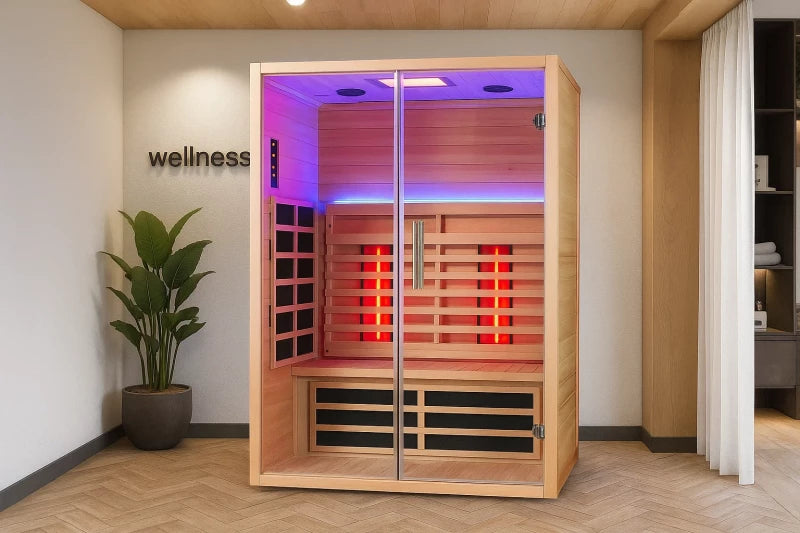
Near a wellness area, position such a nook away from the main wet walkway. Treat the rug here as part of the composition, not as an automatic anti-slip solution. Safe movement and drying capability are more important when choosing the location than a perfectly symmetrical photograph.
Compact seating area under the POSITANO pergola
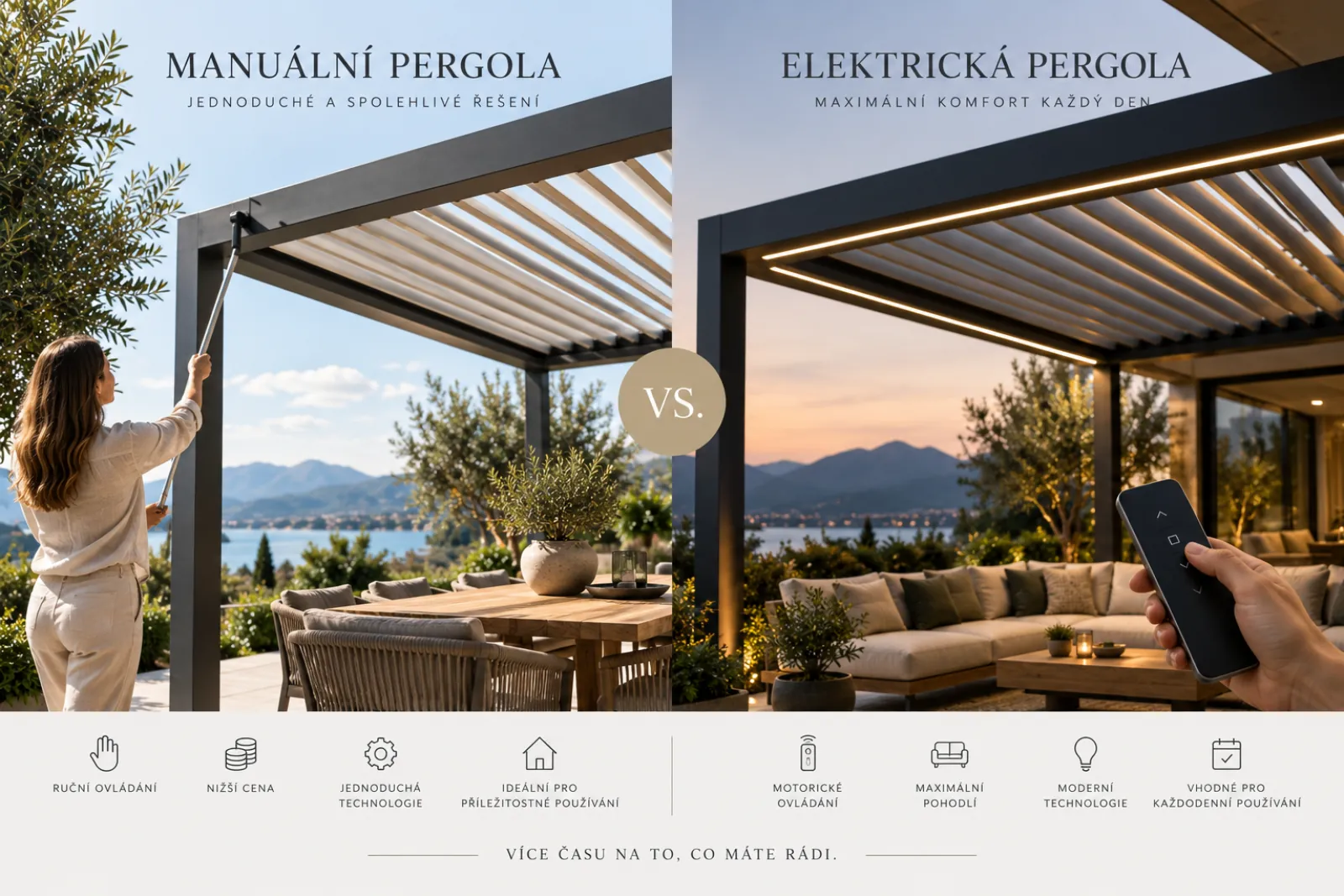
The POSITANO LED 360 × 360 × 250 pergola in matt anthracite has a 3.6 × 3.6 m footprint. Its louvres allow you to regulate sunlight and airflow, and the design combines daytime shading with evening lighting. Plan the rug according to the furniture inside, not automatically around the pergola's entire footprint.
Keep the terrace edges and areas needed for maintenance accessible. In a smaller layout, one well-placed rug can be more balanced than several small surfaces that divide the space and add extra edges.
Advantages and disadvantages of an outdoor rug
The main advantage is visual cohesion. A rug helps anchor the set in the space and separate relaxation from other activities. On an expansive terrace, it can thus reduce the impression of empty space, while with compact seating, it enhances continuity with the interior. However, the resulting underfoot comfort depends on the specific surface of the product.
Another advantage is the ability to change the colour tone of the terrace without replacing the main furniture. A bolder pattern, however, may limit further combinations over time. If you plan to update the upholstery or arrangement of the set, it is usually easier to work with a calmer base and a clearly defined palette.
The downside is an additional surface requiring maintenance. Dirt does not just accumulate on top; it can also remain underneath the rug. Moisture checks, handling during drying and potential storage are all added tasks. A large rug beneath heavy-to-move furniture may therefore not be a practical choice.
A rug is not a mandatory feature of a premium terrace. Omit it if it restricts drainage, complicates safe movement or requires maintenance you do not wish to undertake regularly. A well-considered set on an open floor is a better solution than a decorative element used at all costs.
Cleaning, drying and off-season storage
Regularly remove dust, pollen and loose debris using a method approved by the manufacturer. Address spilled drinks promptly, but without automatically resorting to a harsh cleaner. Check whether vacuuming, rinsing or washing is suitable for the specific rug; there is no single procedure for all outdoor materials.
A cleaning agent intended for garden furniture may not be suitable for a rug. Do not use it without confirmed compatibility. Likewise, do not assume that an outdoor rating allows pressure washing. An unsuitable method can affect not only the appearance, but also the texture or edges.
Check the floor after rain as well
A surface that is dry to the touch may not mean the underside is dry. When inspecting, lift the rug carefully to see whether water or dirt remains underneath. If it is damp, follow the drying instructions and allow the underlying surface to dry too.
During prolonged periods of non-use, do not leave a wet rug trapped beneath furniture. At the same time, respect the requirements of the seating itself: quick-drying foam or outdoor upholstery does not mean you can neglect moisture across the entire lounge area.
It must be thoroughly dry before storage
Before storing, clean the rug and dry it thoroughly on both sides. Choose the method of folding or rolling according to the manufacturer's instructions to prevent undue stress. For extended periods of disuse, consider dry storage, especially if leaving it outdoors under the given conditions is not documented.
Choose protective covers based on the equipment they are designed for; do not automatically consider them a suitable covering for a rug. Coordinating care for the entire terrace is made easier with our guide to winterising garden furniture, which follows on with cleaning, drying and protecting the set.
Checklist before making your final choice
First, confirm the layout: do you know the actual dimensions of the set, and the position of doors and walkways? Have you tested sliding chairs out and standing up naturally? The rug should work while using the terrace, not just when looking at an empty floor plan. Also check whether you can safely move it for maintenance.
Next, verify the product: is outdoor use, material composition, cleaning and drying method documented? Does it suit the intended location? Are any durability claims stated for the exact variant you are ordering? Do not carry over specifications from another size or model without verification.
Finally, assess the whole ensemble in both daylight and evening light, and decide whether the benefits match the maintenance demands. The best outdoor rug is not necessarily the largest or the boldest. It is the one that connects your chosen seating, respects the flooring and brings no unnecessary complications to daily terrace life.
Featured products


Frequently asked questions
Can an ordinary indoor rug be placed on a terrace?
Only if the manufacturer also confirms exterior use. A similar appearance or synthetic composition alone is not enough. Also verify the requirements for placement, cleaning and drying.
How large a rug belongs under a garden sofa?
One that links the selected pieces and leaves walkways clear. As a general guide, tucking it approximately 20–30 cm under the main furniture can be considered, but the actual layout and stable footing of all supports are decisive.
Can an outdoor rug be left out in the rain?
It depends on the documented specification of the specific model. Check the durability, recommended drying procedure and usage restrictions. After rain, also check the underside and the floor; an outdoor label does not mean permanent dryness.
Is a rug under a pergola maintenance-free?
No. Dust and moisture still reach under a pergola, and depending on the conditions, driving rain can too. Therefore, inspect the rug regularly, clean it according to the instructions and allow it to dry as needed.
Are all outdoor rugs non-slip?
No. An outdoor rating and anti-slip properties are not the same thing. Performance also depends on the subfloor and moisture levels. Without substantiated data, do not treat a rug as a safety solution around a wellness area.
Can an outdoor rug be pressure washed?
Only if such a procedure is explicitly permitted by the manufacturer. Otherwise, opt for the recommended gentler method. The same rule applies to washing and the use of cleaning agents.
Does an outdoor rug have to be put away for winter?
Follow the instructions for the specific product and the conditions of your terrace. For extended periods of disuse, consider dry storage. Before storing, the rug must be clean and thoroughly dried on both sides.