Tipy
A beach club on your own terrace: SUNS Evora and Lucia inspiration
Draw inspiration from the IJM beach club. How to combine the SUNS Evora lounger, Lucia tables, and comfortable terrace seating into a thoughtfully designed space for relaxation.
Author: Zuzana Krajčírová, founder of Luxco Living
Published
How to create a terrace with a beach club atmosphere
You can create a beach club atmosphere on your own terrace by combining a comfortable sun lounger, a side table within arm's reach, and clear space for undisturbed relaxation. SUNS Evora and Lucia provide the inspiration for such an arrangement: the sun lounger forms the primary relaxation spot, whilst the side table provides practical support. More important than the quantity of furniture is its position relative to the view, the sun, and the walkway between the house and the terrace.
The starting point is the IJM beach club by the IJzeren Man lake in Vught, the Netherlands, where SUNS products were used. Its concept demonstrates that a holiday feel does not have to stem from ostentatious decoration. What matters is the continuity between individual relaxation spots, comfort, and a visually calm whole. For a domestic terrace, this is a useful principle, not a ready-made set that must be replicated exactly.
Furthermore, in a private setting you usually do not need a row of identical stations. A single reading spot, a pair of loungers for relaxing together, or connecting a lounger with a garden sofa often makes much more sense. It all depends on whether you spend short breaks outdoors during the day, entire weekends, or mainly evenings.
When browsing the selection of SUNS garden furniture, therefore, start by asking how you intend to use the terrace. Choose aesthetics alongside functionality, not instead of it. Even an impressively furnished space loses its value if it is difficult to walk around the lounger or if you have to get up every time you want to reach for a book.
SUNS Evora and the Lucia table: what we actually know about this combination
The luxury SUNS Evora garden lounger combines modern design, a durable aluminium frame, and innovative filling. It is designed for relaxing on the terrace or in the garden. The lounger is indeed the natural foundation of a beach-club-inspired layout: it creates a dedicated spot whose primary purpose is not dining or entertaining guests, but tranquillity.
When planning the layout, it can be paired with the Lucia garden side table in Camel Sand. It measures 45 × 40 × 50.3 cm and features minimalist lines suitable for both contemporary and natural outdoor settings. According to the product details, it can be used alongside a sun lounger, a lounge set, or as an auxiliary surface next to a dining set. Its role is to keep essentials accessible without unnecessarily disrupting your relaxation.
The look of a collection does not guarantee identical features
For individual models, it pays to separate design affinity from technical specifications. Details regarding the upholstery, filling, or cushion fixings of another Evora product cannot be automatically applied to the lounger. Before making your choice, always verify the specifications of the specific model you are ordering.
For the Evora lounger, dimensions, reclining mechanism, and detailed care instructions are not documented here. Do not make assumptions based solely on photographs. A space plan can incorporate the model, but the final layout should always be based on verified dimensions and conditions of use.
Two elements, two distinct roles
Choose the lounger according to how you like to relax, and the table based on the accessibility of its surface. Together, they should neither obstruct walkways nor force the user to stretch uncomfortably. Test the position of the table directly whilst sitting or lying down; symmetry on a floor plan alone is not enough.
Comparison: lounger, garden lounge set, and side table
A relaxation terrace can be based on different types of furniture. A sun lounger prioritises individual relaxation, a lounge set favours social time, and a side table complements both options. The following comparison separates documented product features from practical questions worth addressing during the design phase.
An alternative for the social area is the SUNS EVORA II. garden set in white. It offers soft, ergonomically designed seating and the YOU CREATE modular programme to adapt the layout to your space. The generously upholstered cushions are secured with a zip, loop, and wooden toggle system. These details apply specifically to this featured set, not automatically to all Evora products.
| Product | Documented features | Contribution to the layout | What to verify before choosing |
|---|---|---|---|
| Luxury SUNS Evora garden lounger | Aluminium frame, innovative filling, modern design | A dedicated spot for relaxation | Overall dimensions and desired resting position |
| SUNS EVORA II. garden set – white | Ergonomic seating, cushion fastening, YOU CREATE modular system | The social centrepiece of the terrace | Dimensions and layout of the chosen configuration |
| Lucia garden side table – Camel Sand | Minimalist lines, dimensions 45 × 40 × 50.3 cm | Side surface next to seating or a lounger | Reachability of the surface and clear walkway |
| Lucia garden lounger | Spacious surface, seat height 40 cm, also suitable for wellness areas | Relaxation spot on the terrace or by a home wellness area | Overall footprint and personal comfort when sitting down |
Advantages and disadvantages of individual layouts
The main advantage of a lounger–table combination is a clearly defined relaxation area. Its drawback may be less versatility when hosting guests: the position and orientation of a lounger are typically planned differently from conversational seating. A garden sofa, conversely, brings people together, but might not suit someone who wishes to step away from the group for a moment.
Combining both approaches offers more options, but at the same time requires sufficient space. Therefore, compare not only the range of garden loungers, but also the actual utility of garden lounge sets. The deciding factor is not the number of pieces, but whether each spot serves something you regularly do on the terrace.
Terrace layout: walkways first, furniture second
A successful terrace starts with a simple plan. Sketch its outline, doors, connections to other outdoor areas, and the orientation of the main view. Then mark the routes where people actually walk. Only position furniture in the remaining space, not the other way round. This prevents a relaxation nook from turning into an obstacle between the house and the rest of the terrace.
It is not enough simply to draw the footprint of the lounger. Factor in access, sitting down, standing up, and cleaning around it. For the table, consider not only its footprint, but also which side you naturally reach towards. Especially when placing it between two loungers, check whether both people can use it comfortably.
Views and privacy can take priority over symmetry
Two loungers do not have to be strictly parallel to the edge of the terrace. Angling them slightly can improve the view of the surroundings or reduce direct sightlines from neighbouring properties. This is a design decision tailored to a specific layout, not a universal rule. Always double-check that angling the furniture does not create a narrow bottleneck.
Work similarly with the distance from the social seating area. A reading corner can visually belong to the overall scheme without being situated right in the middle of a conversation. Zoning according to activities is often more effective than attempting to fill the terrace evenly.
Test the layout before placing an order
Mark out the outlines of the chosen pieces on the ground according to verified dimensions. Walk the route from the door, simulate reaching for the table, and check the view from inside the house. For an overview of further materials, see the article what to prepare before choosing terrace furniture. Such a test often reveals issues that are not apparent from photographs or catalogue compositions.
Colours, open space, and shade without excessive clutter
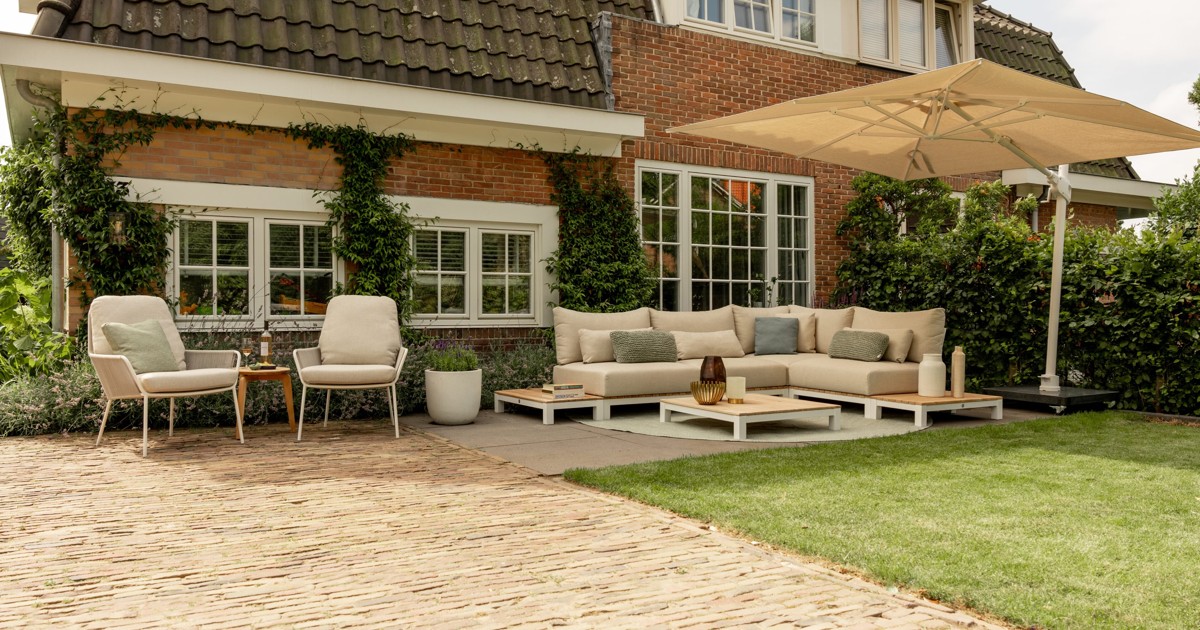
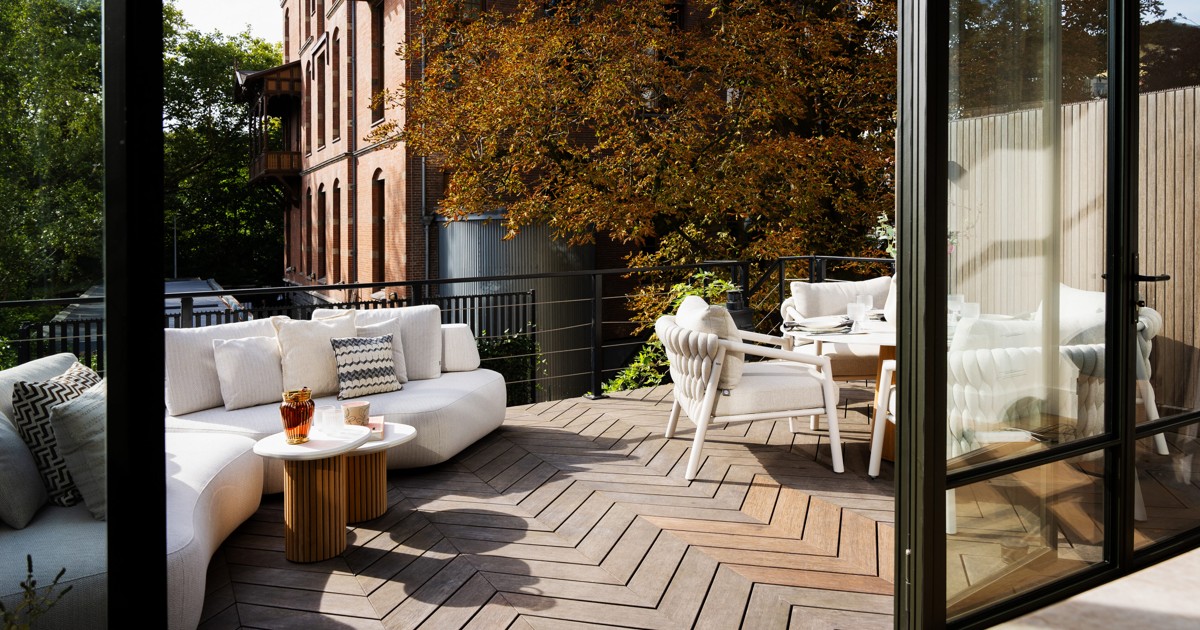
There is no need to copy the beach club look verbatim. On a domestic terrace, a restricted colour palette that ties in with the facade, flooring, and interior furnishings visible through glazed doors usually works better. Select one primary visual direction and coordinate other elements around it. Uncluttered open space remains an essential part of the composition.
Alongside the Camel Sand finish, you can also consider the Lucia garden side table in black for your design. This model also features a minimalist shape and dimensions of 45 × 40 × 50.3 cm. The black finish can be used as an accent point of contrast, whereas Camel Sand can be considered for a subtler chromatic flow. The result always depends on the surrounding surfaces and light.
The advantage of an understated approach is easy navigation and a calmer view from the house. The downside of overly strict minimalism can be a shortage of practical surfaces. If there is nowhere to set down a book or a drink, it is not considered simplicity, but a lack of functionality. Therefore, assess every additional piece based on a specific need.
Check the position of the relaxation spot throughout the day
The same spot can be delightful in the morning and uncomfortable in the afternoon. Before finalising the layout, observe the movement of the sun during the hours you will be using the terrace. If your design includes shading, verify its actual coverage relative to the lounger, not just the centre of the terrace.
A view towards water or open space may be the primary asset of the setting, but it should not eclipse practical considerations. Direct sunlight in your eyes, glare from surrounding surfaces, or walkways clashing with furniture can spoil your relaxation even in an otherwise impressive setting.
Three practical designs inspired by a beach club
The following examples are design scenarios, not descriptions of completed Luxco Living projects. They illustrate how to adapt the same concept to different needs. The exact suitability of the selected pieces must always be verified against your specific floor plan.
A smaller terrace: one quality spot instead of several compromises
If your main goal is reading and a short rest, start with a single Evora sun lounger and a Lucia side table. Position them away from the main walkway from the door. Place the table on the side where it will not get in the way when sitting down. The advantage is clear usability and an uncluttered layout; the limitation is less suitability for hosting visitors.
Only add further seating once a comfortable walkway remains after marking out the floor plan. An empty corner is not automatically wasted space. It may be essential precisely to prevent the terrace from feeling cramped.
Family terrace: social seating and separate relaxation
The EVORA II. set in white can form the centre of social gatherings, while the Evora sun lounger remains separate from the main conversation. Such a division allows one person to read while others sit together. When planning, do not assume that a single table can serve both distant zones.
The advantage is a wider use of the terrace throughout the day. The disadvantage is a larger space requirement and the need to coordinate access to all seating areas. If the lounge set and sun lounger obstruct movement, adjust the configuration or the number of pieces, not your walking comfort.
Home wellness: connected to peace, not everyday traffic
For a separate relaxation zone, you can consider the Lucia garden sun lounger. It is also designed for wellness areas and features a seat height of 40 cm, which facilitates sitting down and standing up comfortably. Position it so that access to the relaxation area does not lead through the social seating. Other spatial considerations are analysed in the study on choosing a sun lounger for a home wellness area.
Furniture care belongs in the design from the very beginning
A holiday-style terrace should remain comfortable even with routine care. Before buying, find out the recommended cleaning method for the specific frame, upholstery and filling. A general outdoor furniture label is no substitute for the manufacturer's instructions and does not, by itself, tell you what to do after rain or during longer breaks in use.
For the Evora sun lounger, documented data cannot be used to infer specific drying times, fabric washability, or exact resistance to individual environmental factors. Likewise, do not transfer the properties of a different table variant to the selected Lucia model. To ensure confidence when making your choice, it is helpful to distinguish beforehand between what is a documented specification and what is merely an aesthetic expectation.
Choose any protective covers for garden furniture only based on verified dimensions and recommendations for the specific product. Clean the furniture and let it dry before covering it; trapped moisture over a prolonged period is undesirable. Practical considerations are also explained in the guide on how to properly cover garden furniture.
When arranging the furniture, leave access for inspection and cleaning. A table squeezed between a sun lounger and a wall might look good in a photograph, but it will complicate everyday use. It is just as important to decide in advance how you will handle periods when the terrace is not used for a prolonged time. Practical care is not separate from design; it helps maintain its intended appearance.
How to choose the final set without unnecessary compromises
Before making your final choice, write down the three main activities for which you are furnishing the terrace. If individual relaxation predominates, start with a sun lounger and an accessible side surface. If spending time together is the priority, design the seating first and only then add a relaxation corner. The order of selection should stem from your habits.
Next, check the dimensions, walkways, orientation to the sun and available maintenance information. For a modular set, work with a specific configuration, not just the collection name. For a sun lounger, focus also on personal comfort and how you sit down. A photograph will help you visualise it, but it cannot replace checking the specifications or trying it out where possible.
The inspiration from the IJM beach club is strongest in its simple principle: every spot has a clear purpose and plenty of space remains around it. SUNS Evora and Lucia can be the starting points of such a design. The result should not be a copy of a commercial space, but a terrace where relaxation fits naturally into everyday life.
Featured products


Frequently asked questions
How do you bring a beach club atmosphere to a small terrace?
Start with one relaxation spot with an accessible side table and leave a clear path from the door. A limited colour palette and a carefully planned orientation of the sun lounger can be more effective than a larger number of furniture pieces.
What features does the SUNS Evora garden sun lounger have?
Documented specifications state a modern design, a durable aluminium frame and an innovative filling. Dimensions, reclining adjustments and detailed fabric specifications must be verified for the specific variant.
How large is the Lucia side table?
For the listed Camel Sand and black variants, dimensions of 45 × 40 × 50,3 cm are documented. When placing it next to a sun lounger, check not only the footprint, but also a comfortable reach to its surface.
Is the Lucia table designed only for the Evora sun lounger?
No. According to product specifications, it can also serve alongside an outdoor lounge suite, a relaxation set, or as an auxiliary side surface by a dining set.
Can the layout of the white SUNS EVORA II. set be adapted to the terrace?
Yes, its YOU CREATE modular programme allows the layout to be tailored to the available space. The specific composition and its resulting dimensions need to be verified before ordering.
Is the Lucia garden sun lounger suitable for a home wellness area?
Yes, a wellness zone is among the listed applications. The sun lounger features a spacious surface and a seat height of 40 cm, which facilitates sitting down and getting up comfortably.
Does outdoor use mean that the furniture requires no maintenance?
No. Follow the instructions for the specific product and its materials. Before covering, the furniture should be clean and dry; verify the suitability of the cover as well as the procedure for long periods of disuse according to the manufacturer's recommendations.