Realizace
Projects: artificial trees that look natural in an interior
How to choose artificial trees so that the interior looks natural: one striking feature instead of dozens of small ones, an airy canopy, the right height and a suitable planter. Olive tree, eucalyptus, kentia and ceramics.
Author: Zuzana Krajčírová, founder of Luxco Living
Greenery that does not feel like superfluous decoration in a space
The first photograph shows a terrace that transforms into a lounge in the evening light. Along a wooden walkway stand four tall planters with a metallic sheen in a single line, and from each rises a slender tree with weeping branches and dense clusters of pink blossoms. Beside them are softly upholstered armchairs, a shallow pool of water and a chandelier made of glowing glass spheres. Nothing feels superfluous, yet the space feels warm.
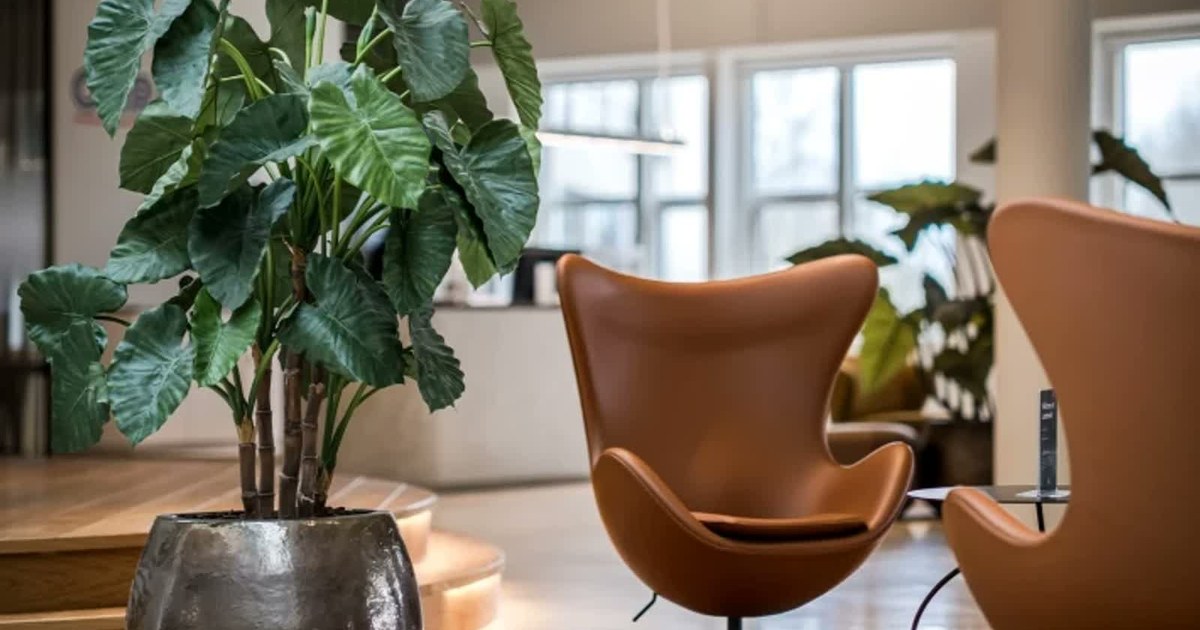
The second photograph shows a different starting point: a kitchen island, a grey armchair on slender legs, and two trees beside them. One is low, coniferous, in a round concrete planter; the other tall and slender in a tall bronze planter. The greenery here does not function as a trinket on a shelf, but as an element that ties together stone, wood, ceramics and brass.
The difference between greenery that works in an interior and greenery that feels like an accessory bought on a whim is rarely down to price. It comes down to four decisions: how many plants there are, their shape, their height, and what they stand in. The same applies to artificial trees, with the added advantage that you make all four choices in advance and the result lasts all year round.
One striking feature instead of dozens of small ones
The most common furnishing mistake is overcrowding the space. Three small pots sit on a shelf, a fourth on the windowsill, a fifth in the corner, yet no garden feel is created. Modern interiors work the other way round: place one larger tree where there is an empty spot and leave the rest clear.
Both photographs confirm this. While there are more planters on the terrace, they stand in a single line and repeat the same motif, functioning as a cohesive whole. In the kitchen there are two trees, each with a different role: the low conifer maintains a horizontal line by the island, whilst the tall, slender tree defines the dining area.
The same rule applies in an apartment: an olive tree by the sofa, a kentia by the window, a tree in a ceramic pot in the hallway. It is also easier to maintain, as you look after two pieces instead of ten.
Canopy shape determines whether it looks like a tree
A living plant is never perfectly symmetrical. That is precisely why cheaper imitations are given away by a canopy that is too dense and too uniform: the leaves are arranged into a uniform mass with no air left between the branches.
In our range, this difference is evident across the various types. The eucalyptus tree 195 cm has a canopy only 75 cm wide, grey-green leaves, and premium plastic with a realistic texture, making it airy and suitable even for smaller rooms. The kentia 190 cm features gently arching fronds and slender stems, whilst the chamaedorea 180 cm has delicately divided leaves; both create an impression of light rather than bulk. At the other extreme is the murraya 325 cm with a canopy diameter of 210 cm and dense foliage of hundreds of tiny leaves, which demands a generous space with high ceilings.
A simple rule applies: the smaller the room, the airier the canopy. The tree should soften the interior, not clutter it visually.
Height alters the atmosphere more than the plant species
Small plants get lost in a large space. A tree that reaches above backrest height visually anchors a corner and restores verticality to the room.
The heights in our range reflect what has proven successful in open-plan interiors: the olive tree 180 cm with a canopy spread of 110 × 110 cm, eucalyptus tree 195 cm, kentia 190 cm, and areca palm UV 175 cm or areca UV 195 cm with a canopy diameter of 140 cm. A step up are the kentia Deluxe 225 cm, olive tree 260 cm with a 150 cm canopy, and kentia XL Deluxe 260 cm with a spread of 200 × 200 cm. The largest specimens are designed for entrance halls and showrooms: the olive tree XL 300 cm with a canopy diameter of 200 cm and a 35 × 35 cm base, and the murraya 325 cm.
More important than choosing the tallest model is ensuring the tree does not feel cramped: it needs open space around it to stand out. In a smaller flat, therefore, opt for an airier canopy rather than maximum height.
The olive tree as a timeless choice
The olive tree is a species that cannot be confined to a single season. It has muted colouring and a calm silhouette, pairing effortlessly with travertine, light wood, beige sofas, linen curtains and ceramics.
It is available in four variants. The olive tree 180 cm made from artificial weave is the simplest route to your first larger tree. The 260 cm model has a dense canopy with a diameter of 150 cm, is supplied in several separate parts, and includes a starter pot. The olive tree XL 300 cm combines plastic and synthetic wood, with hand-assembled details and seamless trunk joints; it is built for hotel lobbies, receptions or showrooms and can also be used in covered outdoor spaces. For terraces and balconies, there is the olive tree UV 150 cm, where UV-stabilised plastic helps retain colour in the sun; it comes in a basic starter pot.
The planter is half the overall effect
Even an attractive tree looks cheap in the wrong container. Most supplied pieces stand in a simple starter pot, which is intended for potting on, not as the final display.
The catalogue features planters that match what works in contemporary interiors: the tall Ella Brass made of polyresin in a bronze colour, 120 cm tall, with an internal diameter of 32 cm and a weight of 15 kg; Luna Brass with the same body in a brass shade and a height of 105 cm; Pot Koos with a diameter of 63 cm and a metallic finish; Nino Black at 90 cm tall with an internal diameter of 27 cm; or the hand-fired ceramic Lela Lava Beige 36 × 103 cm, where each piece features its own unique texture and colour gradients. For a concrete look, there is Jumbo Orb XXS made of fiberstone, 53 × 45 cm, 12.2 kg, resistant to both frost and UV radiation.
For some trees, potting can be ordered directly: for both the eucalyptus tree and the areca palm, professional potting into a planter is an optional service. It saves handling and ensures the result looks like an intentional installation rather than a plant left on the floor.
Where a tree belongs in a room
It works best where it connects with the space: a corner of the living room, next to the sofa, by a large window, in the entrance hall, in the dining nook, in the bedroom, as well as in the bathroom and wellness zone. That is where it makes the greatest impact, because it transforms what would otherwise remain empty.
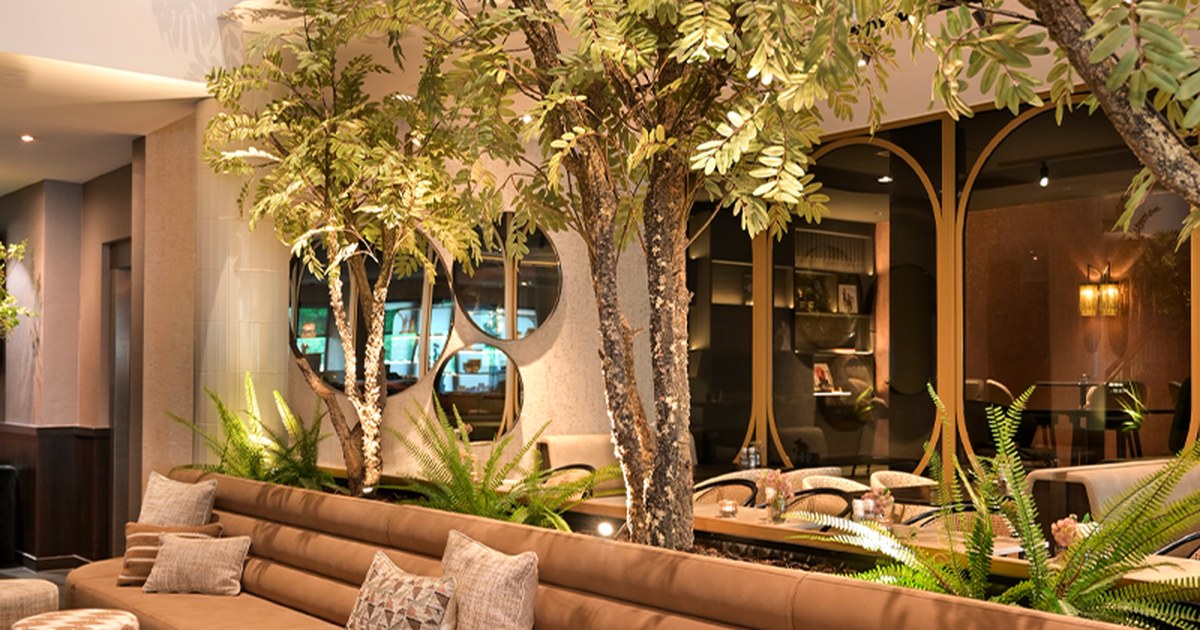
The photographs show this in specific settings: along the terrace walkway, where the planters set the rhythm, and by the kitchen island, where the low conifer separates the cooking area from the seating. More important than placement is ensuring that nothing feels forced; a modern interior works when everything looks as though it has been there from the start.
If you simply need to finish off an empty corner with a light touch, opt for a smaller variety: the monstera Deluxe 140 cm with perforated leaves or ornamental grass UV 150 cm, which is also suitable outdoors thanks to its UV stabilisation.
Maintenance nobody will notice
The only thing an artificial tree genuinely needs is dusting. Wipe the leaves with a dry cloth, rinse the tree with lukewarm water every now and then, and let it dry completely away from direct sunlight. No watering, fertilising, repotting or worrying about light conditions.
Those wanting outdoor greenery should choose a UV-stabilised version: the areca palm UV 175 cm, areca UV 195 cm, olive tree UV 150 cm or ornamental grass UV 150 cm. In all of these, UV-stabilised plastic helps prevent fading. For an interior with no natural light, standard versions are perfectly sufficient.
Why it looks like a hotel lobby
Many homes today take subtle inspiration from hotel lobbies: through tranquility, natural materials, muted lighting and soft textures. In the evening, once daylight fades, this is doubly true. Illuminated greenery, reflections in the water and warm light from a chandelier turn the terrace into an outdoor lounge.
The evening photograph demonstrates why greenery in such a space does not act as mere decoration, but as an integral part of the atmosphere: the trees maintain vertical lines, the planters complete their sequence, and light filters between the branches. The same effect can be recreated at home with two or three pieces.
What to choose and where to get advice
If you are unsure, start with the space rather than the plant: where is the empty corner, how much light is there, and how high are the ceilings? Then choose the species. An olive tree is the safest choice, eucalyptus is the airiest, kentia and areca palms are best suited to taller spaces, and murraya is ideal for generous halls.
You can find both trees and planters in the Artificial plants and Planters and vases categories. We are happy to advise on height, canopy and potting; simply get in touch via contact.