Tipy
An extending garden dining table or bar seating for guests?
How to plan outdoor dining for both family and guests: a comparison of extendable, large, and low tables, bar zones, and practical patio layouts.
Author: Zuzana Krajčírová, founder of Luxco Living
Published
How to arrange garden dining when guests arrive
An extending garden dining table makes sense when you usually dine in smaller numbers, but occasionally need a longer tabletop for visitors. Bar seating is more of a supplement for brief gatherings rather than a replacement for a shared lunch. If you host often, a large fixed dining table is well worth considering; for informal long evenings, low dining is ideal. For the models featured in this article, an extending mechanism is not substantiated, so we do not refer to them as extending.
A well-prepared patio does not need the largest possible number of seats. It needs to reflect how visits actually unfold. Planning a Sunday lunch where everyone sits at the same time is very different from an afternoon gathering where guests take turns at the table. Comfort during a specific activity is what matters, not just the number of people who can fit onto the patio.
Before choosing, note down the usual number of everyday diners, the typical size of your gatherings, and how often larger get-togethers occur. Add whether you plan to serve a full meal or just light refreshments. This simple overview will help you compare the range of garden tables far better than a mere photograph of an attractively laid set.
The season is just as important. In cooler months, outdoor visits tend to be shorter, and easy access to the seating from the house matters more. However, outdoor furniture alone does not guarantee thermal comfort. Adapt the length of the gathering and its plan to the weather and your guests' needs.
Extending, large, low, or bar table: pros and cons
Each dining style addresses different needs. Extending offers an adaptable surface, a long fixed tabletop ensures permanent readiness, and low dining provides a more relaxed way of sitting. A bar zone can separate brief chats from the main dining area, though its higher seating may not suit everyone.
The following comparison describes general layout principles. It does not confirm the availability of any specific extending or bar model. For each chosen product, it is necessary to check the construction, dimensions, recommended use, and compatibility with seating independently.
| Solution | Main advantage | Disadvantage or limitation | When it makes sense |
|---|---|---|---|
| Extending dining table | Adaptable dining surface size | Requires clear space even when extended, as well as verification of the mechanism | Usually a smaller household, occasionally larger gatherings |
| Large dining table without length adjustment | Permanent readiness for shared dining | Occupies the same footprint even without guests | Regular gatherings on a spacious patio |
| Round dining table | Encourages interaction among diners | A larger diameter requires plenty of width | Shared dining and conversation in a single group |
| Low dining | More relaxed seating combined with dining | Requires height-matched seating | Long, informal visits |
| Bar seating | Supplementary space for brief catch-ups | Higher seating is neither comfortable nor accessible for everyone | Secondary social zone, not the sole dining area |
When simplicity outweighs versatility
If a larger group gathers almost every weekend, a permanently laid-out dining area may prove more practical. It eliminates the need to rearrange the space before guests arrive. Conversely, if you only host a few larger gatherings per season, it is sensible to consider whether a large table might unnecessarily restrict thoroughfares and the everyday use of the patio for the rest of the year.
When deciding, do not compare tabletops alone. True spatial requirements also include occupied seats, pushed-back chairs, and walkways for serving. A smaller table surrounded by poorly arranged furniture can function worse than a larger table with a well-planned layout.
What to verify if you are looking for an extending garden dining table
An extending function cannot be determined from table length or collection name alone. It must be explicitly stated in the technical documentation of the specific variant. Likewise, you cannot tell from a photograph how many people are needed to operate it or where the extension leaf is stored. Request this information before ordering.
Ask about the dimensions in both states, how the extended top is secured, and the maintenance requirements for moving parts. Leg placement after extending is also crucial. A longer surface does not automatically mean equally comfortable seating around the entire perimeter if the frame encroaches on knee space.
Also check everyday operation. Will you adjust the table on your own, or will it always take two people? Do you need to clear the surrounding area before handling it? Will the extended set remain within convenient reach of the house? The answers will often guide your decision far better than the maximum length listed in the catalogue.
Floor plan test before purchasing
Mark the outline of both the closed and extended table on your patio. Then simulate occupied seats and walk the route from the doors around the set. Also test a scenario where someone stands up while another person is carrying food. It is precisely the overlap of these movements that reveals bottlenecks.
Mark doors, steps, patio edges, and fixed obstacles on a simple sketch. A detailed guide to preparation is provided in the article what to prepare before choosing patio furniture. Without these basics, it is all too easy to choose the right table for an incorrectly estimated space.
Four specific dining options from the Luxco Living range
If you do not need to change the length of the tabletop, you can focus on shape, character, and the style of dining. The following models present different approaches to outdoor dining. Mentioning them does not confirm an extendable function; recommendations are based solely on documented descriptions.
Basta: an emphasis on handcrafted detail
The Basta designer teak dining table combines a solid tabletop made from four wide teak planks with subtly rounded edges and tapered legs. Hand craftsmanship is complemented by innovative techniques. The result is a sturdy dining table designed for the patio or garden.
This model is worth considering if you are primarily looking for the natural expression of wood and a well-considered shape. However, the specific number of seats cannot be determined solely by appearance. Before setting up your dining area, compare the verified dimensions of the table with your space and intended seating.
Erice: a long surface for gathering together
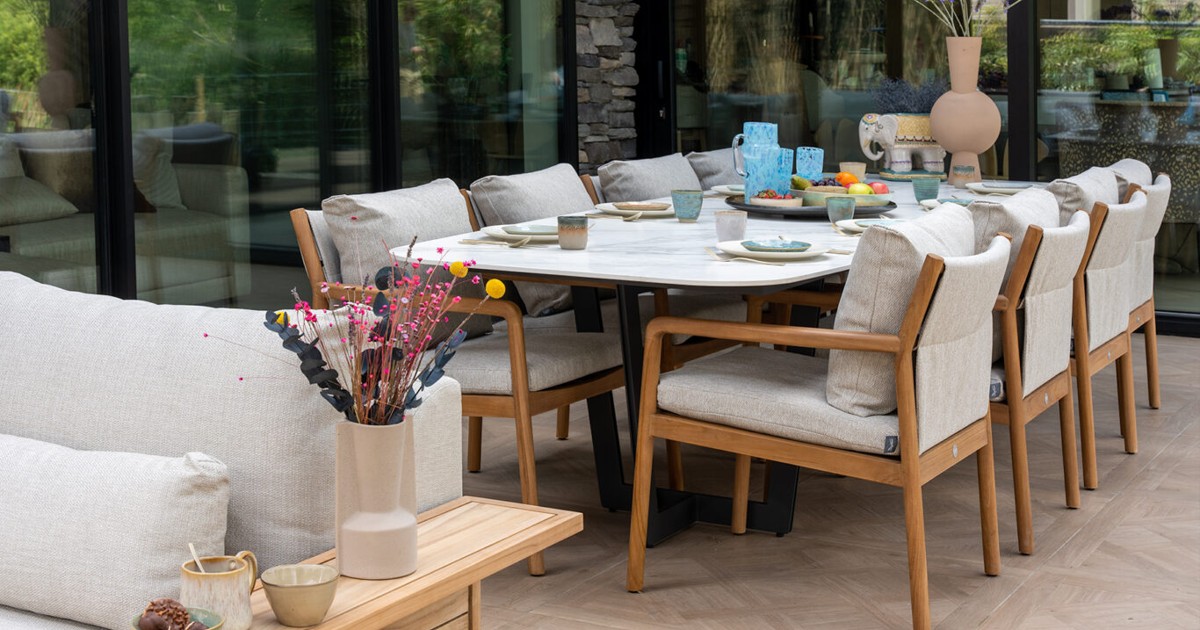
The Erice 300 cm teak dining table offers a three-metre dining surface for shared lunches and evening gatherings. Robust construction and meticulous craftsmanship are paired with a natural look that suits patios, modern gardens, and pergolas alike.
A three-metre length is a good reason to start with the floor plan, rather than an automatic estimate of capacity. The arrangement of seats is influenced by the construction, seat width, and desired level of comfort. For regular guests, it is essential that the long tabletop does not hinder access to the far side of the set.
NOVA: round dining for four to six people
According to the product description, the NOVA garden dining table Ø 120x75 cm creme/creme accommodates four to six people. The round arrangement facilitates conversation as well as shared dining. The model belongs to the SUNS collection and fits into both modern and classic settings.
If your guest count regularly falls within this range, you have a concrete baseline for planning. Even so, compare the comfort of everyday use with full occupancy. The same number of seats may function differently during quick refreshments compared to a multi-course lunch.
Morena: a lower profile for relaxed dining
The Morena teak low dining table Ø150cm – kremova has a documented height of 68 cm. The lower position shifts dining towards lounge-style seating, encouraging softer and longer lounging.
Such a concept should be assessed as a whole alongside the seating, rather than as a standalone tabletop. In the low garden dining category, focus primarily on how the individual elements fit together. A lower table on its own will not guarantee comfort with just any seat.
Bar seating as an addition, not an obligation
Bar seating can divide a patio pleasantly: someone can sit aside for a while, while others remain at the dining table. However, it is not an essential part of every space. If a second zone would narrow the main walkway or take up space needed for comfortable dining, it is better to prioritise a single, well-functioning set.
In the featured selection, there is no specific bar model with verified parameters. Therefore, consider the bar section as a layout option, not as a recommendation for a particular product. Before adding one, check the height alignment of the table and seating, stability on the given surface, and accessibility for guests.
Pay particular attention to who your visitors are. Higher seating might not suit children, people with reduced mobility, or those who wish to sit comfortably for a long meal. The main dining area should therefore remain the primary meeting place, not a less attractive alternative.
A service area does not have to mean an extra piece of furniture
During an informal gathering, you can dedicate part of the existing tabletop to drinks and refreshments. First, however, check whether enough room remains for diners. On a smaller patio, staggered serving often works better than a permanently cluttered table.
Position the self-service area so that arriving guests do not have to walk behind everyone seated. At the same time, keep it clear of the main route from the house. A successful layout allows people to help themselves without others repeatedly having to pull back their chairs.
Three practical scenarios for small and large patios alike
The right solution is easiest to find when looking at a specific situation. The following examples are not ready-made sets, nor are they a guarantee of capacity for other models. They demonstrate how to balance visiting frequency, available area, and dining style.
Everyday dining and occasional visitors
The household usually dines in smaller numbers, but four to six people gather when guests visit. The mentioned NOVA, with its documented capacity, can serve as a starting point. Before deciding, simulate full occupancy and check that clear access from the door remains. A separate bar zone may not offer as much value here as a clear, unobstructed dining area.
Regular shared lunches on a spacious patio
The hosts frequently invite extended family and want to leave the set ready. The long Erice dining surface is a strong candidate for consideration. However, first determine the actual number of comfortable seats based on the chosen chairs and table construction. Plan the service path so both sides can be reached without having to walk around the entire patio.
Long evenings with light refreshments
Guests come mainly to lounge, and conversation takes precedence over formal dining. In this case, the Morena and the concept of low dining are worth trying. When testing the seating, check reach to the tabletop, back support, and ease of standing up. If low seating does not suit certain guests, factor that in when choosing your main concept.
Plan placement and shade alongside the table
A pleasant dining area requires more than just the right tabletop size. Observe the sun's path during the times you actually dine outdoors, the connection to the house, and wind-exposed spots. Shade falling on an empty tabletop might not protect everyone seated. Therefore, evaluate the entire perimeter of the occupied set.
When planning a pergola, sketch its posts together with the furniture on a single floor plan. Similarly, for a parasol, account for the space required by its base and frame. Choose a specific shading solution based only on verified parameters; without them, protection from rain or suitability for windy conditions cannot be guaranteed.
For evening visits, a clearly discernible path between the house and the table is also essential. Check thresholds, steps, and patio edges under real evening conditions. Guests will not know the space as well as you do, and while serving drinks or food, their attention is focused elsewhere rather than on the ground.
During cooler periods, plan for shorter stays with easy access back indoors. A covered area is not automatically warm or shielded on all sides. Therefore, tailor outdoor entertaining to the actual weather conditions, rather than simply relying on the fact that the furniture is designed for outdoor use.
Caring for the dining area and pre-visit checks
Quick preparation for guests begins with ongoing maintenance. Remove food debris and spills gently according to the instructions for the specific surface. Do not assume the same method suits all tables, or that a product suitable for one tabletop can automatically be used on another.
If you use protective covers, ensure their suitability for the specific furniture and fastening method. Only cover clean, dry furniture and respect ventilation guidelines. A cover is not a substitute for checking moisture levels, nor is it a universal guarantee that a set can be left outdoors year-round without care.
Before guests arrive, uncover the furniture in advance and inspect surfaces, stability, and clear walkways. Practical steps for long-term storage are summarised in the guide on how to winterise garden furniture. Always align storage conditions with the recommendations for the specific model.
Keep the final decision simple: first consider the number of simultaneous diners, then the floor plan, seating comfort, and only then secondary zones. An extendable function is only useful where you will genuinely make use of it. Likewise, bar seating adds value when it complements the main dining area rather than eating into needed space.
Featured products


Frequently asked questions
Are the tables mentioned in the article extending?
For the featured models, an extending mechanism is not substantiated in the available data. The article therefore presents them as alternatives for outdoor dining, rather than as extending tables. The function must be verified for the specific variant.
When is an extending garden dining table worth it?
Particularly when you usually need a smaller dining area and larger gatherings happen only occasionally. The patio must also comfortably accommodate the extended state, including occupied seating and thoroughfare.
Can bar seating replace the main garden dining area?
It can be pleasant for short informal gatherings, but for long shared meals it may not suit all guests. Higher seating also has different accessibility requirements. It is usually more suitable as a supplementary zone.
How many people can the specified round NOVA table accommodate?
The garden dining table NOVA Ø 120x75 cm creme/creme has a substantiated capacity of four to six people. This figure cannot be automatically applied to other variants of the NOVA collection.
How do I know whether a large table will really fit on the patio?
Mark its footprint and simulate both occupied and pushed-back seats. Then test the path from the doors, serving, and standing up. Merely placing the tabletop into the open space is not enough.
Can a low dining table be combined with any seating?
Not automatically. The relative height of the tabletop and the seat, reach to the food, and body posture are decisive. Morena has a substantiated height of 68 cm; the suitability of the entire combination is best verified by trying it out in person.
Is it enough just to cover a garden table after the season?
Covering alone does not replace cleaning, drying, and inspection. Follow the instructions for the specific model as well as the cover, monitor moisture, and verify the recommended winter storage conditions.