Tipy
Parasol base: how to choose the right weight and design
How to choose a parasol base according to the specific model, patio surface, and manner of use. Comparisons, examples, and principles of safe operation.
Author: Zuzana Krajčírová, founder of Luxco Living
Published
What kind of parasol base do you need?
Choose a parasol base according to the recommendation for the specific model, mounting compatibility, the patio surface, and the need for relocation. Weight alone is not enough: the base must match the parasol's construction and stand on a suitable surface. A universal rule assigning a safe base weight to every canopy dimension cannot be applied without additional data. Even a heavy base does not justify using an open parasol in adverse weather.
When furnishing a patio, attention is naturally focused on the fabric colour, canopy shape, and matching the seating. However, the base also dictates where you can walk, how easily you can push back a chair, and whether the shade can be operated comfortably. Therefore, address it alongside the parasol, not after it has been delivered.
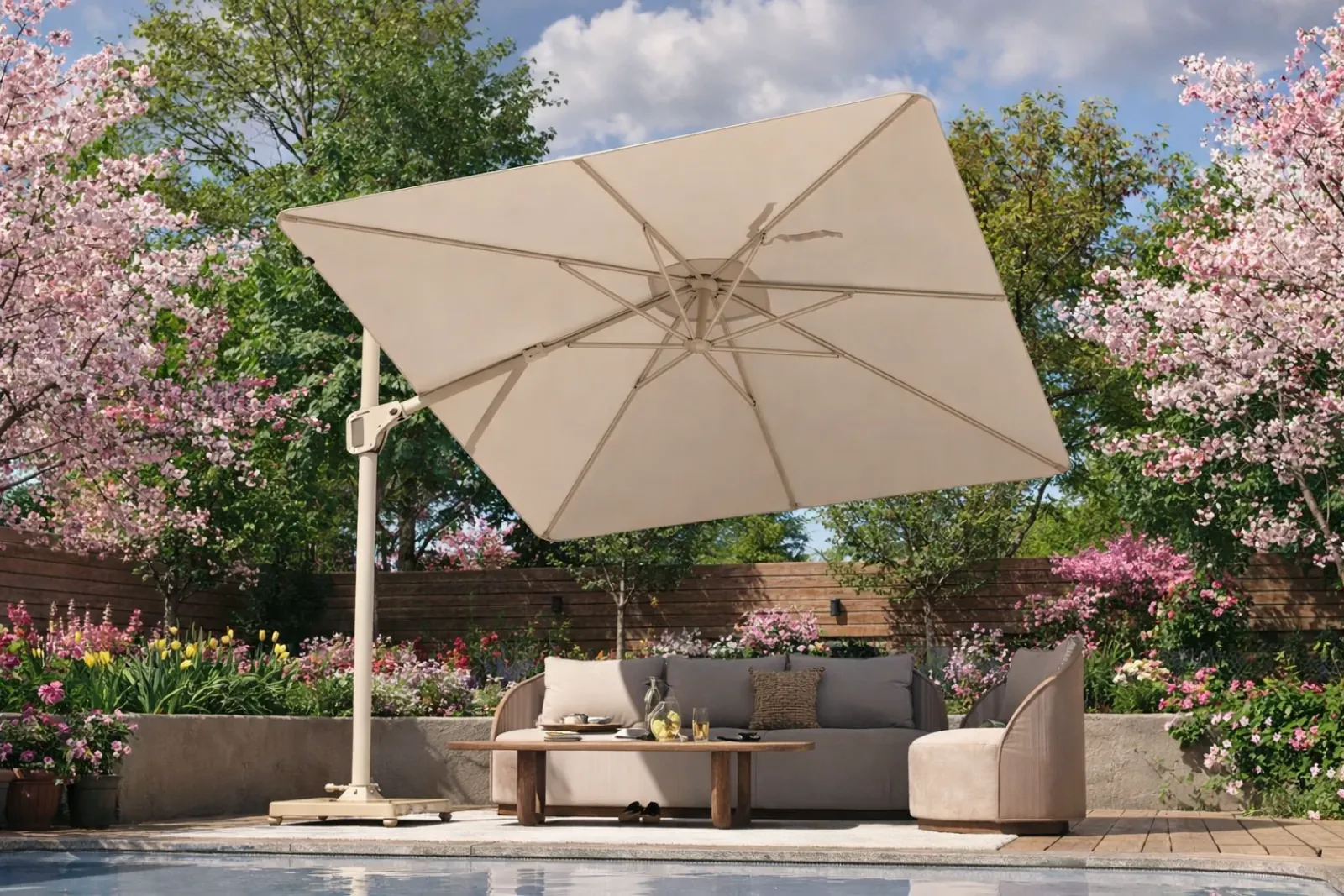
From the range of garden parasols, first choose a model according to the area you wish to shade. Subsequently, verify the recommended base and its availability. The terms stand, pedestal, and base may be used interchangeably in practice for a similar function, but matching terminology does not guarantee identical mounting or interchangeability.
What to prepare before choosing
Note down the exact designation of the parasol, including the variant, take photographs of the installation site, and measure the space around the intended base. Add details about the surface, any slope, thresholds, and the moving route. This documentation is far more useful for a meaningful recommendation than simply requesting the heaviest stand possible.
Base weight: why you cannot decide by kilograms alone
The weight of the base contributes to stability, but it is not the only significant parameter. The base footprint, parasol connection method, canopy position, and on-site conditions also play a role. Consequently, two models with similar-sized canopies may not have identical base requirements.
With a cantilever parasol, the shaded area extends away from the support point. Therefore, base selection cannot be derived merely from fabric dimensions or experience with another parasol. Similarly, a table positioned near the structure is no automatic substitute for adequate weighting and mounting.
If the product description specifies a recommended weight, consider it as applying strictly to that specific variant, not the entire range. Do not transfer a recommendation for one colour or structural variant to another without verification. If in doubt, have the specific parasol and base combination confirmed.
Higher weight also brings operational demands
A heavier base entails more demanding handling. Before purchasing, consider transport to the site, access via steps, and seasonal storage options. On balconies and roof terraces, structural load limits and floor build-up conditions must be respected; if in doubt, verify these with the building manager or a structural engineer.
Do not assume that any heavier base will be more suitable. Without a compatible connection and proper seating, it will not solve the issue. In practice, the best choice is the recommended setup that you can properly install, inspect, and use.
PALMOLI and NOVARA: specific recommendations and delivery contents
In the Luxco Living range, you will find models where the base recommendation is stated directly in the description. The following comparison highlights the differences between specific variants. This is neither a general load-bearing chart nor a guide on how to assign a base to any parasol based on size alone.
For the PALMOLI 3X3 bílý / Světle šedá model, the description recommends a 120kg base on wheels, which is not included in the delivery. The integrated handle allows smooth rotation of almost 360° and precise positioning according to the sun. The colour and form concept complements SUNS garden furniture.
For NOVARA 4×3 Camel Sand / černá s LED, a 170kg base on wheels is recommended for easier relocation. This model is also supplied without a base. Shade adjustment features rotation of nearly 360° and stepless, centimetre-by-centimetre positioning.
| Specific variant | Recommended base | Is the base included in the delivery? | What to watch out for |
|---|---|---|---|
| PALMOLI 3X3 bílý / Světle šedá | 120 kg, on wheels | No | Verify the exact compatible base |
| PALMOLI 3X3 bílý / camel sand – 120kg | 120 kg, on wheels | No | A 120 kg specification in the name does not mean the base is included |
| NOVARA 4×3 Camel Sand / černá s LED | 170 kg, on wheels | No | Consider the route for potential relocation |
| NOVARA 4×3 Camel Sand / černá s LED – 170kg | 170 kg | No | The description states delivery without a base despite the specification in the name |
A specification in the name does not necessarily mean included accessories
Pay special attention to items whose names contain a 120 kg or 170 kg specification. For example, for the PALMOLI 3X3 bílý / Světle šedá 120 kg variant, the supplied description explicitly indicates delivery without a base. The item designation alone is therefore not sufficient confirmation of a complete package.
Before placing an order, verify the delivery contents, the exact designation of the recommended base, and the method of connection to the parasol. When browsing bases for garden parasols, evaluate compatibility first and foremost. Address appearance and coordination with your patio afterwards.
Base on wheels: advantages, disadvantages, and the genuine need for relocation
First, clarify whether you want to move the entire parasol or merely adjust the angle of the shade. These are two distinct requirements. A suitably positioned tiltable model can reduce how often you need to handle a heavy base, though it naturally cannot shade every spot on a patio from a single position.
For example, VOYAGER T¹ 250 x 250 cm Sand/Ivory allows you to adjust the shading to the sun's position without relocating the parasol. Its colourfast fabric provides UV protection up to UPF 50+. However, the required base weight cannot be inferred from these features; it must be verified separately for that specific variant.
Advantages and limitations of a base with castors
The primary advantage of castors is making it easier to change location wherever the surface and instructions allow. This can be practical when rearranging seating or clearing space for cleaning. However, castors do not relieve the base of its weight and do not guarantee an easy crossing over joints, thresholds, or uneven spots.
The disadvantage is the need to consistently address the underlying surface, safe parking, and securing according to the specific base construction. Before purchasing, have the operation and locking mechanism of the castors explained to you. It cannot be automatically assumed that all stands use the same mechanism.
Advantages and limitations of a fixed position
A permanent location simplifies day-to-day operation and allows walkaways around the furniture to be resolved in advance. The disadvantage is less flexibility when changing layouts. Before definitively choosing a spot, observe where you need shade in the morning and afternoon. When moving it, follow the instructions and do not handle it with the canopy open.
Where to position the base: surface, walkways, and patio layout
A base requires a stable surface that meets the manufacturer's requirements. It is not suitable to resolve unevenness with randomly inserted offcuts or improvised shims. If the base does not seat properly, resolve the location first. For decking boards, paving on pedestals, and other modular surfaces, check what loads and support methods their construction permits.
Draw not only the base on the floor plan, but also the parasol in its intended positions. Check the distance from the facade, doors, and surrounding equipment. When folding or rotating, it must not be necessary to force past an obstacle. Leave access to the controls so that routine operation does not require repeatedly moving furniture.
When planning, the article Patio design: what to prepare before choosing furniture will help. Dimensions, photographs, and layout drawings allow the parasol to be assessed as part of the whole, not as an isolated accessory.
Practical example: a parasol by a dining set
With a garden dining set, it is not enough to measure the space between the table and the edge of the patio. Pull out the chairs as you would when getting up from the table, and walk past them. A base that fits into the available space on the plan may, in actual use, get in the way of feet or create an easy tripping hazard.
Practical example: shade next to sun loungers
With a pair of sun loungers, leave clear access from the side and space to change their position. First, test whether adjusting the canopy provides the required shade. If you will also need to move the base, check the entire route, not just its starting and finishing positions.
Safe use: a heavy base is not protection against every wind
The base helps hold the parasol in the correct position, but it does not remove the wind load acting on the canopy and frame. Therefore, even the recommended weight is not a promise of safe use in all conditions. The operating instructions for the specific parasol and the current weather are decisive.
For some PALMOLI variants, product documentation explicitly restricts the use of an open parasol to calm weather. This condition cannot be circumvented with a heavier base. Without documented data, it is also not possible to determine a common wind speed limit across the entire range.
On open and roof terraces, keep in mind that conditions can differ from a sheltered corner by the house. Do not leave the parasol open unattended, and if the weather deteriorates, fold it away in good time according to the instructions. It is not advisable to wait until the base begins to shift or the structure moves significantly.
What to do when wobbling or unwanted rotation occurs
First, stop using the parasol and fold it safely. Check the seating, connections, and locking according to the manual. Do not take up slack with wooden splinters or other improvised packing pieces, and do not tighten bolts without following the prescribed procedure. A persistent problem should be addressed with the retailer or service department.
If the parasol is used by multiple household members or outdoor seating staff, agree on a simple routine: who checks the weather, who folds the canopy, and who verifies that it is secured after being moved. The right base is only one part of safe daily use.
Caring for the base and protecting the parasol when not in use
During routine checks, pay attention to the seating of the base, the joints, and any moving parts. After moving it, check that the base is standing properly and is secured in the prescribed manner. Any new play, damage, or change in the operation of the mechanism is a reason to check its condition, not to continue using it without inspection.
Choose the cleaning method according to the actual material and surface finish of the specific base. Without this information, it is not possible to recommend a universal chemical product or treatment. Proceed in the same way for seasonal storage: follow the manual and do not assume that every base and its mechanisms have the same requirements.
A protective cover serves a different purpose than a base
A base provides support and stability, while a cover protects the folded parasol. The Premium protective cover for garden parasol 290x60 cm uses a breathable technical textile and ventilation that helps limit condensation. One hundred percent handmade finishing is stated for this design.
The suitability of the cover size for the chosen parasol must be verified; merely being listed under protective covers does not confirm compatibility. Allow the parasol to dry before covering, and observe the cover instructions. The broader context is explained in the article How to properly cover garden furniture. A cover does not replace securing the frame.
Checklist before ordering: five steps to the right setup
The first step is accurate identification of the model. The collection name is not enough; record the entire variant and its product description. The second step is confirming the recommended base, including weight and compatible mounting. Do not fill in missing information by guessing from a similar parasol.
The third step is checking the location: suitability of the sub-base, patio load-bearing capacity, space for operation, and clear access. The fourth is planning the handling, from delivery to potential winter storage. Castors are only useful if they can actually be used on the intended route in accordance with the instructions.
The fifth step is checking the order contents. Have it confirmed whether the base is included or purchased separately, and whether the set includes everything necessary for the prescribed connection. Likewise, check the suitability of any protective cover.
To obtain recommendations from Luxco Living, have ready the designation of your chosen parasol, a photo of your patio, and a description of the ground surface. A well-chosen base is not just an unobtrusive weight: it is meant to enable the correct use of the parasol without unnecessarily complicating movement around the seating area. The final decision therefore always combines technical compatibility with the practical day-to-day use of your patio.
Featured products


Frequently asked questions
How heavy should a parasol base be?
The weight must correspond to the recommendation for the specific model and its mounting. For example, PALMOLI 3X3 bílý / Světle šedá has a recommended 120kg base on wheels in its description, whereas NOVARA 4×3 Camel Sand / černá s LED has a 170kg base on wheels. These details are not a universal rule.
Is the base automatically included with the parasol?
No. For a number of the stated PALMOLI and NOVARA variants, the description explicitly specifies delivery without a base. Even a 120 kg or 170 kg specification in the item name does not necessarily mean the base is included. Check the exact contents of the delivery before ordering.
Is it enough to choose a stand based on canopy size?
It is not. The parasol's construction, mounting method, recommended base, and installation conditions also determine this. Canopies of a similar size may not have identical requirements. If a recommendation is missing, have the compatible base confirmed by the retailer.
When does a wheeled parasol base make sense?
When you need to change locations and have a suitable surface as well as a clear transit route. Check the locking mechanism and handling instructions. If you only want to follow the sun's movement, it may be more practical to use the canopy's tilt and rotation adjustments without moving the entire assembly.
Can I leave the parasol open in windy conditions thanks to a heavy base?
A heavy base is no guarantee of safety in high winds. Follow the conditions for the specific model and fold down the parasol in good time when the weather deteriorates. For some PALMOLI variants, the documentation explicitly permits using the open parasol only in calm weather.
What should I do if the parasol wobbles in the base?
Stop using it, fold it down, and check the compatibility, seating, and fixings according to the manual. Do not address play with improvised inserts or excessive tightening. If the cause cannot be resolved using the prescribed procedure, contact the retailer or service centre.
Is a protective cover a substitute for folding and securing the parasol?
No, it is not. A cover is used on a folded parasol according to the relevant instructions and does not replace a proper base or securing the frame. Ensure the cover is the correct size and allow the parasol to dry before covering.