Tipy
Privacy on the patio: how to combine a pergola, side screening and lighting
How to create privacy on the patio using a pergola, suitable furniture layout and lighting. Practical comparison, examples and principles for choosing side screening.
Author: Zuzana Krajčírová, founder of Luxco Living
Published
How to create privacy on the patio without unnecessary enclosure
The best way to create privacy on the patio is through a combination of correctly positioned seating, a pergola, targeted side screening and sensible evening lighting. First, determine where you can be seen from: a roof can limit views from above, but a view from a neighbouring patio requires a lateral solution. Always check the result while seated and after dark, when visibility changes significantly.
The goal is not to enclose the entire perimeter. It is often enough to move the main seating area closer to the house, change its orientation, and screen off the single problematic direction. This preserves the view, access to natural daylight, and the open outdoor feel. Moreover, complete enclosure can restrict natural airflow and complicate movement between the house and the patio.
When planning, separate three distinct needs: screening from sight, sun protection, and weather protection. A single solution may not automatically fulfil all of them. Louvres overhead will help with the sun, but their position might not block a neighbouring window. Pleasantly dimmed light, on the other hand, fosters an intimate atmosphere, yet on its own does not provide visual opacity.
It is equally important to distinguish between visual and acoustic privacy. Without verified specifications, neither a pergola nor standard screening can be considered an acoustic barrier. If your main concern is an undisturbed conversation, simply increasing the distance between the seating and the shared boundary, along with a well-thought-out seating orientation, will help.
First, map out sightlines, the sun and daily traffic
A patio floor plan is a good start, but privacy is also determined by height. A person walking past the house will see you differently from a neighbour on an upper floor. Therefore, walk around accessible spots in the surroundings and compare them with head height when seated, dining, or relaxing on a sun lounger. Do not rely solely on a standing perspective.
Mark doors, windows, the main passageway, and the areas you intend to use most often on a simple sketch. Add the direction of the afternoon sun and undesirable sightlines. A plan prepared this way will show whether you need cover over the entire living area or just a sheltered corner. The article on what to prepare before designing a patio will also help with preparation.
Test out the future seating arrangement before buying
Mark the outline of the planned dining or lounge area on the floor and sit in its centre. Check whether you are looking into an appealing space or directly at the neighbours. Also check the clearance behind pushed-back chairs and access to the edge of the pergola. Privacy protection must not come at the cost of having to negotiate obstacles every day.
Assess daytime and evening conditions separately
Repeat the check in the afternoon and after dark. During the day, seating in a shaded spot can be discreet, whereas in the evening, once lit, it can become the most prominent feature around. Also test the lit interior behind the patio doors: light from inside the house can highlight people's silhouettes, even if the patio itself remains only dimly lit.
A pergola provides a comfortable base, not automatic full privacy
When choosing patio pergolas, start with what is meant to take place beneath the roof. A dining area needs space for pushing back chairs, whilst a lounge area requires comfortable access around the sofa. Therefore, assess the structure's footprint not just by the size of the patio, but by the genuinely usable area, including foot traffic.
A louvered roof allows you to manage sunlight and, depending on the specific model, rain protection as well. In terms of privacy, however, the angle of view from surrounding windows is essential. Even closed louvres may not prevent an angled view beneath the roof edge. It is therefore advisable to verify the pergola's position on a sketch that also factors in the height of neighbouring storeys.
When sun management and rain protection are the deciding factors
With the ROTA aluminium pergola 600x360x250 matt white model, the position of the louvres allows you to adjust the amount of sun and shade. The fully closed roof is watertight and protects against rain. The structure creates a year-round base for an outdoor dining set or a relaxing lounge area.
The advantage of such a solution is the combination of shelter with the ability to alter light conditions. The open sides remain a limitation: the roof alone does not resolve views from an adjoining property. Furthermore, year-round usability does not mean a heated room or unlimited resistance in all weather conditions.
When you want to combine daytime shade and evening light
The POSITANO LED patio pergola 360x720x250 matt anthracite model offers a 3.6 × 7.2 m footprint, along with control over sun, rain and natural ventilation. Evening use is complemented by energy-efficient LED lighting with a long service life and adjustable white-light intensity. For private seating, the ability to dim the lighting is more useful than permanently bright illumination.
Side screening: enclose a specific sightline, not the entire patio
Plan side screening according to the actual visual axis. If the neighbouring patio is on the left, there is no reason to block off the front view just as heavily. At the same time, keep in mind that screening placed directly in front of a sofa might not work from an oblique angle. Position, height, width and the distance of the screen from the protected spot are what matter.
When browsing the roller blinds for aluminium pergolas category, treat compatibility as your primary selection criterion. For any specific pergola, have the installation feasibility, mounting method, control mechanism and operational limitations confirmed. The availability of a side element for one model cannot automatically be assumed for a different structure.
The supplied specifications for the featured pergolas do not confirm specific side walls or their level of opacity. It is therefore impossible to promise full visual screening or recommend a specific combination without further verification. The following comparison describes general design approaches, not the features of individual models.
The advantage of targeted side enclosure is that it keeps the rest of the patio open. The downside can be a restricted view, loss of light, or altered airflow. Do not assume either that an element designed for shading automatically serves as protection against strong winds. These characteristics must be confirmed by the documentation for the specific product.
| Approach | Key benefit | Limitations | What to verify |
|---|---|---|---|
| Louvered pergola roof | Light control and potential limitation of views from above | Does not automatically cover open sides | Angle of view from neighbouring windows and roof functionality |
| Targeted side screening | Restriction of views from a chosen direction | May reduce views, light and airflow | Compatibility, opacity after dark and operational limits |
| Changing the seating position | Greater distance from exposed parts of the patio | Does not create an opaque barrier | Passageways, connection to the house and convenience of use |
| Garden parasol | Adjustable shade over a selected part of the seating | Not a substitute for side enclosure | Shade position, base and operational rules |
| Lowering lighting intensity | A less conspicuous evening living space | Does not guarantee privacy without physical screening | Visibility from outside and safety of movement |
Evening lighting should enhance tranquillity, not put the seating on display
After dark, attention naturally turns toward illuminated spaces. If the surroundings are dark and the patio is brightly lit, people and furnishings can be clearly visible from a great distance. Privacy is therefore primarily fostered by moderate intensity and sensible direction of light. Switch on brighter lighting according to the activity at hand, rather than leaving it on automatically all evening.
For dining, you need to be able to see items on the table, whereas for relaxing, less light is usually sufficient. However, do not overlook the walkway into the house and the edges of the living area. Dimming should not leave guests unable to see their step. The ideal result is achieved through a balance between comfort, orientation, and minimising unnecessary light cast into the surroundings.
Adjust intensity based on the actual view from outside
With a pergola featuring dimmable lighting, start with a low intensity and increase it only as much as needed. Then check the situation from the access path or another accessible vantage point outside the patio. Looking out from under the roof can be misleading: inside, the light may feel soft, whilst from the outside it clearly illuminates the entire seated group.
At the same time, check any side screening. A feature that appears sufficiently opaque during the day may reveal silhouettes when backlit. Without data on the specific design, the outcome cannot be predicted. Further context is covered in the guide to patio lighting for pleasant evening gatherings.
Factor in light from the house as well
Large glazed areas can illuminate the patio more intensely than the pergola itself. Therefore, carry out your evening test under typical household conditions. Only the combination of indoor and outdoor lighting will reveal where silhouettes emerge and whether it makes sense to adjust the seating orientation or the extent of the side screening.
Furniture and a parasol help create a protected living nook
The layout of garden furniture affects privacy more than it might seem. The main seating areas do not need to follow the furthest edge of the patio. By shifting them towards the house, you often gain greater distance from the surroundings, whilst the open edge serves as a walkway. It is important that the seating does not block doors or access to the shading controls.
Assess a dining set in full use, not just with the chairs pushed in. For the lounge area, verify whether someone getting up will find themselves in a cramped space between the furniture and the structure. A private nook should remain comfortable even when guests visit, not only when a single person is sitting on the patio.
A parasol solves moving shade, not the entire question of privacy
If you are looking for shade for a specific spot, also compare garden parasols. The NOVARA garden parasol with LED lighting 4×3 Anthracite / Camel Sand model allows rotation through nearly 360° and smooth positioning centimetre by centimetre. The shade can thus be adapted to the position of the sun.
NOVARA can be combined with SUNS garden furniture and is supplied without a base. This must therefore be considered during selection, not only when positioning it. The benefit is adaptable shade; the limitation for this topic remains the fact that a parasol cannot be regarded as continuous side screening.
A side table maintains comfort inside the protected zone
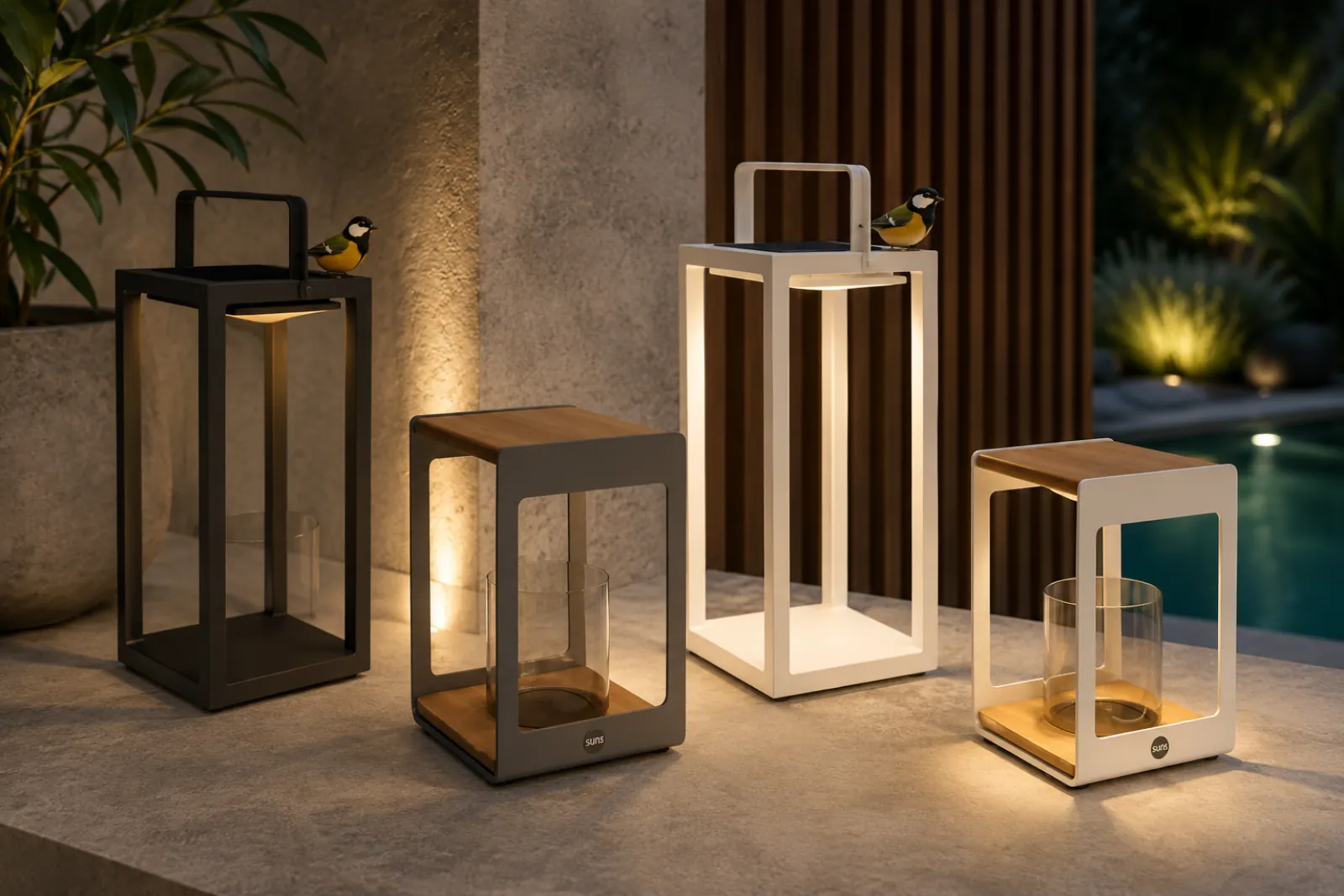
A practical addition to the seating area is the Lucia garden side table – Camel Sand. It measures 45 × 40 × 50.3 cm and serves well beside a sofa, sun lounger, or dining set. Its simple lines suit both modern and naturally styled exteriors. Position it so that you do not have to keep getting up or stepping into the walkway to put down a glass.
Three practical examples of privacy solutions
The following examples demonstrate a thought process, not universal setups. The same pergola can function differently on two patios depending on the surrounding buildings, the orientation of the house, and the position of the seating. The decisive factor is always the specific line-of-sight situation.
An urban patio with neighbouring seating
A direct side view is the most disruptive. Therefore, move the seating area further away from the shared boundary and angle it towards your own view. Consider side shading only on the exposed side, whilst leaving the front section open. Before ordering, check whether the chosen pergola allows the required addition. In the evening, check privacy with both the house and the patio lit up.
A patio overlooked by the windows of a taller building
The main problem is being overlooked from above. The position of the pergola and the sheltered seating is more important here than screening a low side view. Draw an imaginary line between the neighbouring window and the seating area: it will show whether the roof interrupts it. If not, shifting the living zone deeper under the roof can help. Check the result even with the louvres open.
A larger patio for dining and quiet evenings
Separate the social area from the relaxation nook through their positioning. The dining area can connect to the main walkway, whilst quieter seating is placed in a less exposed part. This means you do not have to screen the entire area with the same intensity. For the lighting, check the dimming options and do not assume separate control of individual zones unless confirmed in the documentation.
Maintenance and final checks before choosing
A roof does not relieve garden furniture of the need for care. Dirt and rain can enter through open sides, and moisture can linger under a cover. Therefore, treat the furniture according to its specific materials and the manufacturer's instructions. Likewise, do not use a single cleaning method for the louvres, the structure, and any side shading.
For a suitable corner set, you can consider a protective cover for corner patio seating. It provides year-round protection against rain, UV radiation, dust, and dirt. The breathable material reduces condensation and lowers the risk of mould, but it does not replace checking for moisture or proper use.
When choosing from the protective covers category, verify the suitability of the shape and dimensions for your actual set. Covering should follow cleaning and drying the furniture. A detailed guide is provided in the article how to properly cover garden furniture.
Before making a final decision, confirm five points: where unwanted views originate, which area truly needs protection, whether walkways remain comfortable, how the lighting functions in the evening, and which accessories are compatible with the selected pergola. Also check the base, anchoring, and any building requirements according to the specific location.
The best patio is not the most enclosed one, but the one where protection matches the way it is used. A well-thought-out seating position, a suitable roof, and discreet evening lighting often provide more comfort than trying to screen every metre of the perimeter.
Featured products


Frequently asked questions
Does a pergola on its own provide patio privacy?
Not always. A roof can limit views from above, but open sides remain transparent. The result depends on the position of surrounding windows, the angle of the louvres, and the seating layout. For views from the side, suitable side shading needs to be considered.
Do I need to enclose all sides of the pergola for privacy?
Usually not. It is more practical to screen against a specific unwanted sightline and leave the other sides open. This preserves the view, light, and airflow. Check the extent of screening from various angles and from the eye level of a seated person.
Can a side blind be added to any pergola?
Such an option cannot be taken for granted. It is necessary to confirm compatibility with the specific model, fixings, and operational limitations. Mere similarity in dimensions does not mean the accessory can be safely fitted.
Does side shading work equally well during the day and in the evening?
Not necessarily. When the space behind the screen is illuminated, silhouettes or details that are invisible by day may become apparent. Assess the level of privacy based on the specific design and, if possible, check it under evening conditions.
How to light a patio without drawing unnecessary attention?
Use only the level of intensity needed for the given activity and check the result from the outside. Do not forget the light coming from the house. Walkways and important edges must remain safely distinguishable even under dimmed lighting.
Can a garden parasol replace a pergola when addressing privacy?
A parasol works well for shading a specific spot, but usually does not resolve continuous side sightlines. Assess its benefit according to the position of the sun and the seating. Remember to verify a suitable base and follow operational instructions.
Does garden furniture need a protective cover even under a pergola?
It depends on the level of exposure to the weather and the recommendations for the specific furniture. A pergola may not prevent wind-driven rain, dust, or dirt settling. A suitable cover can supplement protection, but cover furniture only when clean and dry, and check for moisture regularly.